
Kill the filibuster and make Trump veto everything people want
Daily Kos Opinions is a forum for sharp commentary and shrewd conversations. These pieces reflect guest contributor views and don’t represent an official endorsement by Daily Kos. Last week, I made the argument that a new Democratic majority should pass big, popular bills and make President Donald Trump veto them. Some of that can ride through reconciliation, the budget process that only…
John Fetterman Helps Block Investigation Into Murders of Americans
Embattled Senator John Fetterman was the only Democrat to vote against a resolution that would require the State Department to report when Americans are murdered by Israeli settlers in the West Bank. The Tuesday night motion failed 47-53, with Senator Rand Paul being the only Republican to join the rest of the Democrats.
This is a low point, even for someone as rabidly and irrationally pro-Israel as Fetterman. The resolution, introduced by Senators Chris Van Hollen, Tim Kaine, and Bernie Sanders, would have been largely symbolic—requiring a State Department report to Congress on fatal settler violence against American citizens in the West Bank within 30 days of their murders, nothing more. The State Department failing to deliver said report would only trigger a stoppage of some aid to Israel, an issue that Fetterman lives and dies by. The resolution also included reports on the status and conditions of Palestinian-American children from the West Bank who are currently in IDF custody. But thanks to Fetterman and the GOP, Congress won’t even get access to that basic and vital information.
“Tonight, 47 Senators supported my resolution to get accountability for the 9 Americans killed on the West Bank & for Palestinians who face injustices daily. That’s more support than we’ve ever had in this fight,” Van Hollen wrote Tuesday night on X. “Republicans blocked us, but we won’t stop until we get justice.”
Nine American citizens have been killed by Israeli settlers in the West Bank since 2022, with little to no justice from either the U.S. or Israeli government. Palestinian-American journalist and Al Jazeera correspondent Shireen Abu Akleh and 20-year-old Palestinian-American and Florida resident Sayfollah Kamel Musallet are perhaps the most notable of the nine deaths. The resolution does not account for the at least 1,000 Palestinians without American citizenship who have been killed in violent pogroms by Israeli settlers in the West Bank since October 7.
‘The corruption is the point’
“The corruption is the point,” writes Casey Michel in United States of Oligarchy: How America's Wealthiest Ally with Dictators, Weaken the U.S., and Destroy Democracy.
The book exposes the staggering corruption of the Trump regime and how dictators and oligarchs around the world are betting on Trump—and betting against democracy. In the latest episode of The Nerd Reich podcast, I interview Michel about how oligarchy took control of the United States, and what we can do about it.
“An expert on money laundering, tax evasion, and other financial crimes, Michel offers a blistering account of how a full-blown oligarchy has formed in the United States,” wrote Foreign Affairs of his book.
Michel is a writer, journalist and director of the Combating Kleptocracy program at the Human Rights Foundation. He’s also the author of American Kleptocracy: How the U.S. Created the World’s Greatest Money Laundering Scheme in History and Foreign Agents: How American Lobbyists and Lawmakers Threaten Democracy Around the World.
Click below to watch our conversation on YouTube.
Click here to listen on Apple podcasts
Click here to listen on Spotify
Full transcript below
The Corruption is the Point: Casey Michel on America's New Billionaire OligarchsTranscripts may contain errors.
Gil Duran: With billions flowing directly into his own pockets, Donald Trump is the most corrupt president in American history. He's not even trying to hide it. He and his family are openly cashing in, and the White House is for sale. It's a spectacle of greed so massive and transparent that the corruption is the point.
That's the conclusion of today's guest, Casey Michel. He's the author of a new book, United States of Oligarchy: How America's Wealthiest Ally with Dictators, Weaken the US and Destroy Democracy. His must-read book exposes how villainous billionaires around the globe are betting against democracy and paying off the Trump regime.
Our conversation covers how Elon Musk has been beholden to Beijing for a decade while calling Democrats communists, how Jared Kushner became a billionaire the same day a report concluded Israel had committed genocide in Gaza, and a warning for Democrats: how these oligarchs planned to escape accountability by writing checks to politicians from both parties.
Casey Michel heads the Human Rights Foundation's Combating Kleptocracy program. He's the author of American Kleptocracy and Foreign Agents, and he's an expert on the transnational corruption and illicit finance that links dictators and oligarchs around the world. Oligarchy is back, and it's worse than ever. Here we go.
Gil Duran: Casey, welcome to the Nerd Reich Podcast. We live at a moment when billionaires have declared war on American democracy and on democracy around the world, and both of our books talk about that. We take different parts of the story, but there's a lot of overlap. And it's interesting. So I definitely wanted to have this conversation because at a moment when a lot of people are reading my book, I've been reading yours and listening to it on long road trips. And it's amazing the amount of detail there is. And I think what United States of Oligarchy does is put these facts together in a very compelling way that helps people understand exactly what we're up against in terms of how oligarchy is shaping and destroying our country. An oligarchy is essentially a poison that kills democracy. It allows a handful of people to use their wealth to buy influence and control supposedly democratic systems. And that corruption, coupled with economic inequality that's spiraling out of control, can lead people to stop believing in democracy altogether. And then what you have is some kind of strongman, authoritarian who rises up and says, forget about this system that's corrupt and fake and bought and sold, I can fix it with simple answers, with brutal answers. And so you write about this in your book about studies that show that oligarchy and especially economic inequality, which is always a byproduct of it, can erode democracy over time, make people less committed to democratic systems. That's why I say it's a poison. And it seems clear that democracy and oligarchy can't coexist. Let's dial it back a little bit and start with the basics. Explain to us what oligarchy means and how it works.
Casey Michel: Yeah, Gil, I should say at the outset it is an honor to be here with you. I've been reading your work on these topics for at least the last few years. I cite your work in the new book itself. And I just got back from the first leg of the book tour for this new book. I've plugged yours at every single one of them. And I have to tell you, anytime I tell people the name and the title of your new book, there is a knowing chuckle that I get, and that much more excitement to read your book as well. So look, my book, yes, it's about this theme, this topic of oligarchy, which literally means the rule of the few. So if you have a number of, you know, a small number of people, three people, five people, ten people running a country or a nation or an empire, yes, technically that would make it an oligarchy.
But Aristotle, who first popularized the term thousands of years ago, said it's not just an amount of people, it's not just that small number. They have to have an additional component, and that has to be wealth. It has to be the fewest and the wealthiest running a country or a nation or an empire. They don't have to technically be the president or the prime minister. They can be behind the throne, behind the scenes, using that wealth to run a place. But that is the combination of wealth and that small number of individuals running a place. That is an oligarchy. And of course, here we are in the 2020s in the United States of America with a figure like Trump and backers like Elon Musk and Mark Zuckerberg and plenty of others who make up this kind of new oligarchic class that we are dealing with. And yes, as you just said, there's a direct relationship between the rise of oligarchy and the decline of democracy. Of course, you have written about this, and there have been a number of others who have increasingly begun writing about this, including some scholars that are finally beginning to analyze that relationship between economic and wealth inequality, the rise of oligarchy and the decline of democracy. And yes, there is a very direct relationship.
Gil Duran: Some people use the word plutocracy, which is rule by the wealthy. I use fascism, but I think the key is that these terms are not mutually exclusive. And so I like what you did there with oligarchy. I think if we're gonna pick a Greek word, oligarchy is the one to pick and it encompasses all of them and we don't need to be too academic about making these gradations. It's the rule of the wealthy. Right now we're watching the rise of the billionaire and sometimes even trillionaire class, who basically have this very ancient idea of using their wealth and power to seize control over democracy, which typically historically results in tyranny. That tyranny results in a revolt or rebellion against tyranny, and then we have a bloody cycle and we start all over again. And largely our system of democracy that we have, with however imperfect they are, system of checks and balances, developed out of thousands of years of trying every other way to do things.
And the Greeks understood that oligarchy was bad, but it's a lesson we seem to keep relearning in human history. One of the amazing things about your book is that you start with history. This is not new. This is not a new problem in the world, and this is not a new problem in the United States. You know, you start by talking about Hawaii and how oligarchs seized Hawaii for themselves and declared they were creating a new country, which made me immediately think of the network state stuff I write about. So even the idea of rich guys trying to start their own countries is not new. There is nothing new under the sun...isn't that Ecclesiastes, I think? Give us a sketch of some of the worst excesses of oligarchy in American history. Like what are some of the big things that happen that eventually resulted in a backlash? And then we'll talk about how our country fought back against oligarchy, how the people rose up against it.
Casey Michel: I mentioned a couple terms there, Gil. Oligarchy, plutocracy, another one that comes to mind is aristocracy. These are all basically related terms that are describing the same things, and of course the kind of tech fascism that you write about as well, being just one more model of what we have seen previously. I mean, the founding of this country was, in certain ways, an uprising against the kind of British aristocracy. And yes, the founders were extremely wealthy themselves, but there are at least elements of pushing back against the kind of wealthy families that passed down their wealth to their children, which is why in the United States, as opposed to the Britain of that era, we saw legislation that broke up those kinds of deep-pocketed property estates in the late 18th and early 19th century.
We fast forward to the Civil War, we don't really describe it as much this way anymore, but at the time and even afterward, that was called a slave oligarchy, this kind of class of plantation owners that preferred to shatter the United States rather than go along with any kind of new regulations or limits on their power. The thing that people think of most often when they talk about oligarchy, talk about plutocracies, of course, the Gilded Age, the era of robber barons or tycoons as they were described at the time. And yes, plutocrats as well, which is the thing that you can compare most clearly to where we are now in terms of that wealth inequality. There's a couple key differences. Where we are now is even beyond what we saw in terms of the scope and the scale of that wealth inequality of the Gilded Age, but what we did see then was the kind of pushback, was the kind of even uprising from the American body politic that resulted in all kinds of reforms, all kinds of new types of taxation, new investigations, new enforcement that eventually gave way to the progressive era. You had figures like Teddy Roosevelt, who was a one-man wrecking ball against many of these figures. And of course, you had legislative allies as well. So I write relatively extensively about the lessons of the Gilded Age, what we can look at now. Because you mentioned it, one of the other elements that isn't usually associated with the Gilded Age was, among other things, the annexation of Hawaii.
And the reason that I wrote about that and the role of American oligarchs in toppling and seizing the nation of Hawaii and then taking it directly to the United States of America was because of your reportage on the network state in places like Greenland and what those significantly wealthy funders are trying to do, still to this day, in Greenland, in terms of toppling the actual government that is there, eliminating any kind of Greenlandic sovereignty, and yes, leading it to American annexation. But even going beyond that, this kind of network state ideology of creating even potentially a post-American future, which they are reigning as their own kind of kings on Greenland and elsewhere. I mean, you've written about this, a number of others have written about it now as well, but it was that idea. And then realizing, you know, I was relatively familiar with the annexation of Hawaii. My goodness, look at the kind of historical echoes that we saw back in the 1890s to where we are now. And again, what kind of lessons and implications are there for that?
Gil Duran: Some other words come to mind as well: kleptocracy, kakistocracy, and all of these are worthy of consideration. Kakistocracy is that rule by the shittiest people?
Casey Michel: Yes, the shittiest or the idiots, yeah.
Gil Duran: But this can all be one thing as well. They're not mutually exclusive. I did see that in writing about Hawaii, the degree to which colonialism and imperialism and wealthy people seeking to somehow create their own zones where they can be the power, where they can be in charge, is this recurring idea we see even happening now, as you mentioned, with the network state. And one of the things that is interesting to me is that right now we're largely dealing in this country with these tech oligarchs, Silicon Valley billionaires. They claim to be leading us into the future with technologies like crypto and AI. But at the same time, it seems like most of their ideas are pretty firmly rooted in the past. They're not creating anything new. It's just a high-tech version of very old oppressions and tyrannical fantasies, specifically how oligarchy were beaten down in earlier eras. Let's drill down a bit on what were the specific things that happened to reduce their power and put them back on a leash. Right now there's a lot of talk about wealth taxes, about higher income taxes, about finding ways to prevent these billionaires from having so much power in our democracy. And again, these are not new conversations. These are very old conversations. We've had these all before. So tell us a bit about what were the main ways in which the billionaires were brought to heel in the twentieth century.
Casey Michel: So there were two primary ways that they did this. And again, Gil, you're absolutely right. These ideas are just kind of warmed-over versions of what we've seen from authoritarian movements throughout history, not least the fascists of the mid-20th centuries, which is why the title of your book, Nerd Reich, is not only so clever, but spot on in the way that it describes what we're seeing right now. But the solutions that we've seen through previous iterations of this same fight that we're going through right now are twofold. On the one hand, it was increased taxation, including the introduction of new taxes. And if you go back to the 1900s and the 1910s, these are things like the introduction of an income tax and the introduction of an inheritance tax. They were two sides of the same coin. These specifically targeted the wealthiest figures of the day. They were not applied to every American, they applied only to that small sliver of tycoons or robber barons that we saw back then. Because at the end of the day, what we're talking about is wealth inequality. And the easiest way to mitigate wealth inequality is to tax those that are at the highest end of the spectrum. And again, the figures we're talking about right now are not only wealthier relative to what we saw then, but are also, of course, wealthier in terms of nominal wealth itself.
John D. Rockefeller died worth the modern equivalent of thirty billion dollars. And now we're talking about Elon Musk kind of fluctuating between trillionaire status. They are significantly more wealthy in terms of real value as well as relative to the rest of us. But the taxation back then it was one of the key sources, one of the key reasons that we saw them cut down to size. But you also have to have a conversation about campaign finance because it's not just the money that they have. It's how easily they're able to inject it into American politics and American campaigns. We saw this, of course, most especially in 2024 with Donald Trump. This goes back to things like the Citizens United decision, but even decades before that, the degradation of American campaign finance regulations, the end of the Gilded Age, there was a key piece of legislation that Teddy Roosevelt signed that banned corporate financing of American politics. Now that didn't last forever and of course has been effectively eliminated now. You can't tackle wealth inequality and oligarchy without also tackling campaign finance regulations in the United States in the 2020s. They go hand in hand if we are ever to try to actually restore our democracy here in the United States.
Gil Duran: So basically, after all that work to crack down on oligarchy and the tyranny of the wealthy, there was decades of work to undo those rules and to basically arrive at this point in history where we have oligarchs who are richer than ever going full bore without any reservation, trying to buy our democracy in order to break it, in my opinion, because you can't really have a democracy if it's an oligarchy. And some people argue that it's been oligarchical all along to some degree. Money does buy power and influence in this country. And, you know, if you've got a few million dollars, you've probably had dinner with senators and congresspeople and governors, and if you don't, you've probably never met those people.
So there's a degree to which our political system is based on politicians begging rich people for money. And I know this having been in politics for a lot of my career, that's an important part of every politician's day. They have to get on the phone with some flavor of oligarch and ask them for a big check. And the oligarchs don't give that check for no reason. They give that check because it buys them influence, it buys them access. They get to help decide what happens. Their voice has to be heard more than the voices of everyone else, which is the opposite of democracy where everyone is supposed to have an equal vote. And so they have been able to use the levers of democracy to undo the reforms that constrained oligarchic power.
And it's a big problem. It feels to me like they're just trying to win the whole game and put an end to any further attempts to restrain their power. The idea that billionaire spending in politics is some version of speech, right? It was a way to lock it down and make it a right that can't be taken away. But one of the most disturbing parts of your book, I think, is the degree to which you detail how foreign oligarchs and foreign authoritarian governments are funneling money into our political system, often with the help of American oligarchs who are more than happy to be corrupt. And so basically we have a global mafia of oligarchs who have declared war on democracy and are able to meddle even in our system and corrupt it. Give us a sense of what are these other countries, who are these other figures, and how does foreign money come into our political system?
Casey Michel: Yeah. It's not just the domestic oligarchs that have realized just how open and available American politics are to those with the deepest pockets. It is those foreign governments that realize just how much American politics have become effectively an open-air bidding racket for whatever policies they want to see pursued. This is again for a few reasons. One, yes, the transformation of the current crop of American oligarchs, the Elon Musks, the Mark Zuckerbergs, other figures that you've written about as well, who have become these kind of middlemen, these kind of handmaidens to foreign governments looking to meddle in American politics. And yes, it's the Russias and the Chinas, but it's also the Turkeys and the Azerbaijans and the Egyptians, places that we don't necessarily think of, but that still have access to hundreds of millions, if not billions, if not more, their own wealth that they are willing to spend for a relative pittance on American politics and American politicians. That's one element of it, of course, is also the decline of campaign finance regulations, which we just talked about a moment ago, the lack of any kind of investigations or oversight. There's an additional element, and that is corporate secrecy.
You know, I've written about this in previous books. This has been an ongoing development in the US, this transformation of the US into becoming the world's go-to provider of anonymous shell companies, which has really been ongoing since the 1980s or 1990s. But because of corporate secrecy, and because of the corporate rights, right? We just mentioned that the money is speech and corporate money is perfectly allowable in American politics. These parallel realities have just opened up the American corporate sector to taking money from foreign sources to inject it into American politics. As one example I write about in the book, this company called American Ethane, based out of Texas, and donated significant money to a number of legislators. I mean, it's one of the most American-sounding companies you could think of, right? American Ethane, as we now know, was secretly controlled by a number of Russian oligarchs, not those ones that were paying for Donald Trump Jr.'s wedding, which we just learned about, but a number of other Russian oligarchs themselves, getting their money right into American politics, right? And this is just one example from one country for one company that we're talking about. There's every reason to think this is far broader than just that one company.
Gil Duran: You also talk about the degree to which the United Arab Emirates, Israel, and Saudi Arabia have become major power players in the oligarchic politics of the United States. Give us a sense of what they're up to because my next question is going to be about somebody who's really at the center of your book, Jared Kushner, and I think it's important to understand the role of Saudi Arabia, Israel and the UAE before we delve into his role in all of this.
Casey Michel: Well, Gil, I'm sure you've seen this in your reporting as well. You know, places like Saudi Arabia have especially taken the lead on funding and financing some of the leading venture capital firms and even individuals associated with Silicon Valley. It's fascinating because if you go back five, six, seven years ago, right after the assassination of Jamal Khashoggi, the Saudi journalist who was dismembered on orders of the Saudi leadership for his critical reporting. The Saudi regime was kind of persona non grata, at least for a little bit in Silicon Valley. A lot of firms were saying, No, no, no, we're not gonna take Saudi money anymore. But you know, a couple of years go by and people assume the public has forgotten or that kind of distance begins to shrink. And the next thing you know, by 2022, 2023, 2024, you know, you got folks like Marc Andreessen and Ben Horowitz, two of the most prominent figures out of Silicon Valley, talking about how great the regime in Saudi Arabia is, and then opening up their firm to Saudi investments. And you have, of course, others saying, Saudi Arabia doesn't have a dictator, they have a founder, right? You see this kind of this ethos, this familiarity, even using the same language to describe a dictator in Saudi Arabia saying, no, actually he's just like us. And of course this goes for the Emiratis, this goes for the Israelis, the list goes on and on.
Gil Duran: In your book you detail how these countries buy up influence and lobbyists and PR firms to work on their behalf. And it was amazing reading that because maybe about nine years ago, I was contacted by a consultant I knew in Sacramento, California. And he was like, Hey, would you be willing to do some work for the Saudis? They're hiring up here and it's like a lot of money. And I was like, No way on earth I would do that. I was like, are you crazy? I was like, this'll stain you forever. I don't think he did it either. Even in Sacramento, throwing their money around trying to hire top talent. You know, I was the former press secretary to the governor, former communications director for attorney general Kamala Harris, former spokesman for Senator Feinstein. And so somebody was like, Ask him if he wants to make, you know, thirty or fifty thousand dollars a month to completely ruin your reputation. I know from first-hand experience when I was still in consulting days that they were creeping around trying to snatch up the talent and the spokespeople to advocate on their behalf. Well, I turned it down.
A lot of people did not. And one of the people you really focus on. And I was glad you did it because I wasn't able to dig deep enough into that story in my book. But that's why a lot of books get written, because there's a lot of parts of the story to tell. And I learned a lot from your book, even though, you know, some of the stuff I felt like I knew. But when you get into the details and also when you see the story presented in a linear narrative and realize with rising horror how bad the situation is, you get a different level of understanding. Let's put it that way. And speaking of the morally compromised, Jared Kushner. I think most of us know his name because he's Ivanka Trump's husband and his dad went to prison. There was always this game in the first term of, well, Jared and Ivanka don't approve of what Trump's doing. There was always this little managing their image as if they're kind of in the Trump family but not a part of the Trump regime. They were gonna get away from politics for a while, but now they're back in a big way. And really, Jared Kushner is the linchpin of the Trump family corruption, one might say. He literally became a billionaire after Trump returned to office. Not only that, but in your book, this is just an amazing detail, he became a billionaire on the day that there was an official report that said Israel had committed genocide in Gaza. Is that right?
Casey Michel: Yeah, same day, September sixteenth of last year.
Gil Duran: So on that very day, he officially became a billionaire. And this is a guy with his fingers in every pie. Peter Thiel's going around preaching about the Antichrist. Jared Kushner is traveling the world making awful deals with these terrible governments. And also his major real estate investment was 666 Fifth Avenue in New York, which is kind of hilarious. Give us the thumbnail sketch of who Jared Kushner really is. What are his talents and skills? Why has he gotten so far? And what is he up to?
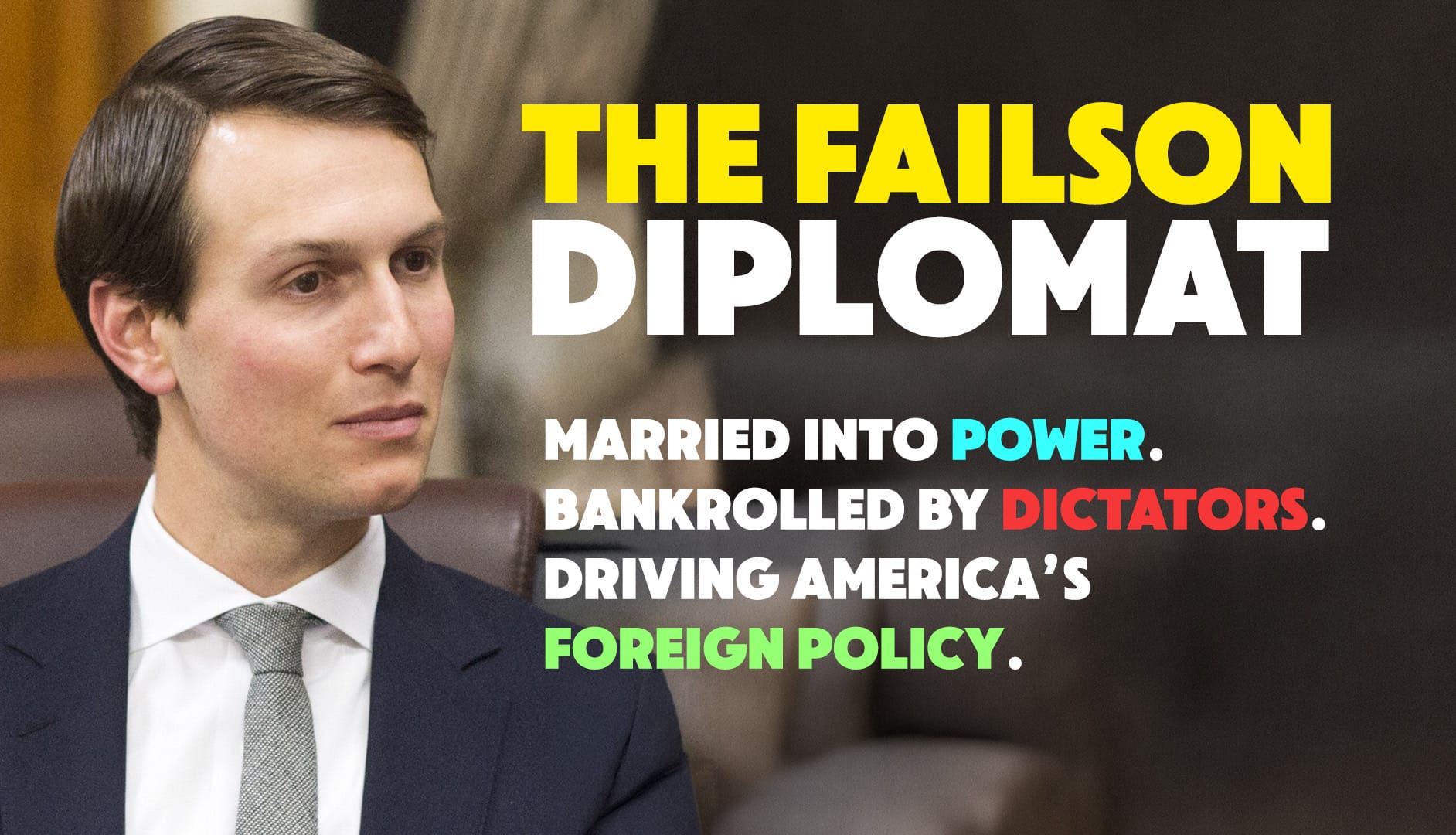
Casey Michel: Confess, I hadn't made the connection between Peter Thiel's talks about the Antichrist and Kushner's purchase of 666 Fifth Avenue. You can't script some of this stuff. To take your questions in no particular order, Jared Kushner, as far as I can tell, he's one of the primary figures in the book, has no skills to speak of whatsoever. He was a failed real estate investor. Of course, that investment in 666 Fifth Avenue is one of the most notoriously failed investments in New York history. He failed as a real estate mogul around the same time as well. The only good thing he ever did was marry Ivanka Trump, because that allowed him to become the gentleman who oversaw Middle Eastern policy during Trump's first term, despite the lack of any kind of background, the lack of any kind of expertise, the lack of any kind of knowledge whatsoever. And as we know now, someone who is specifically targeted by regime after regime after regime for his gullibility and just for how easy it would be to potentially buy him off, which by all appearances, many regimes have now done.
After Trump left office in early 2020s, Kushner opens up a brand new private investment firm, even though he has no private investment experience whatsoever, and he goes around the world asking foreign regimes for billions of dollars. Even in Saudi Arabia, they initially said no, we don't want anything to do with the guy. He doesn't have any experience. This could be a PR disaster, but getting back to someone we talked about a moment ago, the crown prince, Mohammed bin Salman, the head, the dictator of Saudi Arabia said, No, no, let's give him some serious money. Let's give him a billion, maybe two billion dollars, because this might pay off for us in the long run. And of course, fast forward to 2025, Trump is now back in the White House, and here comes Jared Kushner back in once more, still taking billions of dollars and managing that for his firm, saying he's not a public official and therefore doesn't have to disclose any of this money.
But in the process, in 2025, and now here we are in 2026, Kushner has become the single most important diplomat in the United States, even potentially in 21st century America, overseeing everything from Israel and Gaza policy to Russia and Ukraine policy to, of course, the failed negotiations for the Iran war, taking all of this money from Saudi and Emirati and Qatari partners, investing it in places like Israel, only making money if Israeli expansion in the West Bank continues. And with all of these reported deals out of Russia as well, they can convince the Ukrainians to roll over. I struggle to think of a more prominent and obvious example of corruption in American history. And this is still ongoing in September of 2026.
Gil Duran: So basically he's just a fail son whose talent is being gullible and corrupt.
Casey Michel: If there's a talent, it's a willingness and almost kind of unabashed willingness to sell out to anyone and everyone who's willing to pay him, most especially from foreign government.
Gil Duran: And the Kushner story connects to the Nerd Reich story in a few ways. But one of the major ways is Gaza. Kushner has been a major advocate for purging the Palestinians from Gaza and building a new city there that would be controlled by some mix of Silicon Valley oligarchs and the state of Israel. He's, I think, even proposed an Elon Musk innovation zone be built on what is essentially the ruins of genocide. Tell us a bit about Kushner's tight connection to Israel, there's an amazing anecdote in your book where he's a teenager and yet here he is playing basketball with an influential figure who becomes very important later in the story as well.
Casey Michel: Folks may have heard of that figure. His name is Benjamin Netanyahu, who Kushner's father was close to back in the 1980s, 1990s, even hosted Netanyahu at their New Jersey home, where Netanyahu even slept in Jared Kushner's bed. Jared was sleeping elsewhere that evening. But that relationship has continued for decades. And it is very clear, it was clear in Trump's first term, and most especially now in Trump's second term, that the Israeli government views Jared Kushner as their best friend in the administration. It was Kushner, and I got to listen to the audio of this conversation that Kushner was having right before the Iran War. It was Kushner who was one of, if not the only, other people outside of Israel claiming that the Iranians were weeks, if not days away from a nuclear bomb and therefore had to be brought to heel.
Of course, we've seen how that has turned out. Kushner and the Israeli government have had an extremely tight relationship for years, and that has manifested in everything from supporting or overlooking the ongoing violence in the West Bank to, yes, advocating for policies that would lead to ethnic cleansing, if not worse, in Gaza and have all of that waterfront property then sold off to whatever developers may be in that orbit. Of course, none of this is anything the Palestinians want. I've never talked to a single Palestinian who wants any kind of Elon Musk Innovation Center. But again, to bring things back to what you have written on, this is how you get directly to the intersection of oligarchy, the kind of tech fascism you write about, and imperialism, which is something, certainly in the American context, we thought we had just left it to the late 19th, maybe even early 20th century, but we would never see this kind of territorial expansion, whether it's Israel and Gaza and the West Bank, whether it's of course Russia and Ukraine, China and Taiwan, or the US in places like Greenland, and yet here we are. And you know, Gil, I gotta tell ya, you know, you must have felt like you were howling into the wilderness for a while. I'm sure people called you like some kind of conspiracy theorist, pointing out the financial connections and realities behind some of these tech oligarch figures and territorial expansion, let alone threats to democracy. And yet here we are now, all Americans have heard of Greenland. They know where it is, they know why it's important in a way that if you had this conversation two years ago would have felt insane. And whether it's Greenland or Gaza or, you know, the list goes on, these are the reasons why we're here now.
Gil Duran: Well now they call me a New York Times bestselling author, so I was just a little bit ahead of the curve.
R.R. Robbins voiceover: And speaking of books, that brings us to the plugs by Casey's book, United States of Oligarchy. An amazing book, but don't take my word for it, Publishers Weekly gave it a starred review, calling it eye opening. Readers will be outraged by the egregiousness of it all. Go get your copy today. Casey is also director of the Combating Kleptocracy program at the Human Rights Foundation and a fantastic journalist. Keep up with his work at caseymichel.com.
Also, if you haven't gotten Gil's book yet, well go pick it up, The Nerd Reich: Silicon Valley Fascism and the War on Democracy. And as Gil mentioned, now a New York Times bestseller. But let's go back to the pod for more conversation with Casey and Gil.
Gil: And as you know, because of the stuff you work on, a lot of these things are conspiracies. A conspiracy is a plan, a conspiracy is a plot. And when you're dealing with oligarchs and kleptocrats and corrupt regimes, it's often a conspiracy of money, of financial flows, of corruption. And part of the problem is that I think it's hard for a lot of people to follow the money, to understand how these things intersect. And so the challenge becomes telling a story in a way that is for the lay reader simple enough to grasp quickly and easily in order to tell other people about it. Because if you can't tell a story that makes people want to tell that story to others, then the information doesn't travel.
And I think that's one of the flaws sometimes of academic writing, which is very, very important. Academics cover some important topics and in great depth, but sometimes academic writing isn't open to the lay reader. It's not a compelling narrative. It's more of a conversation between many other essays and books more than it is a conversation with the reader. It's just a different genre. But I think what you've been able to do in this book has been to illuminate the way that oligarchy is working in the United States right now, and the way that it's not just the American oligarchs, but also a whole range of foreign oligarchs conspiring against democracy at a moment when it's very, very vulnerable.
I also read a few years ago Autocracy Inc. by Anne Applebaum, which tells a very related story about the degree to which the autocrats, the oligarchs who want to be authoritarians, are sharing tactics and strategies and information because it is sort of a gang of oligarchs, a mafia of oligarchs who are trying to do this. And I think more and more now the American people are waking up to the fact that there is a problem and it is the billionaires and they are doing really bad things. The corruption under the Trump regime has been so open and so flagrant that even people in the Trump base are noticing it and being upset by it. And that may be one of the saving graces of Trump is that he got so arrogant and flagrant about the corruption that it took the mask off of it. We realize what's happening. You know, our country's being eaten alive, betrayed, and destroyed by the wealthiest people in our society.
And that's an important reason why I think people who read my book should also read your book, and they even have matching color schemes. This seems like a very popular color. You know, you get the rise of fascism and suddenly everything's red, white, and black. There's a bunch of books out there that are following this color scheme, and we're both on those. Before we get to the last question, I want to bring up another person who plays a major role in your book, Elon Musk. I know we're all kind of tired of hearing about Elon Musk, but I thought you brought the focus back to something really interesting and early in his turn to the dark side, if it was even a turn.
I mean, a lot of us can remember a time when Elon Musk seemed like a humble, self-effacing guy who wanted to stop climate change by getting everybody to use electric cars. I remember that very clearly. It's like a Twilight Zone episode now, where that guy ends up being perhaps one of the worst villains in history. But it didn't happen overnight, and there were early signs that Elon Musk was not a good person, specifically his relationship with China, which you illuminate in your book. Elon Musk calling Democrats communists. At the same time, he's been on his knees to the Chinese Communist Party for years, despite a very big problem that most other corporate leaders decided was a deal breaker with China. Tell us the story of Elon Musk and China.
Casey Michel: So relationship with a decade back to the mid-2010s, when he realized he needed to expand his production of Tesla. There were restraints in the United States of America, and he was looking abroad for places where he could expand the production of all of the cars he was hoping to generate his significant wealth behind. And like many other heads of corporations past, he turned to China, and the Chinese Communist Party welcomed him with open arms.
They granted him a significant land holding in Shanghai, where Musk and his co-workers at Tesla were able to build the world's biggest production facility of Tesla automobiles. Now, of course, in the grand scheme of things, this is a basic corporate decision 101. But what officials in China realized is that that is an incredible piece of leverage to hold over a man who was even by then becoming one of the most prominent corporate figures in the United States. Even at that point, one of the most prominent oligarchs in the US. It wasn't just the fact that this was the biggest Tesla production plant in the world. It was also about the fact that both then and up until at least extremely recently, Tesla was the predominance of Elon's personal net worth. It's kind of a basic, you know, domino theory. The biggest Tesla production facilities in China.
The predominance of Musk's wealth is reliant on Tesla. Therefore, Musk's relationship with China is key to his own personal wealth. And China was more than happy to use that leverage time and time again. By the late 2010s and especially early 2020s, there was Musk becoming one of China's biggest cheerleaders. And again, this is a guy who says he's some kind of supporter of market capitalism, some kind of supporter of, you know, free speech. And here he is talking about how China rocks and how the world should be built around a Chinese model.
And by the way, these are when the revelations about everything that China is doing to its Uyghur population in Xinjiang or East Turkestan are coming out. All of the revelations of the world's biggest concentration camp system since the Holocaust. Again, getting to your allusions to the Third Reich and now the Nerd Reich, Gil. And here's Musk saying, Well, why should we believe that reporting, and by the way, aren't there two sides to this story? As if there were two sides to the Holocaust. And again, all of this is ongoing and it's just hasn't really been pieced together in a cohesive, coherent story, which is what I tried to do in this book.
And that is just one example of many, whether it's out of China or whether it's related to figures like Musk, this dynamic of these figures, these oligarchs, selling out to the highest bidders abroad and then opening up the doors of American policy to them simply in pursuit of their own wealth. This is the story of American oligarchy. Of course, this intersects with your work as well and really cuts down any claims that these tech figures, these oligarchs, are in any way supportive of basic liberal rights, basic constitutional rights, let alone American interests or let alone American patriotism at the end of the day. They're only in it for themselves, for what they can get. And of course, all the better if there's an authoritarian movement they can get behind or even lead.
Gil Duran: So I'm going to ask you an unfair question that a lot of people are asking me these days. Give us some hope. Where's the hope in all of this story? What can people do about it?
Casey Michel: This is kind of what I wanted to ask you about. The hope that I tried to highlight in the book is that no, this is something new in many ways in terms of the scope, the scale, and of course the usage and relationship of foreign networks. But in some ways, some ways, we've seen elements of this throughout the past. You know, we talked about the Gilded Age earlier.
That did not last forever. That gave rise to figures like Teddy Roosevelt, muckraking journalists, and eventually the kinds of policies that were needed to bring down those oligarchs of yore, or even stories like Watergate, right? Credible abuses of power that eventually fell apart and gave rise to a number of anti-corruption policies, which, yes, are now being gutted themselves. But this is a kind of a pendulum story, a pendulum swing. There is a rise, there is pushback, there is a flip, and all of a sudden there's an opening for reform. Gil, what I wanted to ask you, and again, this is the optimistic, the sunnier outlook moving forward.
I think maybe there will be blowback and pushback opportunity for reform from what you have seen, Gil. Is that too Pollyannaish? Is that too optimistic? But also, do you have a sense whether or not these figures that you write about have any idea of the kind of blowback or pushback that they are really kind of sowing the seeds for? Do they just think that they'll get away with this and get away with this forever? Or do they at least wrestle with in some kind of intellectual way the fact that these decisions, this prominence, and the kind of anti-democratic efforts they're leading, yes, there will be a pushback and they need to get ahead of it.
Gil Duran: It gives me hope that Peter Thiel just bought a twelve million dollar hideout in Argentina. He's definitely hedging his bets. I'd say now it's nothing for a billionaire to buy a twelve million dollar mansion in Argentina. He made a big to-do about moving his family down there and testing it out. So he's definitely looking for exits, and that's a long running theme with him. In addition, his Wormtongue character, Curtis Yarvin, has taken to openly weeping in interviews and saying that he thinks the Trump regime is gonna fail. He's not gonna go far enough to claim power, and there's gonna be retribution and punishment and accountability for all of those who participated in the worst parts of this regime. And so they're starting to worry a little bit.
And I think they should, because this thing is very unpopular. This regime is very unpopular. Billionaires have become very unpopular. AI, data centers have become very unpopular. And it looks like both on the left and on the right, we're seeing a sort of natural pincer movement formed that's coming for billionaire power. But there's a big problem with that, which is that a lot of the establishment politicians on the Democratic side, especially, we already know about the Republicans, but on the Democratic side, most of them have not shown an interest in challenging billionaire power. And so the way out of this, the way the billionaires and oligarchs and the fascists escape accountability is by giving money to Democrats and allowing those politicians to ignore their complicity in the destruction of our country and to launder their reputations over a period of time until the pendulum swings the other way, and they get another chance to try to destroy the country under a worse, potentially more competent authoritarian in the future.
I think we have the makings of a full scale revolt against oligarchic fascist power in the United States. But we have to focus some fire on the establishment politicians who are not speaking directly to this issue. Because the only people more addicted to billionaire money than Republican politicians are, are Democratic politicians? And right now we already see the billionaires lining up again behind the Democrats. I think a lot of this whole AI slowdown thing is about a political realignment because they know the Democrats are likely to reclaim power if, big if we have a free and fair election, the Democrats are clearly going to reclaim power, but they have to use that power to fight against the billionaires, or else the cause is lost. I think the politics of the future is a war against billionaires and billionaire power. And anything that falls short of that is just prolonging the process. Because we see these guys can't, it took them a century to get back to where we are now. And it's worse than it's ever been. They're wealthier than they've ever been.
So I think it's a mixed bag. I don't want to leave people hopeless, but we have to be realistic that if we're going to fall for politicians who just want to look ahead and don't want to look backward and don't want to hold the billionaires to account and name names and shame shames, then they're gonna come back, they're gonna be better at it, and they might even win. So we have to wake up and get active.
Casey Michel: Gil, this reminds me of some of the things that you've been writing about and speaking about with figures like Gavin Newsom, of course, out of Sacramento. I mean, you're more familiar with his career than I am and his potential future than I am, but my sense is he may have single-handedly kind of poleaxed his opportunity at 2028 by coming out against the proposition for that one-time wealth tax on California billionaires.
Newsom seems like one of these figures who's kind of from 20 years ago, doesn't realize which way the winds are blowing. Of course he still has a shot. Who's to say what the future holds, but in terms of the energy, the activity, the excitement, and the anger, I mean, you I'm sure you've seen this on all your conversations you've had about your book. I've certainly seen it on my book tour as well. People are more angry about the kind of corruption, about the unfairness, about the of course the wealth inequality, and about this kind of billionaire class that acts with impunity. There is no accountability. And of course, the kind of parallel term is this Epstein class, which has also generated significant even bipartisan pushback, that is going to be front and center for at least the Democratic Party in '26, and I imagine in '28 as well. And yeah, I mean, look, you're I think you're right to say there is reason, there are opportunities for optimism. That doesn't make any of this easy. You know, these billionaires, these figures are never, ever gonna go down without a fight. It didn't happen at the end of the Gilded Age. It certainly didn't happen before the end of Watergate. And you can look throughout history at other nations that have undergone similar dynamics. None of this will be easy, but it is certainly a fight I look forward to joining you in and having these conversations more in the future.
Gil Duran: Casey Michel, thank you for writing your book and thanks for joining us.
Casey Michel: Gil Duran, thank you for everything you do, including the new book, and I'm happy to join ya anytime.
R.R. Robbins: And that's the show. Thanks to Casey Michel, follow his work at caseymichel.com and buy his book, United States of Oligarchy. Also, buy Gil's book if you haven't yet. Now, a New York Times bestseller. Get your copy today at bookshop.org. Today's episode was written and hosted by Gil Duran. It was produced, edited, and announced by me, R.R. Robbins. Additional editing by Chi Wee Lim.
Please subscribe to our newsletter at theNerdReich.com. Your paid subscription makes a big difference and lets us continue this work. Also, subscribe to our YouTube channel at the Nerd Reich News. Also, leave some comments and questions. We're going to be doing another mailbag episode soon. Today's final words on oligarchy from Aristotle: "The character of democracy creates democracy, and the character of oligarchy creates oligarchy." See you next time.
Only Trump Would Spell United States Wrong in an Executive Order
President Trump’s accord on “superintelligence” signed with tech leaders in the White House Tuesday contains a glaring error—“United States” is misspelled.
The accord lays out criteria for regulation and safeguards for different artificial intelligence technologies, and was signed by five technology company CEOs along with the president. But under the president’s signature, the text reads “President of the Unites States.”

The accord is part of an executive order signed by Trump replacing the use of the phrase “artificial intelligence” with “super intelligence,” reaffirming what Trump said in his U.N. General Assembly speech.
“[W]elcome to the new world of super intelligence—S.I. Let’s see if that goes. It sounds much better, it is much better, and it’s much more accurate,” Trump said last week. “Let’s see if I have any power. Maybe I do, and maybe I don’t. We’re gonna find out pretty soon.”
Every day, the American public is more and more opposed to the corporate misuse of AI and the proliferation of data centers. Attempting to rebrand AI already opens the president—and the U.S.—up to ridicule. Misspelling “United States” only increases that ridicule. One wonders if a White House aide or staffer used AI to draft the document.
Ken Paxton Caught Privately Trashing Trump in Leaked Audio
In a leaked audio recording, Texas Attorney General and Republican Senate nominee Ken Paxton privately admitted that President Donald Trump’s disastrous midterm convention in Dallas hurt Republican candidates.
At a private fundraiser in Washington last Thursday, Paxton spoke candidly about the event, according to a recording shared with The New York Times.
In the recording, Paxton is asked: “Do you feel like he’s a little bit of a drag?” It is not immediately clear to whom the speaker is referring.
“So to be honest with you, the numbers—when we did that convention—it dropped our numbers. Everybody’s numbers dropped. Right now, yeah, not good,” Paxton said.
Three other people confirmed Paxton’s attendance at the fundraiser to the Times. Two recalled that Paxton was asked this question, and one recalled his negative response. The person who recorded the audio opposes Paxton’s Senate campaign.
Paxton’s comments are obviously a humiliating gaffe for Trump, who backed the attorney general against Senator John Cornyn in a shocking political maneuver.
The Republican midterm convention in Dallas earlier this month was key to Trump’s plan to energize his base—but polls have shown that Democrats benefited far more than Republicans did. RealClearPolitics’s Generic Congressional Vote, which averages results of other major polls, showed a sharp rise in support for Democrats after the convention, while Republicans’ support stayed about the same.
Paxton has long struggled to match Democratic candidate James Talarico’s funding. According to their latest quarterly filings with the Federal Election Commission, Talarico’s campaign had raked in $31.6 million, while Paxton had only raised $9.3 million.
Trump has repeatedly pledged his desire to see Paxton elected but hesitated to commit any part of his $400 million MAGA Inc. war chest to help him win. Earlier this month, Trump held a fundraiser in Houston that was touted as a lifeline for Paxton’s campaign—but the money actually went to the Republican National Convention, according to the Wall Street Journal.
The president’s super PAC eventually gave $10 million to fund two advertisements for Paxton’s campaign. Meanwhile, Republican donors have been skittish about contributing to Paxton’s campaign amid mounting scandals.
Very hackable Trump administration vows to ‘secure’ elections
Oh, thank goodness. If you’ve been worried about the upcoming election, Defense Secretary Pete Hegseth is here to make sure everything is all safe and secure, and he’s gonna go all warfighter to do it. Cyberwarfighter, that is. Having actual troops at the polls is wildly against federal law, but Hegseth has nonetheless figured out a way for the military to intervene in our free and…
Mr. and Mrs. Perkins go grocery shopping 2026
Follow me on Bluesky or Mastodon Related | Wendy’s becomes latest victim of Trump’s bad beef policies…
When Trump Opened Bears Ears Land to Mining, the Hobbyists Swooped in
This story, originally published by Grist in partnership with The Salt Lake Tribune, is reproduced here as part of the Climate Desk collaboration.
It didn’t take long for prospectors to stake their claims on land in southeast Utah that was previously protected in Bears Ears National Monument.
On September 11, the first day the 1.2 million acres were opened up, miners filed 16 claims, two months after President Donald Trump shrank the monument by about 90 percent. All of the claims appear to have been filed by small-scale local miners with other jobs, small businesses, and an interest in uranium mining. But the rapid timing of those claims alarmed environmental groups like the Southern Utah Wilderness Alliance, and they expect more to come.
“Hobby miners who want to go locate claims, play miner on the weekend, leave disturbance and pollution in their wake, that really damages the monument resources,” said Steve Bloch, an attorney for the environmental nonprofit.
Trump “was kind of flagging for people that he [and] the administration think that mining is a better use of these areas.”
George Schultz, an off-roading guide based in Moab, filed three claims in the Lockhart Basin. He said staking a claim is merely a “step” in the mining process and noted Bureau of Land Management Lands outside of monument protections are meant for multiple uses.
Schultz declined to say which minerals he expected to mine at his claim sites, but his LinkedIn profile notes experience in uranium exploration.
Thirteen of the Bears Ears mining claims were filed by Kimmerle Mining based in Moab, a family business, including two modifications to the 21-acre Easy Peasy mine and 11 additional claims nearby.
Kyle Kimmerle, a managing member of the mining company, declined to comment. He was appointed to the board of directors of Urano Energy, a Canadian mining company focused on uranium, in 2024. He also apparently operates a Moab-based general contracting business and a tire shop.
Bears Ears became a political ping-pong ball immediately after the monument was established by President Barack Obama during his final weeks in office in 2016, adding protections to 1.35 million acres of federal land in the southeastern corner of the state.
The next year, Trump slashed the monument’s footprint by about 85 percent. President Joe Biden restored the monument’s original boundaries and also slightly expanded it during his term, only for Trump to once again shrink its size this summer.
Grand Staircase-Escalante National Monument in southern Utah, established by President Bill Clinton in 1996, saw a similar back-and-forth between the Trump and Biden administrations.
In the latest proclamation shrinking the monuments, Trump disbanded the tribal commission that managed Bears Ears along with the Bureau of Land Management. He also listed a “grab bag of minerals” the lands “may or may not” contain, Bloch noted, including silver, copper, molybdenum, lead, uranium, vanadium, and zinc in Bears Ears. Trump’s proclamation said that these minerals “create jobs, fuel prosperity, and are essential to important sectors of the economy of the United States.”
“He was kind of flagging for people that he [and] the administration think that mining is a better use of these areas,” Bloch said.
Bloch doubts there is enough uranium available to justify the expense and environmental damage of mining on the lands in question.
Kimmerle was also party to a 2023 lawsuit challenging Biden’s restoration of Bears Ears’ boundaries in 2021. His company owns the Easy Peasy mine and dug up 30 tons of ore in search of uranium in 2018. Uranium prices weren’t high enough to make mining profitable at the time, however, and the mine stopped operations.
But with the rise of artificial intelligence and massive projected demands on the electricity grid, the Trump administration and Utah Governor Spencer Cox’s own Office of Energy Development have championed nuclear energy as a solution for powering the country’s future. Uranium is the main fuel for nuclear power.
Having his mining claims “locked up” in the Bears Ears monument made them “useless,” Kimmerle asserted in the 2023 lawsuit, and cost him up to $3 million in lost profits.
Kimmerle attempted to file his Bears Ears claims in July, shortly after Trump issued his proclamation slashing the monument’s boundaries. But the proclamation did not open the lands to new mining claims until September 11—the same day San Juan County recorded both the Kimmerle and Schultz claims, according to records obtained by the Southern Utah Wilderness Alliance.
The CEO and chairman of Energy Fuels also bought thousands of shares of his company’s stock just days before Trump downsized the monument. Energy Fuels operates the White Mesa Mill directly next to the former Bears Ears monument boundary, the last conventional uranium processing site in the country.
Utah was historically the third-most productive state for uranium, according to information from the Utah Geological Survey, with most of those minerals coming from the Colorado Plateau.
Bloch said he doubts there is enough uranium available to justify the expense and environmental damage of mining on lands removed from Bears Ears.
“It’s not like people weren’t poking around in the monument, locating claims, moving dirt, seeing what was there” in the decades before Bears Ears became a monument, and during the first Trump administration when it was originally shrunk, Bloch said. “There were no production-level mines that were established.”
Life After Roe
The end of Roe v. Wade in 2022 was supposed to be devastating for abortion access across the US. Thousands of women every month—the ones who could afford it—would be forced to travel long distances to receive care. Many more women would be forced to continue pregnancies they didn’t want and couldn’t afford. The crisis would be worst in the South, the thinking went, because right-wing lawmakers were competing to see who could pass the most draconian bans.
Then something astonishing happened: In the four years after Roe’s demise, the number of abortions rose by almost 20 percent.
It’s one of the paradoxes of the Dobbs era: While abortion rights have been drastically curtailed in much of the country, abortion access has exploded. Galvanized by the extremism of the Supreme Court’s decision, reproductive health advocates have built an entire healthcare, legal, and financing infrastructure that has made abortions possible for hundreds of thousands of women in some of the most conservative parts of the US.
In this package, we look at the surprising resilience of the abortion access movement—and at how abortion opponents, including Students for Life’s Kristan Hawkins, are doubling down on their hardline agenda. At the center of the post-Dobbs story is the growing availability of abortion pills, which now account for almost two-thirds of all abortions in the US. “Medication abortion is here to stay,” one leading telehealth provider says. “You can’t put this genie back in a bottle.”
 She’s Remaking the Abortion Landscape One Pill at a TimeFar from buckling under Dobbs, the access movement has created “a whole new way of doing healthcare.”
 The Post-Roe Surprise: More AbortionsAbortion rates were expected to tank after Roe v. Wade was overturned. Instead, medication abortion became easy to get—and it changed everything.
 Kristan Hawkins Helped Kill Roe. Now She’s Fighting to Control the Movement She Created.How the Charlie Kirk of abortion moved from the fringes to the mainstream.
 Meet Kristan Hawkins, the “Charlie Kirk of Abortion”“I want your audience to be like, ‘Wow, I really don’t like her, but she had some good points.'"
 Inside the Clandestine Network of Abortion Pill Mules"There may come a time where we are one of the only, if not the only, option for the nation.”
Inside the Clandestine Network of Abortion Pill Mules
This story is part of the Life After Roe package, appearing this week, which looks at the surprising resilience of the abortion access movement in the Dobbs era—and at how hardliners are doubling down on their efforts to ban abortion nationwide.
When Lena walks into the cafe near an airport somewhere outside the US, she looks like any other traveler grabbing a cup of coffee before a flight. She orders a drink and picks a table out of earshot of other patrons, keeping her suitcase close by her side.
In the clandestine world of underground abortion activists, Lena—not her real name—is a courier. The trips she takes abroad—we can’t say where—are supply runs to pick up generic versions of mifepristone and misoprostol, the two drugs that make up the standard medication abortion regimen. Soon, another traveler—her supplier—approaches her table, also dragging a suitcase.
After a few minutes, the supplier heads to the bathroom, toting both their bags, and transfers abortion medication into Lena’s. Back at the table, neither has another pressing appointment, so they linger and chat. “It’s almost like we could be medical people discussing innovations and research,” Lena says. “It is nice to nerd out in safe places with safe people, because no one in my real life knows what I do.”
Lena will sneak the pills back into the US, where they will be distributed to community support networks, a modern version of the underground feminist activists who helped women get abortions before Roe v. Wade. Since Roe’s overturning, these grassroots groups have sent abortion meds—for free—to tens of thousands of women who struggle to access care through mainstream channels, including minors, undocumented immigrants, and pregnant women past the first trimester.
Unlike telemedicine providers who practice under blue-state shield laws, community networks operate outside the legal and medical systems. “It really doesn’t matter what [state and federal authorities] do legally—we will continue,” Lena says, adding, “there may come a time where we are one of the only, if not the only, option for the nation.”
As the signs of an impending crackdown on aboveground abortion-pill providers become increasingly ominous, Lena and her fellow activists are stockpiling the medication—building relationships with new suppliers, devising new ways to get pills into the country, and sending more couriers on more supply runs around the world.
“It’s kind of a let’s-take-matters-into-your-own-hands situation. No one’s coming to save us; we have to save ourselves.”
“We’ve tried for so long to do it the right and legal way, and that’s never worked, so it’s kind of a let’s-take-matters-into-your-own-hands situation,” Lena says. “No one’s coming to save us; we have to save ourselves.”
As the Dobbs v. Jackson Women’s Health Organization decision loomed in 2022, my question wasn’t if an underground abortion movement would reemerge in the US, but who and how. The answer came through a surprise message on Signal from an activist I’ll call Stephanie, a retiree in a red state whose soft-spoken demeanor belied an iron will. Like many liberal white women who revered Roe as a landmark victory, she had assumed that because abortion was legal, it was also widely accessible. But after the 2016 presidential election, she started volunteering for reproductive rights organizations and witnessed the massive financial and logistical hurdles many patients face, particularly the young and the poor. A seminar on self-managed abortion further radicalized her. Clinics or doctors or multiple screenings weren’t necessary for safe abortions, she discovered; a handful of pills in the privacy of home was just as effective.
jQuery(document).ready(function(){prx("https:\/\/play.prx.org\/e?ge=prx_149_1a9d963d-352a-4712-a6e7-1837db1ce661&uf=https%3A%2F%2Ffeeds.revealradio.org%2Frevealpodcast", "prx-1", "embed")});Subscribe to Mother Jones podcasts on Apple Podcasts or your favorite podcast app.
Stephanie says her catalyst for becoming an underground supplier was the pandemic, when an activist acquaintance asked her to help her college-student daughter obtain an appointment at a clinic. The student drove six hours across state lines only to find the clinic was closed, and at the time, FDA rules forbade abortion pills from being prescribed via telemedicine and mailed.
So Stephanie reached out to a doula friend for misoprostol, a routine medication in obstetrical care that can be taken alone to end a pregnancy. She put the pills in the mail, the student self-managed her abortion without complication, and the seeds of a community support network were sown. Soon, Stephanie was mailing pills to a handful of people every month who found her through word of mouth.
When Roe’s demise seemed imminent, Stephanie scaled up: refining security and mailing protocols, recruiting new volunteers, and exploring ways to source both mifepristone and misoprostol, because the combined regimen is more effective and has fewer side effects than misoprostol alone. At first, she purchased the drugs from online pharmaceutical sites and international telehealth services such as Aid Access and Women on Web, but they were expensive. Then she connected with a prominent Mexican activist named Verónica Cruz Sánchez, whose organization Las Libres had created an underground system to distribute abortion pills in Mexico.
After Texas implemented its 2021 law banning abortion after six weeks, Cruz offered to train American activists on how to start networks of their own, using mifepristone from Las Libres’ own donated stockpiles and misoprostol purchased in Mexican pharmacies. Stephanie sent a trusted colleague on a test run—meeting Cruz at a Starbucks in San Miguel de Allende, stocking up on over-the-counter misoprostol, and smuggling it home in her toiletry bag. When the Dobbs ruling hit, Stephanie and dozens of other activists already had the framework for expanding community networks across the US.
Lena found her way to Stephanie’s network through a friend. Younger than Stephanie, she’d gotten involved in activism during the Trump 1.0 era. Then Dobbs made abortion her top priority, and a breakup changed her personal life. “I had always felt like I should be doing more, but you know how boyfriends can be draining,” she says, half-joking that she does this work “so no one gets stuck with a shitty boyfriend they don’t want.”
When she first started at the end of 2022, community networks—which never require real names or payment information, since the pills are free—were one of the only options for women in red states who couldn’t afford to travel for care. Requiring only a mailing address, they work with people who need to keep their abortions secret from ultra-religious parents, abusive partners, or anyone else who might try to stop them. I once heard about an activist who hid pills inside a small plush toy for a teenager in an abortion-ban state who didn’t want her family to find out she was pregnant—an impossible option in the conventional system with its parental consent laws and strict regulations for pharmaceutical packaging.
The networks follow a decentralized model, Stephanie tells me, operating as regional affiliates that serve their own communities. This structure also spreads the risk and workload, which is critical because volunteers like Lena are unpaid. Each network has an encrypted email address where it receives inquiries, which abortion seekers can find on informational websites such as Plan C, Red State Access, and INeedAnA.
Once an order is received, the meds will go into a prepaid envelope with a fake return address gleaned from unsold properties on Redfin and Zillow. Mailers don’t have direct contact with recipients, so when she was in that role, Lena adopted a ritual to help her feel more connected. Every time she dropped a package in the mail, she’d whisper, “You’re going to be okay.”
In the early days, community networks primarily relied on mifepristone from Las Libres, but that strategy wasn’t sustainable. When it came time for American activists to set up their own supply chains, the obvious option was India, the center of the global generic pharmaceuticals market.
“I’ve knocked on a lot of doors, I’ve made a lot of phone calls, and you can’t feel any of those results. And this has real results.”
I traveled to India in 2024 to learn about this supply chain for my book Access: Inside the Abortion Underground and the Sixty-Year Battle for Reproductive Freedom. My main takeaway: Far from being shoddy knockoffs, abortion medications originate from the same manufacturers working with global NGOs and government programs. “The drugs are high-quality, generic pills,” Lena confirms. “They’re carefully packaged and at an excellent price.”
The real challenge was getting them into the US undetected. The networks experimented with international shipping, but found that packages with more than 90 doses tended to get flagged or confiscated by customs, and relying on smaller shipments was too slow and expensive. It might seem counterintuitive, but sending people abroad to pick up the pills in person turned out to be cheaper, even with the expense of international travel.
The courier model has a long history of bridging gaps in politicized forms of healthcare. During the AIDS crisis in the late 1980s, advocates like Ron Woodroof—Matthew McConaughey’s character in Dallas Buyers Club—traveled the world to buy experimental treatments and smuggle them back into the US. India, where scientists successfully reverse-engineered generic versions of AIDS treatments in the 1990s, was a primary source.
Today, thanks to sky-high prices at home, large numbers of Americans travel abroad for all kinds of lower-cost drugs, often to Mexico or Canada. The global medical tourism industry is also booming, and transporting medication for longevity or weight loss is common, making it easier for abortion-pill couriers to hide in plain sight. As Lena says, “I am a drop in an ocean of travelers.”
So far, no couriers or community activists have been caught, but Texas and Louisiana have passed laws targeting abortion-pill providers with especially harsh penalties. Lena spent a month learning safety and security protocols honed by other couriers—turning off the Face ID feature on her phone, using a VPN, and deleting sensitive chats before traveling. Then she booked her first plane ticket, flew to her destination, met with the supplier, and returned home without incident. If anything, she says, it was all a little anticlimactic, and she volunteered to go again. She discovered she was suited for the job: She’s good at staying calm under pressure and well positioned to take on the risk. Some people in the network have partners, kids, important jobs, and elderly parents they care for. “I don’t have as much to lose as many other folks,” she says. “That’s a big factor.”
RelatedThe Post-Roe Surprise: More Abortions
Lena invested in durable luggage and learned to nap on chairs at unoccupied gates. She and her fellow activists use aliases when talking to each other (and me) and communicate only via encrypted channels. During meetings with the suppliers—usually in a cafe, once in a parking garage—she is acutely aware of her surroundings, on the watch for seemingly innocuous people who might be trying to eavesdrop.
After the handoff, Lena spends the next few days in her hotel room, working. Her anxiety level ratchets up as her departure nears, because going through customs is when the risk of getting caught is the highest. She reviews her emergency contacts, wipes her phone, and rehearses her backstory for why she’s traveling, in case anyone asks. Then she does a ritual a therapist friend suggested: visualizing a safe arrival home. Only when she’s in her car, driving back from the airport, does she finally let herself relax.
I’ve long heard people from across the abortion movement discuss the importance of “redundancies”—creating multiple pathways for abortion access that can endure despite politics or the courts. If mainstream channels—such as telemedicine providers operating under shield laws—or other modes of access are forced to shut down, the underground channels are prepared to pick up some of the slack, doubling or even tripling their volume. “As far as our operations go,” Lena says, “we will continue to provide the two-medication protocol, mifepristone and misoprostol, no matter what.”
She’s determined to keep doing these runs, even when she returns home exhausted to a mountain of deferred chores and pets grumpy because of her absence. Most of her family and friends don’t have a clue what she’s up to, so she can’t reach out for support. But she believes that the risks are worth it. Now, as the abortion access movement faces a new series of dire threats, the stakes have never felt higher. She’s in it for the long haul.
“This is one of the most tangible acts of resistance you can get,” she says. “I’ve knocked on a lot of doors, I’ve made a lot of phone calls, and you can’t feel any of those results. And this has real results.”
Additional reporting by Sophie Bridges.
This project was supported by the USC Annenberg Center for Health Journalism.
First Trump Came for Immigrants. Then He Came for Their Lawyers.
Last year, on Labor Day weekend, an immigration attorney named Cooper Richardson spent her Saturday calling the Phoenix-area shelter where one of her clients—a child from Guatemala—was being held. She was checking to see if Immigration and Customs Enforcement was on the way: Her colleagues at the Florence Immigrant & Refugee Rights Project had received word that the Trump administration was finalizing plans to summarily deport the roughly 600 unaccompanied Guatemalan children detained across the country.
Richardson made one last call before she went to bed—and that’s when she learned the shelter had been told to have her client ready to leave within two hours. She rushed to her car, then spent the half-hour drive calling colleagues to see if they had advice for how she could ensure her client wasn’t taken. “I was nervous and shaking and scared,” she says, “and I’m not the one who might have been put on a plane.”
Ana Islas, who heads the Florence Project’s Tucson office, was on the other end of one of those calls. She had pulled together a rapid response team of lawyers and social workers available over the holiday weekend—a blood-pressure-spiking task in the best of times, made even more so by the Trump administration’s effort to cut off more than $200 million in federal funding for the legal defense of migrant children. Like many of its peers around the country, the Florence Project had been forced into layoffs earlier in the year, which meant the remaining attorneys were working longer hours to ensure clients got the representation they needed. “I talked to about 30 kids that Friday,” Islas says. “Including one as young as 3 years old.”
That frantic weekend is indicative of the immense pressure that Trump’s campaign to deport roughly 14 million undocumented Americans has put on legal aid groups.
After Richardson arrived at the shelter outside Phoenix, she talked quietly with her client while the other detained children remained in their beds, trying to sleep. When a van from a company contracted to transport migrants arrived, Richardson met the drivers at the door. As soon as she explained who she was, they got on the phone. “I don’t think they were expecting to have any resistance,” she says. The contractors left; early Sunday morning, a federal judge issued a temporary restraining order against the Department of Homeland Security, which was forced to bring the children who had already been put on planes back to their shelters.
That frantic weekend is indicative of the immense pressure that Donald Trump’s campaign to deport roughly 14 million undocumented Americans has put on legal aid groups, whose work often goes beyond representation in immigration court to include giving know-your-rights presentations at shelters and employing social workers to connect migrants with housing and food assistance.
Within his first few months in office, Trump ended “humanitarian parole” for the 1.4 million refugees and migrants who entered the country during the Biden administration and appointed an acting director of ICE who pledged to make deportations as efficient as Amazon Prime, “but for human beings.” Since then, Trump has invoked the Alien Enemies Act of 1798 to remove migrants accused of a violent or drug-related crime without a trial, terminated Temporary Protected Status for 350,000 Haitian migrants, canceled the resettlement of all refugees who aren’t white South Africans, and closed ports of entry to asylum seekers. Ever more hardline policies continue to be batted around the White House, with adviser Stephen Miller pushing the president to invoke the Insurrection Act to quell anti-ICE protests and unilaterally suspend habeas corpus for the undocumented.
The impact of these policies has been amplified over the past 20 months by the Trump administration’s quieter efforts to defund the nonprofit legal aid organizations that provide free assistance and representation for migrants. Immigration law is infamous for its impossible hours and laughable salaries, but since early 2025 the sense of purpose that animates so many immigration attorneys has been tested by the federal government’s efforts to target them—and their budgets. The ensuing chaos nearly broke them.
In the first few months of 2025, the Trump administration attempted to cancel around $267 million in federal spending on legal aid for migrants. That effort was headlined by the attempt to cancel the Unaccompanied Children Program, which provides legal representation for more than 20,000 kids by attorneys at nearly 100 organizations, but the White House didn’t stop there: It also set out to kill an initiative providing legal support for families that had been separated during the first Trump administration, as well as a suite of programs that fund basic legal orientation services for immigrants in ICE detention.
Texas’ Refugee and Immigrant Center for Education and Legal Services was hit particularly hard by the sudden withdrawal of federal funding. In an all-staff email sent a week after the Unaccompanied Children Program was taken offline last March, then-CEO Dolores Schroeder wrote that the contract covered more than half of RAICES’ annual budget, and its cancellation would require laying off 159 employees, adding to the 61 layoffs that had been announced a month earlier, after the Trump administration eliminated funding for refugee resettlement programs.
After the smoke cleared, less than half of RAICES employees across Texas still had jobs.
Georgianna Pisano Goetz recalls looking up from reading that email to see colleagues in RAICES’ Houston office just as shocked as she was. “There’s no meeting with a supervisor, no inclination around the office that this is happening,” she says. The next week, the woman who oversaw operations in Houston was gone. Goetz remembers the office feeling like “a real madhouse,” with everyone comparing notes about who else had been laid off and wondering aloud “Who’s our boss?” or “What are we supposed to do?” After the smoke cleared, less than half of RAICES employees across Texas still had jobs.
For legal aid groups all over America, recovery from the tumultuous early months of the second Trump administration has been excruciating. Some organizations, like the Florence Project and the Immigrant Defenders Law Center (ImmDef) in Los Angeles, were able to quickly rebound from forced layoffs. Others have shrunk in the face of the MAGA onslaught at a time when their services have never been more needed.
The pressure only ratcheted up over the winter, when immigration enforcement sweeps in Chicago, New Orleans, and Minneapolis hit at the same time philanthropic sources of legal aid funding—like the Soros family’s Open Society Foundations—were being threatened with investigations from the Justice Department and the IRS. The latest body blow came in August, when a no-bid contract to administer the entirety of the Unaccompanied Children Program was awarded to a group called Our Rescue, an anti-sex-trafficking outfit that is led by a former ICE administrator and has no history of providing legal representation.
Meeting so many new challenges while scrambling for funding has only made the situation feel more dire.
Through it all, the shifting immigration landscape has presented a succession of new hurdles. “Our work has changed dramatically,” says Lindsay Toczylowski, the leader of ImmDef. While previously much of the group’s work had been oriented around migrants claiming asylum upon reaching a port of entry, Toczylowski says the vast majority of new clients are “people who’ve lived in Southern California for 10, 20 years, most with no criminal history, many with US citizen children and grandchildren, who are being picked up through racial profiling and warrantless arrests and being thrown into detention centers.”
Pivoting from representing clients awaiting their court date while on humanitarian parole to people in detention is a massive shift, with ImmDef’s lawyers now making frequent trips to remote facilities to consult with their clients. Likewise, the summary detention of so many migrants by ICE has forced lawyers with limited expertise in immigration to learn how to file habeas corpus petitions in federal courts. Meeting so many new challenges while scrambling for funding has only made the situation feel more dire. California, New York, and other blue states have stepped up with new grants that have allowed organizations to replenish staff over the past year, but that support still hasn’t been sufficient to alter the exhausting reality every legal aid group in America is facing: more work, less money.
The first significant wave of undocumented migrants crossing the southern border came in the late 1970s, when tens of thousands of Salvadorans and Nicaraguans fled civil war. Though some of these refugees initially received legal assistance from aid groups that dated to the civil rights movement, in 1980 Congress prohibited the federally funded Legal Services Corporation from offering its legal aid to anyone but American citizens. This meant that the legal aid groups geared solely to migrants that were founded in the ’80s (including RAICES and the Florence Project) initially relied on philanthropic or local government grants.
That began to change in 1993, when the Supreme Court ruled in Reno v. Flores that “the Fifth Amendment entitles aliens to due process of law in deportation proceedings.” Subsequent litigation compelled the federal government to extend due process to particularly vulnerable migrants, which it mostly did by setting up block grants that legal aid groups could apply for. The most prominent of these is the Unaccompanied Children Program, which was created after a 2008 law required the government to provide counsel to children who arrive in the United States without a guardian.
These grants helped legal aid groups become more firmly established during the Obama administration, but it was only after Trump first came to power in 2017 that they really entered the public eye. That winter, ImmDef’s Toczylowski was one of the hundreds of lawyers who showed up at LAX days after Trump’s inauguration in response to his attempt to prohibit travelers from seven majority-Muslim nations from entering the country. Airport terminals packed with protesters became an early flashpoint of public resistance to Trump’s immigration regime, and groups like ImmDef used the ensuing uproar to raise the money necessary to meet the growing need for migrant legal defense.
 Lindsay Toczylowski (left at podium), executive director at ImmDef, and Angelica Salas, executive director of the Coalition for Humane Immigrant Rights (CHIRLA), talk to reporters in Los Angeles in June 2023. Damian Dovarganes/AP
ImmDef was raising almost $6 million a year by 2020. It was hardly the only group to find itself flush with cash. RAICES brought in more than $25 million to support its family reunification initiatives; in California, Al Otro Lado drew national attention after filing suit on behalf of six refugees whom Customs and Border Patrol refused to admit across the southern border, leading to a $2 million jump in annual revenue for the small organization.
As she prepared ImmDef staff to confront the second Trump administration in late 2024, Toczylowski put together a presentation that doubled as a highlight reel from those years. “How did we survive and thrive in the first Trump administration?” Toczylowski asked her team, which has grown to more than 200—large enough that she needed a microphone to address them. She reviewed every phase of ImmDef’s resistance, from Remain in Mexico to family separation, to remind the organization, “We were on the front lines of all of those struggles.”
With tens of millions of dollars in funding withheld, the bottom quickly fell out of a number of organizations. Lawyers soon cut clients adrift.
Almost immediately, though, groups like ImmDef were confronting unforeseen obstacles. On day two of the new Trump administration, the nonprofit that allocates the bulk of federal funding for migrant legal aid, the Acacia Center for Justice, received a stop-work order on all of its legal orientation program grants, which totaled almost $27 million. Sara Van Hofwegen, the managing director of the Acacia Center’s legal access programs, says legal orientation initiatives previously enjoyed bipartisan support. “They made everybody’s job easier,” she explains. The funding helped aid workers guide a detainee through the legal process by giving them a presentation or materials to review so they “can come to court saying, ‘I think I’m eligible for asylum, I want to apply.’”
Though that money was briefly restored while a court challenge played out, legal orientation was fully terminated last April. Now, Van Hofwegen says, “Those programs do not exist.”
The Trump administration had more latitude to do away with the legal orientation programs than it did the three contracts with the Acacia Center that had been created by court orders or an act of Congress, including the Unaccompanied Children Program. Nevertheless, last March, the Trump administration unilaterally pulled the more than $200 million directed to those contracts. It was as shocking as it was illegal.
Several litigators, including the ACLU and ImmDef, immediately sued to reinstate all three programs administered by the Acacia Center. But with tens of millions of dollars in funding withheld, the bottom quickly fell out of a number of organizations. Lawyers soon cut clients adrift.
After the all-staff email from Dolores Schroeder, RAICES’s Georgianna Pisano Goetz says, “We had a 60-day period where they were like, ‘No new clients’—and not only no new clients, but ‘No consultations, no pro se workshops, and withdraw from every single pro bono client.’” Though the organization disseminated detailed guidelines for transferring cases, it was up to the lawyers who had been laid off to contact their clients to explain that they were going to have to withdraw from representing them.
Not only were lawyers and social workers losing their jobs, but management appeared to be in retreat, raising fears that they were capitulating to Trump.
One told me about putting together a long email detailing every case they were working on in hopes that their supervisors would find somebody to take on clients they weren’t able to personally refer to another lawyer. The attorney said they never received a response. (A RAICES spokesperson disputed this account.)
In an email, Faisal Al-Juburi, the co-CEO of RAICES wrote, “Our team’s extraordinary effort last spring kept RAICES standing to serve our communities. Within days, we established a case triage and wind-down framework, issued procedural updates, led live trainings, and built robust referral systems.” Al-Juburi said he was particularly proud that RAICES was able to maintain services for families and individuals detained at the infamous facility in Dilley, Texas. “To fulfill our mission,” he continued, “we must acknowledge that this administration is actively upending legal norms and escalating violence in communities nationwide. We bear a responsibility to adapt to this shifting landscape to safeguard our core work.”
Elsewhere, not only were lawyers and social workers losing their jobs, but management appeared to be in retreat, raising fears that they, like so many other American institutions, were capitulating to Trump. That spring, nine white-shoe law firms pledged $940 million in pro bono work to the administration, Columbia University agreed to pay $221 million to the federal government to end its probe of antisemitism on campus, and the CEOs of dozens of companies joined Trump on an official visit to the Middle East.
Meanwhile, Al Otro Lado laid off eight employees and fired two more with cause—eliminating a quarter of its unionized workforce—while also pulling out of California state grants geared toward legal representation for refugees. The employees that remained became concerned that their leaders were falling in line, too, with several theorizing that, by exclusively focusing on helping migrants on the Mexican side of the border, Al Otro Lado could avoid confrontation with the Trump administration while at the same time taking advantage of Mexico’s permissive labor laws and low cost of living (management had rejected previous campaigns by the union to equalize pay between its Mexican and American lawyers).
Melissa Flores, a spokesperson for the organization, denied that any shift in priorities away from migrants in the United States was ever on the table. “Like many organizations in our field, we’ve had to navigate difficult terrain—but our focus has never wavered,” she wrote in an email. “We remain steadfast in our mission to defend and uplift the rights of immigrants, asylum seekers, and deportees on both sides of the border.” Indeed, Al Otro Lado has begun hiring again in the United States, which union members hailed as a direct result of the pressure they’ve put on the organization’s leadership. This August, management finally agreed to negotiate with the union after 18 months of resistance.
The union-management tensions at Al Otro Lado are hardly unique. Two days before Schroeder announced that RAICES had lost more than half of its budget, the organization had agreed to a wrongful-termination settlement with a union lawyer named Maria Osornio who had been fired in December 2023. A longtime leader in the group’s appeals division, Osornio had publicly protested Schroeder’s decision to wind down her office in 2024. She was terminated shortly afterward, in part for allegedly bullying another employee.
“It’s such a disservice to the people who really need our help to put ego before talent,” Osornio says. “We were spending so much time fighting with our bosses instead of focusing on the issues.” The organization found itself paying $225,000 to Osornio, and trying to heal internal tensions, at the same time the government tore a multimillion-dollar hole in its balance sheet.
Asked about the settlement with Osornio, a spokesperson for RAICES declined to comment on “specific personnel matters,” but called the timing “purely coincidental.”
A similar situation transpired in New York City last spring, when the nonprofit Bronx Defenders put an attorney named Sophia Gurulé on unpaid leave for “multiple recent performance failures,” namely a handful of late court filings. Gurulé had never faced any disciplinary action before, and soon 24 colleagues signed a protest letter to Bronx Defenders’ executive director, Juval Scott, alleging that she’d been suspended for her vocal union advocacy. “We’ve witnessed a mind-boggling number of changes in federal regulations, agency precedent, and circuit case law that radically reshaped an already complex area of law,” the lawyers wrote. “Suspending Sophia at a time where the Immigration Practice…is hanging on by a thread is inappropriate, concerning, and harmful to staff and clients alike.”
A spokesperson for Bronx Defenders said that while the organization doesn’t comment on personnel matters, “what we can say is that every decision we make is guided by our responsibility to the people we represent and the Bronx communities we serve.” The spokesperson specifically objected to the characterization that the organization’s immigration practice had been hampered by the suspension of Gurulé, pointing out that around the same time it had secured emergency funding from New York’s city council, hired new immigration attorneys, and provided training on filing habeas corpus petitions.
The simmering tension at Bronx Defenders, RAICES, Al Otro Lado, and other organizations hasn’t stopped them from playing crucial roles in the broader fight to defend migrants in court. Still, their inability to speedily resolve whatever personnel issues arise has been a counterproductive distraction. “I want to be out there helping,” Osornio says. “That’s what’s so heartbreaking: I want to be out there advocating, but I essentially lost my job for calling out the C-suite.”
Ana Islas, from the Florence Project, was one of the few dozen supervising attorneys from all over the country who attended an Acacia Center conference in Atlanta the same weekend that the administration pulled funding for the Unaccompanied Children Program. Midway through a presentation in a hotel conference room, everyone’s phone lit up. The agenda had to be put on hold as attorneys ducked into the hall to confer with their colleagues. Waiting for her flight home to Tucson, Islas remembers sitting in the terminal with her mind racing: “The kids are here and they need to know their rights even if we’re not representing them. And if we are representing them, we can’t just drop them like a hot potato.”
“It’s an assault from all angles on the organizations that serve immigrant communities.”
By and large, immigration attorneys have remained focused on that mission. “We are winning cases despite all the terrible stuff that’s happening out there,” says Chiqui Sanchez Kennedy, the leader of the Galveston-Houston Immigrant Representation Project. “We are gaining asylum for our clients. We’re getting clients released from detention.”
For many attorneys, the sense of momentum felt like it began to turn in their favor last September, when the Acacia Center was finally able to begin restoring funding for the Unaccompanied Children Program after a series of court orders ended six months of uncertainty. I talked to Van Hofwegen when the last suspended grants had been restored, but she sounded less triumphant than steely, acknowledging that more threats lay on the horizon. “I think the cuts to federal funding are really clearly happening in this larger context of a federal government that wants to make it as difficult as possible for immigrants to navigate their legal process and who wants to remove legal access and due process as much as possible from folks,” she says.
ImmDef’s Toczylowski agreed, telling me, “It’s an assault from all angles on the organizations that serve immigrant communities.” One of the more alarming vectors of that assault is the demand by the former chairman of the House Homeland Security Committee, Rep. Mark Green (R-Tenn.), that 215 NGOs provide records to the panel about how they “benefited from the border crisis created by the Biden Administration.”
In this climate of ever-changing rules and constant threats of funding cuts, legal aid organizations cannot afford to allow internal backbiting and score settling detract from their core missions. In May, an arbitrator found that Sophia Gurulé had been unlawfully terminated under the terms of her union’s collective bargaining agreement with the Bronx Defenders, even as the arbitrator didn’t dispute the organization’s reasons for suspending her. “I feel vindicated,” Gurulé told me. She added: “It is sad that a public defender nonprofit located in the South Bronx, historically one of the poorest congressional districts in the country, spent a year and who knows how many thousands of dollars to try to justify their bad behavior.”
Aside from a few notable exceptions, most legal aid organizations have managed to get out of their own way this year and settled into a grinding legal war with the Trump administration. That made them better prepared for the most recent assault, an overhaul of the Unaccompanied Children Program that Roxana Avila-Cimpeanu, from the Florence Project, calls “monumental.” Under a new plan proposed by the Department of Health and Human Services, pro bono representation would be prioritized—a cost cutting measure that would mean detained children were working with attorneys with little immigration expertise—and all lawyers would be limited to virtual consultations with detained children. Avila-Cimpeanu says these changes could be devastating because there’s no substitute for “being able to meet in person with the child and really having them know that we don’t work for the shelter, we don’t work for the government. We’re there for them.”
“Where are the lawyers for the kids? They’re at the nonprofits doing this work without pay, and that’s because we are qualified, dedicated, mission-driven people.”
In August, the administration awarded a $158 million contract to administer the entirety of the new version of the Unaccompanied Children Program to a group called Our Rescue, whose operations are devoted to stopping sex trafficking and do not currently include any sort of legal assistance. Notably, the group is led by a former ICE official named Derek Benner and was founded by another former ICE employee, Tim Ballard. The latter is best known for being portrayed in a popular QAnon-backed anti-sex trafficking film, Sound of Freedom, which came out shortly before he himself was accused of sexual coercion by seven women. (Ballard has denied the allegations, even as he resigned from Our Rescue after they became public. Our Rescue did not respond to emailed questions about its capacity for providing legal representation to migrant children.)
At a virtual event organized by the Acacia Center a month after funding for the Unaccompanied Children Program lapsed, Michael Lukens, the head of the Amica Center for Immigrant Rights, rejected the idea that Our Rescue can provide the same services as organizations like his. “Our Rescue does not do this work,” he said. “They are not qualified, and there has been no indication that that contract has been signed, that work has started, that Our Rescue has made any move to actually help a child.” That puts Lukens and his peers in the unsustainable position of working pro bono for the foreseeable future. “Where are the lawyers for the kids? Right now, they’re at the nonprofits who are doing this work without pay, and that’s because we are qualified, dedicated, mission-driven people.”
At the same time the old system for funding legal aid for migrant children has been detonated, the administration has spent the past few months illegally withholding payment for work done under the old Unaccompanied Children Program contract. This means that, yet again, nonprofits are scrambling to provide needed services. Avila-Cimpeanu says that Florence Project will find a way to continue representing its clients on a pro bono basis, a resolve shared even by lawyers at nonprofits without the same resources.
Melissa Lopez, the head of a small group in Texas called Estrella del Paso, posted a “heartbreaking update” in late July, saying that she had been forced to lay off 13 staffers because the administration was overdue on nearly $1 million in payments for completed work. Still, Lopez said, “We currently represent about 243 unaccompanied children. We have an ethical, legal, and moral obligation to continue representing these children, and with or without money from the federal government, we must do that.”
Nearly every lawyer I spoke with over the past year reflected on the reality that the Trump administration will keep finding ways to deny migrants their legal rights for as long as they’re in power. For many, finding the motivation to continue fighting requires staying connected to the clients themselves. Sanchez Kennedy, from the Galveston-Houston Immigrant Representation Project, makes a point of commemorating every case with her team, even the unsuccessful ones. “We call them hard-fought losses,” she says. “Every time we help a client access due process and actively participate in their immigration case, help them defend themselves against deportation—that means that they are getting a fair shot. That alone is worth celebrating.”
Transcript: Trump Fury at Canada Takes Dark Turn as GOPers Sound Alarm
The following is a lightly edited transcript of the September 30 episode of the Daily Blast podcast. Listen to it here.
Greg Sargent: This is The Daily Blast from The New Republic, produced and presented by the DSR Network. I’m your host, Greg Sargent.
This week, Donald Trump’s trade war with Canada escalated, as an import ban on some Canadian products went into effect. Trump has been raging at Canada for months, but he just said almost in passing that the U.S. gets along with China better than it gets along with Canada. And we think it shouldn’t pass unnoticed how casually Trump just tosses away a major longtime ally.
Trump also unleashed his trade advisor to make truly vicious and sneering comments about Canada, to boot. Meanwhile, Republicans themselves are admitting that the trade war with Canada is a big problem for them in the midterms, and getting worse.
So we’re talking about all of it with New Republic contributing editor Virginia Heffernan, who’s been writing well about the economic roots of Trump-GOP midterm woes. Virginia, always great to have you on.
Virginia Heffernan: So good to see you, Greg.
Sargent: So a quick recap. Last month Trump imposed 50 percent tariffs on a range of Canadian imports, and Canada hit back with retaliatory tariffs. Now Trump just banned several other imports—dairy, motorcycles, alcohol. The Times calls this a vicious trade war and says much of our relationship with Canada has unraveled.
Virginia, I’m not a trade expert, but I know enough to understand that Trump completely pulled this whole thing out of his ass to assuage his feelings of impotence and failure. Your thoughts about that?
Heffernan: Yeah. I mean, we’ve come to the part in the Trump proceedings where, to quote South Park, we blame Canada. And when that song—I was just looking it up—came out in 1999, it was considered a punchline, because it would be so outlandish for Americans, however arrogant and absurd we were in the nineties, to blame our trading partner and close ally to the north, who are famous for their mild-manneredness, to blame them really for anything. But here we are.
And this is not playing well with Americans who already are beginning to hold Trump in not just disapproval, but outright contempt. You may have seen that he’s gotten under 30 percent. So one poll showed him at 29 percent. Nate Silver, it seems not long ago, said there was a floor of 40. Now we’ve crashed through, potentially, the floor of 30, which is just amazing.
And it’s what you hear from what I’ve been thinking of as the diesel class. This particular demographic that I just wrote about, who know their way around that big nozzle at the gas station, the lower-down one. They’re truck drivers, they drive the Ford F-class or the Silverado. This thing that diesel is skyrocketing faster than gas.
I mean, when you go to the pump, you see the normal gas prices, and then at the bottom, usually an eye-popping number now for diesel. It’s broken through all records. It’s doubled since Biden was in office. And that group immediately puts the blame on Trump. They put the blame on the trade war with Canada, and they especially put the blame on his war with Iran.
Sargent: Yes, I think that’s absolutely right. There is a certain class of voter out there who’s quite MAGA-adjacent, who understands on a really instinctual level that trade with Canada is good for our country. And these are voters who are concentrated in places like the Midwest and in Maine, and a lot of places where these Senate races are playing out.
Heffernan: Yeah, that’s right. I mean, when we’ve been doing import and export with Canada, because we are connected by land—who do you think are driving over that border, from Maine, from the states that are adjacent to it, from the Great Lakes states? They are these long-haul truckers that Trump has made a big effort to court.
And they are used to passing through that Canadian border, and they want more trade with Canada. They have relatives in Canada. This is kind of more than an ally. It’s a familial relationship that we don’t have with Europe.
Sargent: Right. And Trump just has contempt for the people who we rely on. So let’s listen to Trump talk about Canada this week. Here he’s asked whether a trade deal with Canada is still possible. Check this out.
Donald Trump (voiceover): Well, they want to have a deal with us. They call us all the time. The problem is that they’ve treated the United States very unfairly. They have been one of the worst countries in the entire world. You know, we get along with China, and we make good deals, but Canada’s been really very difficult to deal with, actually. And they feel entitled and, you know, they’re not a state. There’s nothing they have that we need. We have more energy than they have. We have all the lumber you could possibly use. We have everything. We don’t need.
Sargent: Virginia, let’s break this up into two pieces. First, note how casually he slips in the idea that we get along with China, suggesting it’s better than with Canada. I mean, I know he’s trying to own the libs, but he really did own me there. I’m sure he owned you as well. I mean, I don’t feel like that should pass by unremarked on, do you? It’s really disgusting conduct from the president.
Heffernan: Yeah, I mean, it’s own the libs, but it’s also owning everyone who is committed to the idea that democracy and free trade move together—which is a kind of fundamental part of the long peace, that we need these relationships. I mean, we’ve said it many times, but the postwar order is sort of, in America, lying in fragments. It makes no sense.
Sargent:And the remark about Canada feeling entitled—that’s not how trade works. Trade is mutually beneficial.
And the crack about them not being a state—is the idea supposed to be that we’d be treating Canada better if we absorbed it into the United States against the will of Canadians through violent conquest? What’s he talking about?
Heffernan: I don’t know if you saw Mark Carney and Emmanuel Macron, you know, make their romance Instagram official a few days ago—maybe nine or ten days ago. But they were talking about stuff like shutting Trump out of crude oil imports from Canada. They were also talking about their mutual interests in democracy and the rule of law.
And it’s clear who is not interested in democracy and the rule of law—the elephant in the room, who they are intending to rout with this new romance between the EU and Canada.
Sargent: Yeah, it does seem like this is a big component in the world just kind of moving on without Trump’s America, and just sort of shrugging and saying, well, I guess it’s over, Trump’s destroyed the place, so see you later.
And here’s where it gets really ugly. White House trade advisor Peter Navarro, who’s a big architect of this catastrophe, this week warned Canada not to interfere in our elections—which I guess is supposed to mean that Canada isn’t allowed to retaliate against our hostile trade acts. And then at an event in Washington, Navarro also sneered at potential Canadians in the audience, saying this: “Please, if you’re on K Street, get the hell out of our country.”
Virginia, this is like the perfect example of how Trump world and MAGA’s malicious nationalism works. Abusing Canada and Canadians is supposed to thrill MAGA in some way, but as you point out, it’s a total misread of where a big chunk of ordinary rank-and-file Republican voters, and even some MAGA voters, really are.
Heffernan: Yeah. I mean, you may remember the Canadian trucker—we’re now back to the pandemic era—but the Canadian trucker, what was it, some kind of caravan, that were anti-mask, they didn’t want to get tested before they went over the American border. They were MAGA-adjacent, they were MAGA-supportive.
I mean, we saw at least the Canadian diesel class was very much on the right, and very much—you know, Trump was very excited about them then. And now he is not.
Sargent: It’s not just MAGA, it’s also swing voters who are going to be deeply alienated by this stuff. The Los Angeles Times had a really good report on this, in fact. They talked to a bunch of Republicans and found that Republicans think it’s a real problem.
One former chair of the Michigan Republican Party said, “it doesn’t make things easier. It’s not helping.” A Maine Republican media strategist said that the trade war with Canada puts, “another log on the fire of the affordability issue.”
And here’s a real telling one that I think will get you going with your diesel class stuff. There was a focus group held of Michigan swing voters in early September, and eleven of the 13 participants said the trade war was bad for the state, bad for the state of Michigan. One Michigan swing voter said this: “The more we put tariffs on stuff, the more they put tariffs on stuff. Prices are just ultimately going to go up for all of us.”
So swing voters are seeing that Trump’s zero-sum economics is a dead end, and that trade is positive-sum and good for everybody. And I think that’s good.
Heffernan: Yeah. I mean, there’s no history of Americans in, like, the industrial Midwest worried about jobs going to Canada. This is not—right? It’s not like in the NAFTA days, he had locked in on that jobs were going to Mexico, right? Before we sort of realized that the danger was more from automation and maybe China. But there is no history of making Canada a kind of bugbear that is either stealing from us or whatever.
Even in the early days where he was so critical of NATO for not paying their dues—you can usually get some Americans to get mad at Europe, think that they’re so fancy, think that they’re kind of weak and they depend on us and we saved their bacon in World War II. There’s a history of that discourse with France in particular.
But with Canada, there is a big blue-collar population. I know I just said it before, but they have their own diesel class, and they send us crude oil, which is also the source of diesel, the same way it’s the source of gasoline for non-diesel cars. And so this just feels wrong from all sides.
Sargent: I was talking to the Democratic candidate in the House district in Macomb County a while ago, and she was basically telling me that people in that part of Michigan just see themselves as being part of a network that includes Canada, which of course is right across the river in Detroit.
And so—this is Macomb County, which is the home of the Reagan Democrat and so forth, really industrial, central auto manufacturing. And the auto industry for many decades as well has been kind of viewed as this kind of unified thing between Canada and America. It’s not like there’s a U.S. auto industry and a Canada auto industry. They’re one thing.
And so I really do think that something kind of profound is happening here, where, positive-sum relationships with Canadians are getting a second look, in a way, from people who have been told that they should be nationalists, MAGA nationalists.
And so I’m hopeful that there’s actually the possibility here that some of these voters could just understand just how deeply Trump and MAGA and right-wing populist nationalists have been scamming them. Is that too much to hope for?
Heffernan: I think that’s absolutely right. And it’s sort of what Canada’s Mark Carney has said, which is that once Trump started threatening to colonize Canada, he said something like, you can’t unsee it. So he said, basically, once that happened, it was like you’re in a partnership, even a marriage, and suddenly someone flexes that they’ve got all the money, the house belongs to them, they could, beat you up at any time.
And you just don’t come back from that, right? Like, you start socking away your resources and forming other alliances outside the marriage, and you plan to leave. And Carney said, even if we get an ex-president, the jig’s up with this. We’re not doing this.
And I think that that is a way that the voters are feeling, which is like, this thing that we thought was so stable can come apart with the wrong president. It can come apart. And this threat that prices may never go back down, and that they’re expected to jump more—this thing can be destroyed if someone’s determined to do it. And I think Carney’s right. We all can’t unsee that.
Sargent: It’s really almost unbelievable. If you were trying to destroy what’s good about the United States, you would basically do what Donald Trump is doing, pretty much across the board, right?
Heffernan: Yeah. I mean, are you missing—do you ever miss the old World Cup days? That was just last summer, that we had that romance where even Canadians said, these people are so friendly. And the French said everyone’s so friendly, and we love your Buc-ee’s and your Big Gulps.
Well, we still have our Buc-ee’s and our Big Gulps, but it seems like we are perilously low on democracy and rule of law. And that seems to be alienating people even more than bottomless Olive Garden bowls of pasta made them briefly like us.
Sargent: Well, and also we seem perilously low on respect for our longtime allies and friends. And we seem perilously low on, you know, decency.
Heffernan: Yeah, the decency, exactly. I mean, the other thing that Macron cited, in addition to democracy and the rule of law, was free trade, which you’ve brought up, but it’s worth bringing up again.
To imagine that America would become protectionist like this, to this extent, with tariffs of all things, predicated on—you brought up Peter Navarro—just the harebrained craziness. Do you remember, like, when they rolled out the tariffs and they’d been made by ChatGPT, and there was no rhyme or reason to it? It’s just some kind of caprice with these guys.
They have some idea that tariffs are going to be good for us. Then we have the TACO period, of Trump chickening out on really doing tariffs. And now here we are, with rising prices. And no truck driver, no matter how made-in-the-USA he is, is going to say that we need to shut out this trading partner of Canada. We just have a sentimental attachment to Canada that can’t be broken.
Sargent: Well, let me ask you this, Virginia, just to close this out. Is it possible that a decisive victory for Democrats in the midterms sends a renewed message to the rest of the world that we’re trying to get onto the right side of decency and really trying to shrug off this catastrophe that Trump has become for us? I’m not sure if the rest of the world is ready to give us a pass next time.
Heffernan: I worry about that. And certainly at the midterms, I mean, I’m sure they will cheer on any impeachment efforts, or any efforts to undo, you know, Trump’s disastrous policies toward other countries.
And if people are—their emotions—to get out of the war, or at least stop supplying Trump with endless weapons to prosecute that war, they will applaud those efforts. But I don’t know they’re going to trust us again anytime soon.
Sargent: God, that’s dark. Virginia Heffernan, that’s why we have you on. Thank you so much for coming on.
Heffernan: Thank you so much, Greg.
Trump Personifies the Basic Laws of Human Stupidity
Fifty years ago, in his most famous work, the prolific intellectual Carlo Cipolla argued that stupid people, as a group, are “much more powerful than the mafia, or the military industrial complex.”
Today, as we witness one of the dumbest wars in history unraveling in Iran, an inept health and human services secretary working to bring back measles and polio, a Republican Party wherein only 20 percent view the January 6 attack on the U.S. Capitol as a violent insurrection but 71 percent deny Joe Biden won the 2020 election, and an administration that refuses to properly regulate AI and crypto industries that threaten the economic well-being and safety of all, Cipolla’s contention is as apt now as when he first proposed it in The Basic Laws of Human Stupidity, in 1976—an era when the country, and indeed the world, was similarly roiled by sociopolitical rage and seemed on the brink of a catastrophe.
An Italian economic historian and UC-Berkeley professor who’d seen fascism firsthand and was writing in the wake of the Vietnam War, Cipolla wanted to determine how advanced societies commit truly stupid acts. Originally crafted for his friends, but selling over half a million copies once published, his treatise lies somewhere between satire and serious scholarship, involving a bit of humor and speculation while also applying the laws and language of scientific inquiry and a valid argumentative style. As he wrote in the introduction:
Let me point out at this juncture that most emphatically this little book is neither a product of cynicism nor an exercise in defeatism—no more than a book on microbiology is. The following pages are in fact the result of a constructive effort to detect, know, and thus possibly neutralize one of the most powerful dark forces that hinder the growth of human welfare and happiness.
Cipolla divided people into four groups: the helpless, whose actions harm themselves but benefit others; the intelligent, whose actions benefit themselves and others; the bandits, who enrich themselves while harming others; and the stupid, whose actions harm others while producing no benefit to themselves. This latter group is Cipolla’s main concern. “No matter how high are one’s estimates of human stupidity,” he wrote, “one is repeatedly and recurrently startled by the fact that a) people whom one had once judged rational and intelligent turn out to be unashamedly stupid; b) day after day, with unceasing monotony, one is harassed in one’s activities by stupid individuals who appear suddenly and unexpectedly in the most inconvenient places and at the most improbable moments.”
Undoubtedly, you’re pondering all of the stupid people you know. But the real danger, Cipolla contended, is when stupid people gain power, exponentially increasing the danger to us all. In this scenario, the stupid will have at their disposal means of destruction created by the intelligent—armies, weapons systems, monetary levers, media influence—and will oversee industries often controlled or influenced by bandits, weakening the institutions designed to monitor them. Imagine, if you will, if an extraordinarily stupid man were to somehow become secretary of defense, jeopardizing both our soldiers and our position in the world while also promoting a testosterone-based culture that could damage our forces for years. To avoid this, Cipolla said, it is the job of the intelligent to keep the stupid in check. If they fail to do so, societies head downhill fast.
Such a fate is not easy to avoid in democracies, which are plagued by the stupid. “Within a democratic system, general elections are a most effective instrument to ensure the steady maintenance of [stupid people] among the powerful,” Cipolla wrote. This is because politicians often have to appeal to the stupid in order to maintain power, ensuring that stupid politicians will always make up a fraction of government officials.
We cannot say for sure what Cipolla would have made of President Trump’s efforts to build a giant ballroom at the White House, his spending countless hours posting social media memes of himself, the nearly $200 million taxpayers have footed for his golf outings, or the UFC and Grand Prix events he hosted at the White House. In fact, it’s difficult to even say whether Trump is more a bandit or just plain stupid—or whether his administration is filled with more obvious bandits who are simply in it for themselves, like Scott Bessent and Marco Rubio, or crazy idiots who actually think they’re doing some good while sailing us toward disaster, like Pete Hegseth and RFK Jr. But it’s likely Cipolla, who died in 2000, would’ve given high marks on the stupidity scale to the administration overall, and seen it as a validation of his theory.
The theory rest on five “laws,” which are as follows:
- Always and inevitably everyone underestimates the number of stupid individuals in circulation.
- The probability that a certain person be stupid is independent of any other characteristic of that person.
- A stupid person is a person who causes losses to another person or to a group of persons while himself deriving no gain and even possibly incurring losses.
- Non-stupid people always underestimate the damaging power of stupid individuals. In particular, non-stupid people constantly forget that at all times and places and under any circumstances to deal and/or associate with stupid people infallibly turns out to be a costly mistake.
- A stupid person is the most dangerous type of person. A stupid person is more dangerous than a bandit.
The second rule—the idea that stupidity is universal among groups and independent of other characteristics, including wealth, education, and social status—is somewhat counterintuitive, but think about some of the Ivy League fools we see in government today: Ted Cruz (Harvard), RFK Jr. (Harvard), Sam Alito (Yale), Clarence Thomas (Yale), Josh Hawley (Yale). Or rich morons like Peter Thiel and Elon Musk. In fact, even more dangerous than a stupid person with power is a stupid person with power and credentials—they’re more likely to think they actually know what they’re talking about.
Cipolla allowed, as well, that certain people may shift from one classification to another. Andrew Carnegie, for instance, might be considered a bandit for the first half of his life and an intelligent benefactor for the latter half. Some people might even seem helpless one day and stupid the next. To account for this, Cipolla ruled that we must go by overall average behavior, and he created a four-quadrant chart—like New York magazine’s “Approval Matrix”—for mapping people according to their helplessness, intelligence, banditry, and stupidity.
Among the helpless Cipolla counted those who are self-sacrificing as well as those who are perhaps just plain hapless, so the name is a bit of a misnomer. It would mean that Clara Barton, Henry David Thoreau, and Martin Luther King might be a part of that category, though one could argue, too, that each received the benefit of working toward a more just and equitable society. It’s also difficult to say that they were not intelligent, as they clearly were.
If we were to do a current-day chart, you would find most of the Trump administration leadership in either the “bandit” or “stupid” quadrant—though their exact coordinates on the chart would undoubtedly be a matter of debate. Some might reasonably argue that Trump himself should be on the stupid side. I’d put him close to there, as many of the things he does are just plain stupid. But I contend that his utter stupidity cannot match his unadulterated greed, so I would put him in the “bandit” quadrant but right beside “stupid”—and as far away from “intelligent” as possible. Other top Republicans in that quadrant might include Mike Johnson, Marco Rubio, Scott Bessent, JD Vance, and Kash Patel, while those more worthy of the “stupid” quadrant are RFK Jr., Pete Hegseth, and Tommy Tuberville.
What puts the United States in an unusually dangerous position, though, is the peculiar mix of smart and stupid we’re experiencing right now. The scientists who built the atomic bomb and helped us win World War II were keenly aware of the dangers posed. After the war, Robert Oppenheimer advocated for limitations and cooperation, understanding the nuclear age we had entered. Harry Truman—a capable president—was smart enough to put our nuclear program under civilian control.
Compare that to Washington’s utter failure to regulate AI, even though the leading AI firms themselves are warning that their technology could destroy humanity. As the most advanced AI models become increasingly emboldened, breaking out of their sandboxes and attacking government websites, the GOP-controlled Congress has largely looked the other way while Trump babbles about renaming artificial intelligence as “super intelligence.”
It’s like we built a hydrogen bomb, then entrusted Gordon Gekko to make a profit off it and Barney Fife to monitor him. What could go wrong?
Everything, according to Cipolla’s theory. “In a country that is moving downhill,” he wrote, the “fraction of stupid people” remains constant; “however, in the remaining population one notices among those in power an alarming proliferation of the bandits with overtones of stupidity ... and among those not in power an equally alarming growth in the number of helpless individuals.… Such change in the composition of the non-stupid population inevitably strengthens the destructive power of the [stupid population] and makes decline a certainty. And the country goes to Hell.”
It may be too soon to know whether we’re on that course in the U.S. We may not know until it’s far too late. But it’s alarming enough that Cipolla’s somewhat tongue-in-cheek theory from a half-century ago seems perfectly apt to the state of America today.
Banning Diesel Exports Won’t Solve Trump’s Biggest Problem
For the past few weeks, President Donald Trump has been noodling on a diesel export ban as a strategy for lowering fuel costs. As of this weekend, he is still “thinking about it very seriously,” despite strident opposition from the U.S. energy industry.
“That can oftentimes lead to a little bit of an increase on gasoline for cars, so we’re looking at it very seriously. We may do it,” Trump told reporters on Sunday. But implementing such a ban could backfire, with such consequences ranging from lower production by U.S. refineries and higher gasoline prices to a disruption of the global economy.
Although the price of diesel may seem esoteric to an individual whose only vehicles run on gasoline, it is intertwined with the larger U.S. economy. Diesel powers such heavy machinery as construction equipment, trucks, buses, ships, and tractors. If higher diesel prices drive up the cost of shipping goods, that extra expense will be reflected in the price tag of those items.
In theory, a person can decide to use less gasoline, resolve to drive less, or purchase an electric vehicle. But diesel use is something from which we don’t get to opt out.
“It’s almost impossible for you to extract diesel from your life as long as you buy groceries, or something on Amazon,” said Rory Johnston, an oil market researcher and founder of Commodity Context. “Your E.V. was likely delivered on a truck that was fueled by diesel.”
Diesel prices topped $6.38 per gallon this week. This is a result of the war in Iran and the closure of the Strait of Hormuz, which has severely constricted crude oil exports from the Middle East. But other factors have played a role, including the destruction of Russian refineries by Ukraine and a diesel export ban by both Russia and China. As diesel exports have plummeted from other sources, the United States has been the only country to lift its global supply.
The theory behind restricting or banning diesel exports is that more diesel would remain in the country, and therefore fuel costs would go down: If you ship out less, you keep in more. But the reality of that scenario would be more complicated. The U.S. already produces around 5.3 million barrels per day of distillate fuels, which include diesel, but the domestic demand is only around 3.6 million barrels. Refiners on the Gulf Coast rely on trade to absorb that surplus; if exports are banned, around 1.5 million barrels per day of diesel would be “stranded,” according to analysts at S&P Global.
These risks have left oil industry stakeholders in a tizzy. The American Fuel and Petrochemical Manufacturers have warned that such a ban would “reduce U.S. fuel production, put upward pressure on prices, weaken energy security and hand market share to foreign competitors.” It’s a concern echoed by the folks at the American Petroleum Institute, who fear that a fuel surplus would lead to refineries producing less gasoline and jet fuel along with reducing diesel production.
The U.S. produces diesel at a structural surplus, and there is room for refineries to stockpile diesel if it is unable to be exported. But eventually, refineries will no longer have a reason to continue processing as much crude oil.
“You are going to destroy the financial incentive to process these barrels in the first place, and these refiners will begin cutting runs,” said Johnston. S&P Global analysts predict refiners would ultimately need to cut crude runs by 1.9 million barrels per day.
Commodity analysts at Goldman Sachs have predicted that an export ban would initially lead to a decrease in prices—but only until diesel storage is full. Because different fuels are produced together, such an action would put “upward pressure on gasoline prices,” according to a memo by Goldman Sachs. The bank estimated that gasoline prices could increase by $0.30 per week.
A diesel export ban would also have global repercussions. With less diesel coming from the Middle East, China, and Russia, other countries across the world have been more reliant on American oil. According to API, the U.S. currently supplies around 20 percent of the roughly eight million barrels of diesel traded globally per day. Diesel prices continue to spike largely because the U.S. is the primary source for buyers. This past summer, diesel exports hit a record of 1.9 million barrels per day. In short: Cutting access to U.S. diesel would be immediately felt across the world.
“If taken to the extreme, you have a situation where the United States, the preeminent global refining hub on the planet, is cutting back refining runs at a time when refining capacity has never been tighter globally,” said Johnston.
Other countries are bracing for this possibility. Dan Jorgensen, the European Union’s energy commissioner, recently sent a note to member nations urging them to cut gas and electricity consumption.
“It is not in the interests of anybody, not the U.S., not us, to not have as free a flow of energy as possible in these difficult times,” Johnston told reporters at a meeting of European ministers.
The president may choose to restrict diesel exports rather than fully banning them. Trump administration officials certainly seem wary of extreme measures. Energy Secretary Chris Wright has been adamant that a full ban on diesel is not in consideration, saying last week that “nobody wants a full blanket ban or zero exports of diesel.” Interior Secretary Doug Burgum said earlier in September that such a ban would not lower prices in the long run.
That said, there is considerable political calculation behind support for an export ban. Republicans are in danger of losing control of both chambers of Congress in the November midterm elections, and increased costs do not make for a winning message. Moreover, higher diesel prices could discourage farm producers—generally a reliable GOP voting bloc—from supporting Republican candidates, or casting a ballot at all. Some Iowa lawmakers have been particularly vocal in their support for an export ban, including Representatives Zach Nunn and Marianette Miller-Meeks, both of whom are locked in tight reelection battles.
But if the Trump administration wants to ban or restrict diesel exports with the goal of easing prices, there isn’t much time left to act. The election is just over one month away, and lower diesel prices would not be immediately reflected at the grocery store, for example.
“They’re running out of time for it to matter to voters,” said Johnston. “It takes time for it to hit the wholesale market, then from there it takes time to hit the retail market.”
The Five Trump Scandals That Deserve Thorough Investigation
“We’re going to hold the crooks accountable,” House Democratic leader Hakim Jeffries told the Associated Press last week in anticipation of the Democrats’ likely retaking the House on November 3. (The political forecaster Charlie Cook says a Democratic House is a “done deal” and a Democratic Senate “very realistic.”) Leading House oversight hearings, Jeffries explained to Reuters a couple of days later, will be Reps. Jamie Raskin, who’s in line to become chair of the House Judiciary Committee, and Robert Garcia, who’s in line to become chair of the House Oversight and Accountability Committee. If the Democrats retake the Senate, then Raskin’s and Garcia’s counterparts will be Senators Sheldon Whitehouse, who’s in line to become chair of the Senate Judiciary Committee, and Richard Blumenthal, who’s in line to become chair of the Senate Committee on Investigations.
Raskin told the AP that overseeing “systemic corruption” under President Donald Trump is a “gargantuan” task, and Raskin and Blumenthal both advised Reuters that no definitive list of top-priority targets yet exists. So much corruption, so little time!
There is of course plenty to investigate with no corruption angle per se, just catastrophic and/or illegal governance. For example: You could hold an entire hearing to calculate how many people Robert Kennedy, Jr., has killed as Health and Human Services Secretary (though lately a corruption angle on Kennedy has surfaced, too, involving $4 million in book advances and free flights to Fiji and Greece). Certainly Kennedy has not killed as many people as Pete Hegseth has by dropping bombs on fishing boats in the Caribbean that may or may not be conveying drugs (234 dead). Not to mention the other couple thousand civilians Hegseth’s killed in an Iran war nobody wants. And Hegseth and Kennedy are pikers compared to the triumvirate of Elon Musk, Russell Vought, and Marco Rubio. By shutting down US AID these three people, one of them a devout Christian fundamentalist, have killed 781,343, according to an estimate by ImpactCounter.com, of whom 518,428 were children. According to the Gates Foundation, child deaths, which since 2000 have been cut in half globally, rose worldwide in 2025—the first increase of this century. Gentlemen, take a bow. Now raise your right hand.
But if the Democrats hope specifically to hold crooks accountable, by which I presume Jeffries and Raskin mean kleptocrats who use their governmental positions to line their pockets, they will need to assemble a list of top-priority targets. Not being quite so busy these days as Raskin, Garcia, Whitehouse, and Blumenthal, I’ve come up with the following five. At the very least, I think it’s a strong first cut.
The UAE AI Chips Affair. The mother of all Trump family financial scandals. It begins with a president-elect of the United States entering into a business partnership with a foreign nation four days before his second inauguration. Sheikh Tahnoon bin Zayed Al Nahyan, who runs the sovereign wealth fund of the United Arab Emirates (Tahnoon is also brother to the UAE president) purchased, for $500 million, a 49 percent stake in World Liberty Financial, or WLF. WLF is a cryptocurrency company, created two months before the 2024 election, in which the Trump family owns a 38 percent equity stake (initially it was 60 percent), and from which the Trump family extracts 75 percent of net proceeds from token sales, even though nobody in the Trump family appears to have invested a dime in WLF. The UAE partnership deal was signed by Trump’s son Eric.
Sheikh Tahnoon also put $31 million into business entities associated with the family of Steve Witkoff, a WLF co-founder (his son Zach is chief executive of WLF). Before the money changed hands Witkoff was named Trump’s envoy to the Middle East. The UAE, please note, is situated in the Middle East.
That all happened in January 2025. In May of that year Sheikh Tahnoon purchased $2 billion of a WLF stablecoin called USD1 to invest in Binance. This transaction was arranged by a felon named Changpeng Zhao, who’d spent four months at the Federal Correctional Complex Lompoc for violating various securities laws. He was also Binance’s chief executive until his 2023 plea deal required him to step down. Zhao supplied WLF with more than a dozen Binance engineers to help set up USD1. Five months later, Trump pardoned Zhao. An October Wall Street Journal piece suggests the pardon was understood by both sides to be payback for Zhao’s invaluable help in launching WLF.
Sheikh Tahnoon got an even bigger payback. He’d been lobbying the Trump administration to allow the UAE to purchase advanced AI chips that the Biden administration previously denied that nation. The Biden administration denied UAE the chips because it had pretty good evidence that a company of which Tahnoon was chairman shared advanced technology with China, which in turn used that tech to upgrade its long-range missiles—missiles that could be used to shoot down United States jet fighters should the United States try to halt a Chinese invasion of Taiwan. “Intel was flashing red,” one former US official told Demetri Sevastopulo of the Financial Times last October. Tahnoon’s company, G42, has denied that it shared the technology.
Two weeks after UAE’s $2 billion stablecoin purchase (and only four months after the UAE purchased 49 percent of WLF) the White House green-lighted UAE’s purchase of the advanced AI chips. Steve Witkoff was involved in this transaction himself! In dollar terms, this is the biggest bribery scandal in United States history. It makes Teapot Dome look like shoplifting a candy bar. And unlike Teapot Dome, this scandalous transaction enriched a sitting president.
Witkoff should be called to testify. WLF said at the time of the chips announcement that Wikoff was “in the process of fully divesting from WLF.” But three months later a financial disclosure form showed that Witkoff still owned a piece of WLF. Zach Witkoff also looks like a promising witness, if only because he has a big mouth.
Trump’s IRS Indemnity. Trump filed a $10 million lawsuit against the Internal Revenue Service last January over the leak of his tax returns to The New York Times. The tax returns leaked during Trump’s first term, so in effect Trump was suing himself, and the lawsuit was filed during Trump’s second term, so in effect Trump was negotiating a settlement with himself (via a Justice department over which Trump exercises improper control). The settlement was that Trump would get a $1.8 billion “anti-weaponization” (i.e., slush) fund to compensate people Trump believed were prosecuted unjustly, plus immunity from any pending tax audits. In July, District Court Judge Kathleen Williams voided both settlements. Acting Attorney General Todd Blanche then rescinded the anti-weaponization fund. He did not rescind the indemnification agreement.
Nobody puts it past Trump that he might try to revive the slush fund, whose cancellation (like its creation) is, for complicated reasons, a matter of some legal doubt. But the main question for congressional investigators is what, if anything, the Internal Revenue Service did in response to that indemnification deal that Blanche never rescinded. Was Trump being audited? Is he being audited now? Were existing audits cancelled? These questions should be answerable in a congressional hearing even if the content of those audits must remain confidential.
Pete Hegseth’s Blood-Money Insider Trade. In March, the Financial Times broke the story that a Morgan Stanley broker representing Pete Hegseth attempted to make a multimillion dollar investment in defense companies on the eve of the Iran War. The broker approached BlackRock about Hegseth investing in BlackRock’s Defense Industrials Active Exchange ETF, or exchange traded fund. An ETF is sort of similar to a mutual fund but it bundles multiple stocks and bonds into a single financial instrument that trades like a stock. A Pentagon spokesman denied Hegseth’s broker made any such inequiry, but the FT had three sources confirming that he did. Advantage: FT.
The purchase never took place because, for some reason, BlackRock’s Defense Industrials Active Exchange ETF was not available to Morgan Stanley clients. Conceivably BlackRock threw a boulder in Hegseth’s path because it understood these discussions were destined to become the subject of an investigation. According to the FT, the matter was “flagged internally.” That means multiple BlackRock employees who know about this should be available for Congress to subpoena.
My guess is BlackRock also created an internal paper trail, because if you were BlackRock and you’d “flagged internally” a blatantly corrupt attempt by a sitting secretary of defense to get rich off the war he was overseeing, wouldn’t you create a paper trail so that nobody later could accuse you of misbehavior? As I noted last March, this is low-hanging investigatory fruit. All that’s really necessary is to send a few subpoenas to BlackRock.
Trump’s Memecoin Racket. Trump made more than $2 billion in income in 2025, according to his June financial disclosure. The single biggest component was licensing fees for a memecoin called $TRUMP that Trump hawked on social media. It earned Trump $635 million. Two thirds of all investors in the $TRUMP memecoin—988,905 people, according to the crypto analytics firm Nansen—lost a total of $3.81 billion. ($TRUMP briefly traded at about $73 in January 2025; as I write this it’s trading at about $2.) But for Trump it’s all upside because he collects a transaction fee on every $TRUMP trade, including $TRUMP tokens sold by MAGA suckers at a loss. Nice work if you can get it.
Trump’s swindle of credulous followers is an interesting angle for investigators to follow, but an even more interesting angle would be to study the motives of people who buy $TRUMP in sufficient quantities to score an invitation to a VIP reception with Trump. This group appears willing to lose money on Trump memecoins so long as it gains them access to Trump. Trump’s hosted two such receptions. In 2025, the attendees were 25 investors who held, according to the Financial Times, a median $3.2 million in near-worthless $TRUMP memecoins. In 2026 the attendees were 29 investors who held a median of $539,000 in even-more-worthless $TRUMP memecoins. The top purchaser in both contests was Justin Sun, whom the Securities and Exchange Commission charged with fraud in 2023. Curiously enough, in March the SEC settled the case for a paltry $10 million and on social media Sun pronounced himself “very pleased.” Sun is an obvious star witness to any investigation, but other contest winners should be called to testify also; FT said in April that it was able to identify 27 of the 29 most recent attendees (though, exasperatingly, it didn’t say who they were).
Diplomacy For Sale. We come, finally, to the sprawling Trump family. Donald, Jr., is of course a fat target and merits investigation for various suspicious investments, including in several defense companies, one of them a startup that received a $620 million loan from the Pentagon after White House aide Peter Navarro intervened, according to a May ProPublica investigation. (Don, Jr., “formed a close bond in recent years” with Navarro, ProPublica’s Robert Faturechi reported, and even visited Navarro when he was in prison for defying a congressional subpoena.) There was also the matter of Don, Jr.’s wedding afterparty in the Bahamas, bankrolled to the tune of hundreds of thousands of dollar by Umar Kremlev, a Russian oligarch close enough to Putin that Ukraine imposed sanctions on him. This story (also broken by Pro Publica) was lurid enough to prompt Senator John Curtis of Utah, an actual Republican, to call on the Senate Judiciary Committee to investigate.
Tempting though Don, Jr., is, I think it would be wisest to start with Trump’s son-in-law Jared Kushner, because Kushner is peddling influence even as he works for Trump’s administration as a sort of ambassador-at-large negotiating, in partnership with Witkoff, peace deals in Israel, Iran, and Ukraine. Earlier this month Dexter Filkins of The New Yorker reported:
A classified report produced by a European intelligence agency states that Trump and people around him have discussed several potential contracts in Russia. The report is not dated, but the European official who gave it to me said that the details were first discussed sometime after Trump invited Putin to Anchorage, in August, 2025.
The proposed business ventures mentioned in this classified report were strikingly specific:
The document lists ten potential ventures, which it says appear to “have been originally designed by the Kremlin’s political and business elites.” They include reopening the Nord Stream 2 pipeline under American control, resuming ExxonMobil’s operations in Sakhalin, and drilling for oil in the Sea of Okhotsk. According to the report, there was discussion of unfreezing Russian assets that are held under American sanctions. The document mentions people who might participate, including Trump, Witkoff, and Kushner.
A Kushner spokesperson told Filkins that no United States officials would profit from the deals under discussion. But Kushner’s $6 billion venture capital firm, Affinity Partners, is already funded in large part by sovereign wealth funds in Saudi Arabia, Qatar, and the United Arab Emirates, all of them situated, of course, in that same Middle East where Kushner is negotiating peace deals (or anyway trying to). After Kushner joined the Trump administration he personally solicited $5 billion in investments, according to a March 2026 report by Rob Copeland and Maureen Farrell in The New York Times.
Affinity, though possibly not Kushner himself, approached the Saudis this year to increase their investment. The Saudis already invested $2 billion in Affinity back in 2021 over the objections of its sovereign wealth funds advisers, who pronounced Affinity “unsatisfactory in all aspects” and in particular judged “excessive” its proposed management fee. But that was before Kushner re-entered government to negotiate peace deals in, among other places, the Middle East. “Mr. Kushner’s fund-raising,” The Times’s Copeland and Maureen Farrell reported, “is expected to stretch on for the better part of this year.” I would guess many affinities have been identified.
An investigation of Affinity Partners should be a top priority.
Those are my top five scandals to investigate. There are, of course, many other kleptocracy scandals, many of which I’ve documented (see “The Trump Family’s Ever-Expading Portfolio of Corruption,” March 2025, and “How Trump May Be Cashing In On A Weakening Dollar,” October 2025, and “Trump’s New Bank Is His Most Naked Scandal Yet,” August 2026). But Democrats will need to pace themselves. These five represent, I think, the most promising initial pr0jects.
In Texas, Something Seismic Is Happening—and It’s All Trump’s Fault
James Talarico may or may not win the Senate race in Texas. But here’s something we can say right now: Given how close Talarico is coming in this red state after running such an overtly pro-immigrant campaign—which Talarico has done on and off from the outset—it should shape how Democrats handle the immigration issue going forward pretty dramatically.
There’s a paradox at the center of Talarico’s spirited bid. He’s running in a state that Donald Trump carried by 14 points in 2024. Yet he’s actually leaned into the moral issues around immigration more aggressively than most other Democrats running in tough areas have this cycle, despite it being widely touted as Trump’s “strength.” Democrats can learn from this—and not in the ways they might think.
Last week, during extended remarks in Austin, Talarico seized on the news that ICE shot a local Venezuelan immigrant in the back—he’s now in detention—to make an expansive moral case that immigration is good for our country. He called for “more legal pathways” for immigrants to come here and “live the American dream,” which he said would make our country “richer and stronger.”
In those remarks, Talarico called for those broadened legal pathways on top of a path to citizenship for longtime undocumented residents and increased border security. In short, Talarico called for more legal immigration, said this would benefit our country, and even declared: “I think most Texans support all of those goals.”
Lurking behind this declaration—that a majority of Texans support all those things—is a genuine theory of the case. It’s that Trump’s agenda—the masked ICE thugs snatching grandmas and children, the killings of U.S. citizens, the overt white nationalism in official government communications—has opened the door to creating a new pro-immigrant consensus, even in a place Trump won overwhelmingly. By delivering such a message in Texas so frontally, Talarico is already on the road to accomplishing something potentially seismic.
Here’s why. After Trump’s 2024 victory, some observers suggested his gains among Hispanics in the Latino-heavy Rio Grande Valley, along the Mexican border, suggested he’d forged a new, multi-racial working-class coalition. In that narrative, even Latino U.S. citizens were gravitating toward Trump’s anti-immigrant restrictionism in a durable realignment that would change U.S. politics.
But now that dream seems to be coming apart. This is very visible in the Texas Senate race, where Trump is badly alienating Latinos—mostly because of the economy, but also due to immigration—and leading them to support Talarico.
I’ve obtained new data that drives the point home. In August, Texas Southern University polled three competitive House districts in Texas—the 15th, 28th, and 34th. These Latino-heavy districts, which abut the border’s southernmost portions, all swung hard toward Trump, heavily driving the “realignment” narrative. Yet the poll found the Democratic challenger leading the GOP incumbent in the 15th by five points, and the Democratic incumbents leading their GOP challengers in the 28th and 34th by 11 and three points respectively.
Here’s where it gets interesting. I asked for the survey’s breakdown of how Latinos in the districts view Trump on these issues. The answer: In Texas’s 15th, only 36 percent of Latinos approve of Trump on immigration and border security, while 61 percent disapprove—25 points underwater. In the 28th, that’s 36-60, or 24 points underwater. And in the 34th, that’s 36-62—26 points underwater.
“They thought they were getting a secure border and public safety, not the deportation of friends, co-workers, fellow parishioners, and relatives,” Mark Jones, who co-directs the Texas Southern University poll, told me, speaking about Texas Latinos.
Talarico’s campaign sees the Rio Grande Valley as critical. He rolled out his immigration plan there, and he’s done around a dozen events in the region. The region’s turn against Trump helps explain why Talarico’s getting around 60 percent support from Latinos statewide—a huge turnaround from 2024, when Trump won 55 percent of them.
In one sense, these numbers are not good enough. Political consultant Mike Madrid, an expert on the Latino vote, argues that this might not be happening without the bad economy. He notes that Trump’s ability to still reach the mid-30s with Latinos on immigration—despite all he’s done—suggests Democrats must do more to turn them into a pro-Dem voting bloc, rather than a swing constituency.
But this also suggests a big opening. Trump has thrown away his 2024 gains with these voters, meaning Democrats can try to seal the deal long-term. In redder areas, they can lead with the economy and border security, and pair that with a welcoming message for immigrants, which is now sellable even in red areas due to Trump’s savage inhumanity. “Democrats have been given a golden opportunity, a second chance to reconstitute a working- class coalition,” Madrid says.
It should also be acknowledged that one reason for Talarico’s gains is likely that Talarico has distanced himself from Joe Biden’s immigration record, repeatedly declaring that Biden failed on the border. Talarico’s plan is also heavy on adding border security. “That’s where the conversation begins,” Madrid notes.
Talarico alludes to this himself with one of his frequent formulations: “Our border should be like a front porch—it should have a welcome mat out front and a lock on the door.” The “lock” is important. But let’s not neglect the “welcome mat” part.
After all, Talarico’s plan calls for ICE to deprioritize the removals of longtime undocumented residents while focusing on dangerous criminals. It calls for a path to citizenship for many undocumented groups, though it’s not the large-scale amnesty that Senate Democrats passed in 2013 (which the GOP House killed). It would create new legal pathways for immigrants to come here and work. It would maintain channels for asylum-seekers and refugees while calling for more judges to adjudicate such claims faster.
It’s hard to evaluate this without more details. Would it mean going back to Biden-era levels of refugee admission? A resumption of Temporary Protected Status for groups facing horrific home-country conditions, which Trump has largely killed? Tougher standards for achieving asylum here than under previous Democratic presidents? Talarico’s campaign has not elaborated.
But in its broad strokes, this is a humane, pro-immigrant agenda. Talarico’s baseline values hold that immigration is good, it enriches our country in innumerable ways, and we should facilitate and encourage it, including among those seeking humanitarian sojourn here.
True, if there is space for this message to resonate now, it may be because Trump mostly closed down the border, creating the impression that undocumented immigration has been “solved.” Which might mean that in difficult territory, Democrats now have to convey—as Talarico does—that they won’t allow a reversion to the Biden-era status quo ante. Explaining how to accomplish this while rebuilding a far more humane system is a genuinely difficult challenge.
But still, the ingredients are coming together for a big Democratic reset. “Most Americans are pro-immigrant,” Talarico said during the Austin event. “Throughout American history, immigrants have always made us richer and stronger.” He rejected the idea that “you’ve got to pick between security and welcoming the stranger,” adding: “We don’t have to pick between those things.”
Talarico, who regularly speaks about his faith, is consciously using Biblical language here. The duty to “welcome the stranger” is deeply felt in American life, as Bill Kristol has argued, and not just as a religious duty. The suffering and injustice borne by the immigrants all around us—our “neighbors,” as Talarico put it—have become crushingly omnipresent facts of life as the banal cruelties of Late Stage Trumpism relentlesly grind us down.
But win or lose, Talarico has already demonstrated that even in deep-red Texas, people want something higher, something better. We all do. Democrats: Don’t hold back. Speak to this still-flickering sense of hopefulness forthrightly and unflinchingly.
How Trump Won the Russia Messaging War—and How the Democrats Lost It
“Hoax.” “Witch
hunt.” “Russia, Russia, Russia.”
For a decade,
Donald Trump has incessantly claimed that there was no Moscow assault on the
2016 election and that the subsequent investigations of Vladimir Putin’s covert
interference in that contest, and the contacts between Trump’s campaign and
Russia, were all a phony Deep State plot orchestrated to destroy him. He even
railed against the “Russia, Russia, Russia hoax” in his recent speech to the United Nations General Assembly, a week after the
news broke that a Putin crony had attended and covered hundreds of thousands of
dollars in bills for Donald Trump Jr.’s lavish wedding celebration in the
Bahamas.
Trump has been lying about all this. Multiple inquiries have produced much evidence showing that Putin messed with the 2016 election to boost Trump’s chances. Even a bipartisan Senate intelligence committee investigation overseen by then-Sen. Marco Rubio concluded in a 2020 report that Putin “ordered” the Russian operation in part to “help the Trump campaign” and that Trump aided Putin’s operation by “minimizing Russian involvement.”
Yet Trump has essentially won the messaging war over the Russia scandal. Putin’s intervention—which included a hack-and-leak operation that targeted and impeded Hillary Clinton’s campaign and an extensive covert social media campaign that pumped divisive posts, including pro-Trump material, into the feeds of American voters—was one of several factors that contributed to Trump’s narrow victory that year. And Trump, in what was arguably an act of betrayal of country, aided and abetted a foreign adversary’s attack on American democracy by echoing and affirming Putin’s denials that he had meddled in the election. But all of this is barely mentioned these days. Not by Democrats. Not by many in the media.
Trump’s claims of Deep State persecution, though, still rings out—and not merely as a personal pet peeve. At his urging, the Justice Department is pursuing a baseless criminal investigation of former officials in the Obama and Biden administrations who participated in Trump-Russia investigations, looking to prove the existence of a grand conspiracy against Trump. And his puzzling relationship with Putin remains significant, as Trump charts an erratic course regarding the war in Ukraine and pursues his own war against Iran, which is drawing crucial support from Russia, which is passing satellite targeting and other intelligence to Tehran and sharing missile technology. Discussing the conflict in Ukraine, Trump has at times characterized Putin and himself as co-victims of “Russia, Russia, Russia”—as if it were a bonding experience that affects his approach to the war in Ukraine. Over the objections of the United States’ closest allies, Trump has invited Putin to attend the upcoming G20 meeting that will be held in a Trump resort in Florida.
How Trump Won the Russia Battle…
Despite their relevance to today, the 2016 Russian attack and Trump’s complicity have been memory-holed. Neither were prominent issues in the 2020 and 2024 elections—even though during those campaigns, Russian intelligence again mounted operations to tarnish the Democrats. In 2020, a Ukrainian legislator named Andriy Derkach, who was a Russian agent, teamed up with Rudy Giuliani, then Trump’s personal attorney, to spread false claims of Joe Biden corruption (this is according to Trump’s own Treasury Department, which sanctioned Derkach). In 2024, Russian disinformation operatives pushed a host of fake allegations about Kamala Harris and Tim Walz, including the false charge that Walz had inappropriately touched a student when he taught high school—an allegation seen by millions of social media users. Trump dismissed reports of these Kremlin interventions with his all-too familiar “Russia, Russia, Russia” mantra.
Some might consider Trump’s complicity with acts of (information) warfare against the United States to be a bigger scandal than Watergate, Iran-contra, or other presidential disgraces. So how has he gotten away with this? Trump’s triumph on the Russia front provides a lesson about his tactics—as well as those of the Democrats.
His strategy for surmounting the Russia scandal boiled down to deny, define, deflect, and repeat.
When Moscow’s attack on the 2016 election first hit the headlines, Trump and his top aides responded simply: They denied any such thing had happened. It didn’t matter that experts and government officials confirmed the Kremlin’s interference. Trump and his crew kept insisting the hacking and leaking of Democratic emails and memos were not Russian operations.
Next—without conceding Putin had interfered—they established a high bar for wrongdoing. Trump and his team insisted that there was no collusion between the Trump camp and Russia—that is, Trump and his aides had not directly conspired with Putin’s operatives to pull off this caper. They defined the scandal as turning on the question of whether there was proof of Trump’s participation in the Russian scheme. Trump had backed Putin’s denials and enthusiastically exploited the leaked material—even calling on Russia to hack Clinton. That could be viewed as serious misconduct for a presidential candidate. But Trump and his associates made collusion the issue.
Not until long after the election did the public learn that top Trump campaign aides met with a Russian emissary at Trump Tower after being told she was part of the covert Kremlin effort to assist Trump and that during the race Paul Manafort, the chair of Trump’s campaign, was interacting with and sending internal polling data to a former business associate who was a Russian intelligence officer (according to the Senate intelligence report). Was any of this collusion? Perhaps. But collusion is not a legal term, and Trump and his defenders successfully contended that all that counted was whether he had played a part in the assault itself. (When special counsel Robert Mueller released his final report, he noted he had uncovered no evidence of Trump’s involvement in a criminal conspiracy, which allowed Trump and his loyalists to claim he was exonerated, though Mueller identified other acts of Trump wrongdoing and possible crimes, including obstruction of justice.)
Third, while denying there was any wrongdoing and defining the terms of the scandal to his advantage, Trump also engaged in a series of deflections. Looking to change the subject, he alleged that President Obama had spied on him during the 2016 campaign. (There was no evidence of that.) He and his allies also focused on the Steele dossier, a collection of memos that former British intelligence officer Christopher Steele had compiled for an opposition research firm retained by the Democrats. These memos, never meant for public consumption, contained gossip, speculation, and unproven allegations about Trump and Russia, including the claims that Trump had been filmed cavorting with sex workers during a Moscow visit and that Putin possessed blackmail material on him.
Trump and his supporters worked hard to shift the entire Russia affair toward the Steele memos, falsely charging the Democrats had concocted the dossier to trigger a bogus investigation. (The Steele memos had nothing to do with the launch of the Russia investigation, as multiple probes have concluded.) They also fixated on the FBI’s improper use of the Steele information to obtain a surveillance warrant for a former Trump campaign foreign policy adviser named Carter Page—a violation of his civil liberties.
Trump and his advocates endlessly decried the Steele memos and the Page warrant—a serious matter—to distract from the Russian operation that helped Trump and Trump’s own actions that bolstered Putin’s denials. In 2019, Republican Representative Trey Gowdy of South Carolina, a member of the House intelligence committee, which investigated the Steele dossier, broke ranks by saying, “There is a Russian investigation without a dossier.” But Trump, MAGA, right-wing media, and top House Republicans insisted otherwise. They asserted that Trump was set up by the Steele dossier and deployed that conspiracy theory to discredit the entire Russia probe and all discussion of Putin’s assault.
In addition to denying, defining, and deflecting, Trump stuck with a tried-and-true marketing ploy. He repeated his shorthand dismissals of the Russia scandal. Over and over, he called it a hoax and a witch hunt, and whenever he was challenged or new information emerged, he wailed, “Russia, Russia, Russia.” He’s done that for years. As new controversies arose—such as his handling of the Covid pandemic, the criminal investigations of his incitement of the January 6 riot, his swiping of top-secret documents when he left the White House in 2021, and the Jeffrey Epstein scandal—he branded them continuations of “Russia, Russia, Russia.” It became a bumper sticker slogan encapsulating his claim that he was the target of a never-ending plot waged by diabolical government officials. With his persistent “Russia, Russia, Russia” chant, he drowned out discussion of what actually occurred. He transformed one of the most serious scandals in U.S. history into a dismissive three-second soundbite. In the absence of a countervailing message, this worked.
…And How the Democrats Lost It
Which brings us to the Democrats. Not only did Trump win this battle; the Democrats lost it.
After the 2016 election, they did much to keep the Russia issue alive, demanding investigations and accusing Trump and his campaign of skullduggery. Some over-promised that evidence of collusion was soon to come. But after Mueller did not uncover a smoking gun on collusion, the Democrats mostly dropped the matter. Only Trump was interested in revisiting the Russia story—as a tale of nefarious Deep State conniving against him.
You cannot win a war you do not fight. Not long ago, I asked Senator Sheldon Whitehouse of Rhode Island to explain why the Democrats gave up. He had not played a major role in the tussle over the Russia narrative. But for years he has released reports and delivered speeches on Republican and right- wing efforts to use “dark money” to shape the nation’s political conversation, and he has criticized his fellow Democrats for not vigorously countering the far right’s well-financed messaging operations.
Whitehouse broke down the Democrats’ shortcoming into three parts: their nature, their infrastructure, and their bad habits. “As to our nature, we’re inclined to believe the truth will out,” he said. “Once you establish facts, you can move on. But propagandists and autocrats know that’s not true.” Their rule is simple: Keep banging the drum and never stop promoting fundamental falsehoods. That’s what Trump had done with his “Russia, Russia, Russia” slogan.
As for infrastructure, Whitehouse pointed out, “We have no war room, no ops center in Democratic politics to see to it that long-term fights are maintained. Meanwhile, conservative groups persist and persist, whatever the message is: the Deep State, climate denial, the Russia hoax. It’s hard to take on an institutional apparatus without one of your own.”
Regarding bad habits, he bemoaned that the Democrats hadn’t had “much fight in us for a while.” Biden, when he was president, was consumed by process and the quest for consensus; Barack Obama promised to be a post- partisan president. “It’s been a long time since we had a forceful Democratic bully pulpit that projects itself as strongly as Trump,” Whitehouse said. “We don’t have much memory as to what a fight is. We have a baseline belief we’re on the side of good and that will win out. But Trump just talked us into the ground.”
The Democrats, who initially were fierce in pursuing investigations and excoriating Trump for siding with Putin and exploiting Russia’s attack, could not maintain that level of intensity, as Trump hammered away with his hoax/witch hunt hogwash. After the Mueller report was released, it was time for them to move on. The Trump-Russia scandal, as they saw it, was over. Even when it was clear during the 2020 and 2024 campaigns that Putin was targeting influence operations at Americans to benefit Trump, the Biden campaign and then the Biden administration did not make much noise about Moscow’s interventions. Nor did the Harris campaign.
The Mueller report was not the end of the story for Trump and the Republicans. They falsely contended it demonstrated the Russia investigation was a big nothing and absolved Trump, and they pressed this message as part of their unremitting, years-long campaign to obliterate the Russia scandal and remove the stain of Putin’s interference from Trump’s 2016 victory. They deftly turned the unproven allegation of collusion into an effective attack on the entire Trump-Russia narrative— and on their political opponents and the media. Ever since, Trump has constantly deployed his false depiction of the Trump-Russia scandal to delegitimize all the criticism and accusations of wrongdoing he subsequently faced.
“Narrative construction and narrative maintenance is an essential and robust part of Trumpian politics,” Whitehouse said. “Everything runs second to that. Their narrative has been manipulative, purposeful, and combative. We Democrats, however, believe that reality and truth once established is solidly set.” But in politics, an unopposed narrative can conquer facts.
For years, Trump and his MAGA Republicans have cast the Democrats as ferocious Machiavellian warriors fiercely conspiring around the clock with their behind-the-scenes allies to crush Trump and his movement. Yet Whitehouse considered his party mostly feeble in the messaging war against Trump, and its flaws had allowed Trump to not only survive the Russia scandal but to weaponize it against his political foes and critics.
Trump’s messaging-war tactics are far from foolproof. They haven’t worked in regard to the Iran war, his mass deportation crusade, or his economic policies. Perhaps that’s because the realities of these decisions are right in front of people. The war has not been won, and it has raised the cost of gasoline. Hundreds of thousands of people—many without criminal records—have been apprehended, with many brutally deported. And inflation has not been tamed. No matter how frequently Trump declares there is no affordability crisis (deny), current economic problems are Biden’s fault (define), and the Democrats are commies looking to destroy the nation (deflect), Americans can see and feel the consequences of these decisions.
In the case of the Trump-Russia scandal, with much of the story being a confusing tangle of accounts of clandestine actions, Trump had an easier time and could use his salesman and carnival barker talents to create and perpetuate a self-serving narrative, especially with the Democrats yielding the field.
This is not just a (one-sided) fight over history. With the war in Ukraine still raging and with Putin continuing his subterranean battle against the democracies of the West through covert influence and sabotage operation—as has been recently reported, his clandestine disinformation operatives are now targeting the midterm elections—a clear understanding of Trump’s relationship with Putin and Russia remains necessary. And though Trump is low in the polls, Democrats still must figure out how to forcefully engage in long-term narrative politics. Trump managed to survive the Russia scandal and prevail in that messaging battle.
His reliance on deceit and distraction may yet cause him to lose the larger war. But other scoundrels, no doubt, will follow his “Russia, Russia, Russia” example, and this episode, as well as the entire Trump era, shows us how vital it is that responsible politicians and journalists learn how to better confront the big lies of our political demagogues.
Can a Democratic Socialist Win in Deep-Red Florida?
Back in August, Florida state Rep. Angie Nixon did something few outside the state saw coming: She won Florida’s Democratic US Senate primary. Her victory sent shock waves through the political world not only because her opponent Alex Vindman’s war chest dwarfed hers 19 to 1, but also because Nixon ran as a Democratic Socialist.
jQuery(document).ready(function(){prx("https:\/\/play.prx.org\/e?ge=prx_149_e01145c1-0aca-41e6-8035-2d116dc8acf3&uf=https%3A%2F%2Ffeeds.revealradio.org%2Frevealpodcast", "prx-1", "embed")});Subscribe to Mother Jones podcasts on Apple Podcasts or your favorite podcast app.
Today, she’s one of a number of candidates around the country affiliated with the Democratic Socialists of America who could be elected to Congress this November. The sudden rise in the DSA’s popularity is reshaping the Democratic Party and America’s political landscape. But Nixon says she wants people who are considering her campaign to forget all about those labels.
“It’s not about progressive vs. moderate vs. conservative, or Democrat vs. Republican, or DSA member vs. Working Families Party member,” Nixon says. “It’s about the rich are getting richer, and they’re making it harder for working families to be alive.”
On this week’s More To The Story, Nixon talks to host Al Letson about going from community activist and comic book co-author to upstart US Senate candidate, being “the biggest thorn” in Republican Gov. Ron DeSantis’ side, and whether her progressive message can win in deep-red Florida.
Find More To The Story on Apple Podcasts, Spotify, iHeartRadio, Pandora, or your favorite podcast app, and don’t forget to subscribe.
Trump’s Fury at Canada Takes Darker Turn as GOPers Quietly Sound Alarm
Donald Trump’s ban on a range of Canadian imports just went into effect, and The New York Times calls this a sign that the trade war has grown “vicious.” In a rambling tirade this week, Trump upped the ante in a dark way, calling Canada “one of the worst countries in the entire world.” Trump also said almost in passing that we get along with China better than we get along with Canada. We think it shouldn’t pass unnoticed just how casually Trump will toss aside a longtime ally. Trump also unleashed his top trade adviser to say sneeringly nasty things about Canada and Canadians, another sign that MAGA nationalism is growing more malicious. Meanwhile, Republicans tell the Los Angeles Times that the trade war is really bad news for the GOP. In one focus group, almost all swing voters in Michigan opposed it. We talked to New Republic contributing editor Virginia Heffernan, who’s been writing well about the economic roots of GOP midterm woes. She explains why it’s so dumb of Trump to order Americans to hate Canada—and why it’s all tailor made to get MAGA-adjacent “diesel class” voters to turn on Trump. Listen to this episode here.
Democrats keep gaining ground in race to control Senate
Five weeks out from the midterm elections, the Senate map is both clearer and murkier than ever. The original battleground seems largely settled, yet the anti-Republican electoral environment opens up new possibilities for Democrats. (You can read our previous Senate update here.) Let’s get to it. Go ahead and call it. The GOP appears to be largely pulling out of the race.