


Political rhetoric preceding autocratic rule
Many of us were legitimately confused on Jan. 22, 2017 when Kellyanne Conway uttered the phrase “alternate facts.”
President Donald Trump’s Senior Counselor during his first term of office dutifully defended Press Secretary Sean Spicer’s factually inaccurate statement that Trump’s inaugural had drawn the “largest audience to ever witness an inauguration, both in person and around the globe.”
Photographic evidence indicated undeniably that Trump’s audience was significantly smaller than President Obama’s in 2009.
Little did we know at the time that we would be exposed to overwhelming rhetorical manipulation. Shortly after assuming office in January 2017, Trump accused the press of being the “enemy of the American people.”
By doing so, he entered dangerous territory. Multiple 20th century dictators—notably Stalin, Hitler and Mao—all habitually denounced their critics, especially the press, as “enemy of the people” to create confusion about what is real and what is not. Trump conveniently adopted the moniker “fake news” to describe any news or media he disliked. He habitually dismissed negative coverage as unfair, inaccurate, anti-American and a threat to democracy.
Trump was by no means alone in characterizing unfavorable and unsupportive news coverage as an affront to the ruling regime. The phrase “fake news” functions as a rhetorical weapon and a symbol of authoritarianism used by political leaders to delegitimize independent journalism and erode public trust in democratic institutions. Page one of the autocratic playbook recommends seizing control of national television and radio channels, and cutting access to internet and social media. Emerging autocrats seize or pressure broadcast, print and digital infrastructure to project disciplined, pro-regime messaging. News media in their regimes are forced to transition from being an independent watchdog into an instrument of control, used to shape public reality, suppress dissent, and monitor internal governance.
During the Russian Revolution, newspapers Pravda (Truth) and Izvestia (News) became the primary source of information, used not as an instrument of objective truth, but as an instrument of class struggle to spread socialist values and build support for the regime. While Trump appears intent on labeling unsupportive coverage as “fake news,” Hitler identified his opposition as “lugenpresse” (lying press), Stalin referred to them as bourgeois or counter-revolutionary press. Others came up with “enemies of the state,” “western puppets,” “subversives” or “economic saboteurs” intent on destabilizing the nation or to sabotage national unity.
Autocratically inclined political actors seek to replace “verified truth” with “authoritative truth,” truth based on their own authority. They are increasingly adopting more autocratic approaches to information and truth. Instead of promoting facts and rational debate, they encourage citizens to place their trust in charismatic figures “who they hope will save the nation, in the process granting them the power to dictate reality as they see fit.” (Martin Moore and Thomas Colley, “Dictating Reality: The Global Battle to Control the News.” Columbia University Press, 2025).
Some autocrats don’t shrink from the ultimate method to control dissemination of unwanted news. They may not hesitate to cut the release of information at the source. UNESCO (United Nations Educational, Scientific and Cultural Organization), a specialized agency of the U.N., which maintains a registry of killed media workers worldwide, reported that between 1993 and 2024 more than 1,700 journalists were killed, and between 330 and 533 were imprisoned.
Trump has not yet sunk that low. His most recent attack on the press involved revoking media access to the White House and to Air Force One from CNN, MSNOW and Politico, a move Attorney General Todd Blanche defended as a response to negative reporting of which Mr. Trump is “sick and tired,” and which “therefore had to be inaccurate.”
He cautioned that the targeted reporting raises security concerns. When District Court Judge Timothy Kelly, a Trump appointee, issued a 14-day temporary restraining order in support of a federal lawsuit filed in response to the ban, the president called him “disloyal to the administration’s interest.”
Trump has a significant record of attempting to manipulate the media. Decades before entering politics he used multiple pseudonyms like “John Barron” and “John Miller” to plant flattering stories about himself in New York tabloids. He uses several tactics, including empty words, misleading spectacles and gaslighting to emphasize his opinion.
Although Trump has occasionally proclaimed his affinity for the power of autocratic leaders, considering he has exhibited a diminished ability to organize, process and articulate his thoughts, it is questionable that he understands that this resembles to many people the notable precursors to a developing autocracy.
However, chances are that some of his advisers like Stephen Miller and Susie Wiles know exactly what they are doing.
There have been repeated calls for a revived dedication of constitutional knowledge, the principle that society must preserve and respect rigorous, time-tested processes that determine what is true and what is not.
However, hopes that politicians will turn away from storytelling and renew their respect for logic remain aspirational.
Photo story: Firefighters quell Brennan Street house fire

Watsonville firefighters deal with a fire that erupted at a single-story home on the 100 block of Brennan Street Sunday evening. They were dispatched around 5:30pm to reports of flames and heavy smoke gushing from the side of the wood home in a residential area. Firefighters put a quick end to the fire and no injuries were reported. The cause of the blaze is still under investigation.
PVWMA seeks input on land repurposing plan

Pajaro Valley Water Management Agency (PVWMA) is seeking public input on a plan that would allow agricultural landowners to voluntarily convert marginal farmland to other uses in an effort to reduce groundwater demand while providing environmental benefits.
The agency has released a public review draft of the Pajaro Valley Multibenefit Land Repurposing Plan, which outlines how state funding could be used for projects that provide flood protection, wildlife habitat, water supply improvements and open space.
The public has until Nov. 6 to comment on the plan.
The effort is funded through the California Department of Conservation’s Multibenefit Land Repurposing Program, which supports voluntary changes in land use intended to reduce groundwater pumping.
The program focuses on marginal agricultural land, where transitioning to other uses could help conserve groundwater while providing additional benefits to the surrounding community.
According to PVWMA, the plan establishes priorities and a process for selecting projects that could receive funding in future rounds.
It also describes how PV Water and its regional partners have worked together under an existing state block grant to implement six initial projects.
The plan does not require property owners to take land out of agricultural production, nor does it identify specific parcels for conversion.
Instead, it provides a framework for landowners and other partners to propose voluntary projects that could qualify for state funding.
The effort comes as the Pajaro Valley continues working to address groundwater overdraft, a longstanding problem in a region where agriculture is a major economic driver.
PV Water has scheduled several opportunities for residents and landowners to learn about the proposal and provide feedback.
A virtual workshop is scheduled for Wednesday, Oct. 14, from noon to 1pm on Zoom. The session will be recorded and posted on the agency’s website.
An in-person workshop will be held Tuesday, Oct. 20, from 4–6pm in the Civic Plaza Community Room on the fourth floor of the Watsonville Civic Center, 275 Main St.
PVWMA will also host virtual office hours Wednesday, Oct. 28, from noon to 1pm, allowing participants to ask questions directly of agency staff.
The agency and its partners are also offering presentations to community organizations and individual meetings during the public comment period.
After the comment period closes, PVWMA will review the comments and incorporate changes as appropriate.
The Pajaro Valley Multibenefit Land Repurposing Plan Steering Committee will then review the final draft before PV Water submits it to the California Department of Conservation for approval.
Written comments can be submitted through an online form or emailed to me******@*****er.org. Comments in Spanish are welcome, and Spanish-language materials are available upon request.
To read the draft plan, find workshop links or submit comments, visit pvwater.org/pajaro-valley-mlrp.
Sheriff’s Office investigating Aptos shooting

The Santa Cruz County Sheriff’s Office is investigating a shooting that occurred on Oct. 10 around 11:30pm, in the area of Center Avenue and Sea Terrace Way in Aptos.
Deputies responded to reports of gunfire, and while searching the area they found evidence and available surveillance footage.
No injuries were reported.
The Sheriff’s Office is asking anyone with information, video, or other potentially relevant evidence to call the Sheriff’s Office at 831.471.1121.
Residents, businesses, and anyone who traveled through the area around the time of the incident are encouraged to check security cameras, doorbell cameras, and dashcams.
Even information that may seem minor could be helpful, officials said.
Community leaders host rally for Measure E

Dozens of community members and local leaders gathered at a rally Friday at Watsonville Community Hospital in support of Measure E, the temporary half-cent sales tax created to protect the community services threatened by federal cuts.
Speakers urged supporters to take action in support of the tax in the final weeks before the election on Nov. 3.
“Federal funding cuts are putting our local healthcare and safety net systems at risk,” said Elaine Johnson, executive director of Housing Santa Cruz County. “Without local action, our hospitals and emergency rooms will face reduced services … Measure E is how we respond.”
Measure E is expected to generate $27 million annually over the course of the tax, which supporters said will help the county’s safety-net services stay afloat in the face of the $200 million loss in funding coming from the federal level as a result of H.R. 1.
H.R. 1, commonly known as One Big Beautiful Bill, is a federal law that changes federal spending for healthcare and welfare. The bill cuts approximately $1-1.15 trillion from federal healthcare and $200 billion for federal SNAP spending over a 10-year period while limiting who qualifies for those benefits.
MariaElena De La Garza, executive director of Community Action Board, spoke on behalf of CAB and the Pajaro Valley Collaborative, a collective of 26 member organizations who voted yes to endorse Measure E.
“If 15 Community Action Board Board of Directors—who are activists, who understand the issues of poverty—can come together and collaboratively agree to support this measure, it’s because we know what we need to do in this response,” De La Garza said.
Tony Nuñez, Pajaro Valley Health Care District Board Chair, discussed the recent PVHCD decision to endorse Measure E.
“What is coming from the White House today and what is coming from the White House and what we are fighting as a community and in this hospital is an onslaught on healthcare and it’s an onslaught on our community,” Nuñez said. “We have to band together and fight.”
Nuñez and PVHCD board member Joe Gallagher, a retired physician, have been canvassing on behalf of Measure E, which Nuñez said is necessary not just for Watsonville Hospital but for Santa Cruz County as a whole.
Watsonville City Councilmember Maria Orozco addressed the predicted effects of H.R. 1 in the county.
“These changes threaten essential services that thousands of our neighbors depend on every single day,” Orozco said.
Nearly one in three county residents rely on Medi-Cal for healthcare and projections show that overall enrollment could drop by as much as 32%. As for food services, nearly 50% of Watsonville residents rely on Second Harvest Food Bank for food, which will be impacted by the funding cuts to SNAP.
“I wish that we were not in this situation,” Orozco said. “I would rather be reinvesting in our community, expanding those services, but here we are. This is the reality that we’re facing and I believe we have a shared responsibility to do everything we can to minimize the harm to our communities, because this is a county-wide issue.”
Other speakers included Salud Para La Gente’s CEO Donna Young, Senator John Laird and Santa Cruz County Board Chair Monica Martinez, all of whom encouraged voters to vote Yes on Measure E and get involved in the campaign.
“Measure E will be one of the things that helps Watsonville Hospital get to that point of sustainability,” Laird said. “It is locally managed, locally accountable … it is really a measure that will make a fundamental difference.”
Martinez, a co-chair of the Yes on E campaign, called for volunteers to support Measure E as the election draws near—physically, financially or via social media.
“We’re not going to let this community lose essential services, lose access to healthcare, lose access to food assistance because of the inhumane decisions that are happening at the federal level,” Martinez said. “We know we can do better.”
•••
Syd Fluker is a California Local News Fellow. Visit fellowships.journalism.berkeley.edu/cafellows.
Folkloric attire of Mexico gets the spotlight

The art of folkloric attire is the focus of the current exhibit at Watsonville Center for the Arts.
Presented by Galeria Plazita, “Threads of Identity” showcases men’s and women’s attire created for the world of folkloric dancers through the ages.
Watsonville Arts Program Manager Yesenia Molina said that the exhibit features clothes from Oaxaca, Veracruz, Guerrero, Campeche, Chihuahua, Jalisco, Nayarit, and Colima.
 HAND SEWN Esperanza del Valle perform in their 45th anniversary show in 2025. Such attire will be shown at the exhibit. (Tarmo Hannula/The Pajaronian)
“And we have a few things from Michoacan—can’t forget that—because many people in Watsonville are from there,” Molina said.
Most of the items stem from Esperanza del Valle, a folkloric group in the Pajaro Valley that is currently celebrating its 46th year.
The exhibit features dresses and men’s clothes, hats, jewelry, hairpieces, shoes and props.
“So many of the Mexican dresses have amazingly fine embroidery,” said Molina, who is a dancer with Esperanza del Valle.
 SET UP Janet Johns (right) and others help set up the Threads show (photo courtesy Yesenia Molina)
As an example, she pointed to a dress covered in sequins and tiny, colorful beads.
“For us, this show is about bringing the outfits to life,” she said. “And it’s about having some of the young folks participate, bringing the next generation along. A lot of them are in youth dance groups.”
Janet Johns, dancer and choreographer with Esperanza del Valle, said the exhibit represents a sampling of Esperanza del Valle’s collection of traditional attire and accessories gathered over 46 years.
“Each piece tells a story of its own,” Johns said. “You can clearly see the influences of the three roots: indigenous, African and European in each garment and region presented.”
The garments of the Huasteca region of Veracruz were handcrafted and embroidered by the seamstresses of Chicontepec, Veracruz. A team of Esperanza dancers traveled to the Huasteca region along with a seamstress Soledad Jauregui.
“We experienced firsthand the danzas, but also the intricate work that went into creating these beautiful masterpieces of embroidered attire worn by the people of the region,” Johns said. “Our seamstress was able to reproduce some of the handcrafted outfits. Many of the hairpieces were created by the masters of the region.”
The Center, 375 Main St., is open Tuesdays and Thursdays from noon to 3pm, and Saturdays from 1 to 4pm. The public is invited to their opening reception Oct. 10 from 6-8pm. It will include a fashion show at 7pm.
Town hall to address Watsonville hospital’s challenges

Watsonville Community Hospital is in one of the most consequential periods since returning to public ownership.
Today, the hospital is operating with roughly eight days of cash on hand. Before supplemental government payments, daily expenses exceed the cash coming in by approximately $85,000.
Those supplemental payments help close some of the gap, but they arrive periodically and will be greatly reduced in the coming years.
As such, the hospital has continued to rely on advances, loans, grants and outside assistance—including $10.6 million in state emergency funding earlier this year—to maintain operations.
That financial pressure is why, in September, the Board of Directors began a public review of a range of strategies, both new and ongoing, that could improve the hospital’s long-term stability.
These include growing surgeries and other services, improving efficiency and collections, pursuing partnerships and additional outside funding, and changes to existing services.
Labor & Delivery and the NICU have been at the center of much of the public discussion because they represent one of the most significant financial challenges currently facing the hospital. Together, these services lose approximately $10 million a year—meaning the hospital has absorbed a loss of roughly $27,000 every day for the past four years as it has worked to stabilize its finances.
While maternity care is a critically important service, sustaining that level of loss day after day, year after year, has become increasingly difficult as the hospital’s broader financial challenges have intensified.
Beginning in 2027, federal and state healthcare changes driven by President Trump’s Big Beautiful Bill are expected to further reduce the resources available to hospitals like ours.
At our Sept. 30 meeting, Michael Schrader, CEO of the Central California Alliance for Health, reported that, of approximately 78,000 Santa Cruz County residents currently enrolled in Medi-Cal, one-third could lose coverage by the end of 2028. Another 8,800 residents will be moved to a state program that reimburses hospitals at substantially lower rates.
Because more than 80% of Watsonville Community Hospital’s patients are covered through Medi-Cal, Medicare or other government programs, these changes will be devastating.
We expect cuts to government payments could reduce hospital revenue by another $4 to $7 million each year, starting next year. This does not include the extra cost of caring for people who lose their insurance.
This is the context in which the board is evaluating Labor & Delivery, the NICU and other strategies that could improve the hospital’s financial outlook.
I want to be clear—no decisions have been made. But with a service line losing approximately $10 million annually, a hospital operating with very limited cash, and millions more in expected funding shortfalls ahead, these conversations must occur.
At the same time, this cannot be just a financial calculation.
Any potential change to maternity services must consider the impacts to families in the Pajaro Valley, the capacity of neighboring hospitals, emergency transfers, transportation and language access.
Those concerns are not secondary to the financial analysis. They are part of the analysis.
The broader responsibility of the board is to weigh both the importance of the services our community relies on and the financial capacity of the hospital to continue providing them.
Watsonville Community Hospital is a publicly owned hospital. That means the community deserves transparency and to be included in the process, including understanding the risks we face if we do not act.
Our responsibility as a board is to share information, consider options and hear from people who depend on this hospital before making decisions. There are risks associated with every path before us. But there is also a very real risk in failing to act.
Please join us for a community town hall from 5:30-6:30 p.m. on Thursday, Oct. 22, in the Community Room at Watsonville Civic Plaza.
Our obligation is to make the decisions necessary to give Watsonville Community Hospital the strongest possible chance to remain open, stable and serve the Pajaro Valley for generations to come.
Tony Nuñez is chair of the Pajaro Valley Health Care District Board of Directors and Watsonville Community Hospital.
PVUSD trustees approve teacher contract

Pajaro Valley Unified School District trustees on Wednesday approved a three-year contract with the district’s teachers union, ending more than a year of negotiations while raising concerns about the district’s increasingly precarious financial situation.
The agreement passed 5-1, with Trustee Misty Navarro abstaining. Trustee Gabriel Medina was absent.
The Pajaro Valley Federation of Teachers had already ratified the agreement with 85% of members voting in favor.
The contract covers the 2025-26 through 2027-28 school years and provides a 2% ongoing salary increase retroactive to July 1, 2025, followed by 1% increases in each of the next two years.
It also restores a $250 classroom-supply reimbursement, increases instructional aide support in kindergarten classrooms and makes numerous changes to working conditions.
The agreement comes as PVUSD faces a $20 million budget gap that must be addressed by 2027-28 to maintain the state-required 3% reserve.
Douglas Crancer, a consultant from Ryland School Business Consulting told the board that the district can afford the agreement, but only if it implements those reductions or finds additional revenue.
The district projects its combined general fund balance will fall from approximately $86.6 million this year to $44.3 million in 2028-29.
Superintendent Heather Contreras said the Santa Cruz County Office of Education has warned that the district will likely receive a qualified financial certification in December, meaning it may not meet its financial obligations in future years.
PVUSD must submit a fiscal stabilization plan showing how it intends to address the shortfall.
Contreras said the district’s financial problems stem largely from its fully funded employee health benefits and operating too many schools for its declining enrollment.
That means school closures and changes to employee benefits will likely be necessary.
Trustee Joy Flynn said the district must move quickly.
“We have to close schools and we have to do it urgently,” she said.
Trustee Jessica Carrasco was equally direct.
“Closing schools is the only way we can financially sustain this new contract,” she said, adding that doing so would not solve the district’s long-term financial problems.
Contreras acknowledged that school closures alone probably would not eliminate the deficit.
Navarro opposed the agreement, arguing that the district’s generous health insurance offerings are financially unsustainable.
“Your salaries will remain low until we do something about the benefits,” she said.
Navarro also criticized a provision affecting Aptos High School’s seven-period schedule, saying the community had not been given adequate opportunity to weigh in.
Beginning in 2027-28, the agreement eliminates the additional teacher collaboration period associated with that schedule. District documents project a reduction of eight full-time-equivalent teaching positions.
Contreras said the arrangement has made staffing Aptos High more expensive than Watsonville and Pajaro Valley high schools.
PVFT President Brandon Diniz defended the agreement, saying union members had compromised on salaries to preserve their health benefits.
“We compromised on salary in order to maintain our benefits,” he said.
Diniz said the agreement also creates a partnership to explore reducing health care costs without imposing the benefits cap the district had previously sought.
He warned that rejecting the contract could put teachers back on the path toward a strike.
“Voting no on this would send our entire school system into disarray,” he said.
Flynn said rejecting the agreement after lengthy negotiations would further damage an already strained relationship between the district and its teachers.
“Why would I … start over again after all that hard work and cause so much upheaval?” she said.
The agreement also resolves two pending unfair labor practice cases between the district and union.
From Our Archives: Fine art

These folks assemble an exhibit of Japanese art in Watsonville on March 2, 1956.
Letters to the Editor Oct 9-15
Medina a liability to the district
I want to address a critical concern regarding the PVUSD district’s liability with regard to workplace safety, and board governance. A recent report by the Pajaronian, and public legal records, show that Trustee Gabe Medina has a documented background involving a workplace harassment lawsuit settled outside of court.
My concern—shared by many in the community—is that his aggressive and harassing behavior has NOT ceased since the lawsuit, as Medina claims, and continues to be on full display during Board meetings, directed at fellow Trustees and district personnel.
As public entities, school districts have a legal duty under state and federal law to provide a safe, harassment-free working environment. When behavioral patterns of harassment are brought onto a governing Board and left unaddressed, PVUSD is exposed to severe legal risk, potential hostile work environment claims, and costly litigation. I urge the Board and district leadership to proactively consult with legal counsel, review your established bylaws and anti-harassment policies, and take decisive administrative steps to mitigate this liability before it results in formal claims against the district. Furthermore, how the district allows any person with a sexual harassment lawsuit history in any role interacting with minors and school campuses, especially in a role intended as community representative and leadership, is beyond me. I encourage the district to protect the safety of its employees and students, and take a preemptive look at what legal problems might arise if Trustee Medina is allowed to continue his reprehensible behavior.
Kristin Hurley
Aptos
•••
PVFT Won & Lost Last Night
At last night’s Board meeting PVFT got their contract approved; they won their battle and lost the war. Superintendent Contreras will be leaving the District at the end of this school year after being continuously ridiculed by PVFT. She leaves as the impact of her changes has raised the academic performance to a district that has been flat for 18 years. She leaves after providing new training for our teachers that helped bring about these improvements. Most impressive has been the improvement in Spanish speakers.
This makes two superintendents and two chief business officers leave our district in the last two years. This was the result of PVFT refusing to work on lowering the effects of benefit increases that have risen 121% over the last 12 years and are forecasted to double in less than seven years. When the district presents the 1st Interim Budget in December, it will show that the District becomes insolvent in 2028-29. The County Office of Education and the State will then require a recovery plan. As was discussed at last night’s meeting, closing schools will not recover enough and limiting the Benefit increase will be paramount.
Benefits are presently 80% of wages and will increase to over 90% in three years. No one has benefits that large. It means that teachers will be compensated more than the average engineer who works 37% more days.
PVFT claims that they are for the students and yet they are driving the District into bankruptcy. They also seem to be inhibiting the school closure process because it will mean letting more teachers go. Without school closures the District will fail.
Bill Beecher
Aptos
•••
Vote no on Prop. 33
Currently, local special taxes, taxes dedicated to purposes such as roads, public safety, or transit, can face different voting requirements depending on how they reach the ballot. Government-sponsored special taxes generally require two-thirds voter approval, while some citizen initiatives can pass with only a simple majority.
Prop 43 closes this loophole. Beginning Jan. 1, 2027, it would require a two-thirds vote for all local special taxes, regardless of whether they are proposed by local government or through the citizen initiative process.
We have seen why this matters. Santa Cruz Metro considered placing a half-cent sales tax on the ballot. Rather than having the tax proposed by the agency, supporters pursued a citizen initiative, allowing the tax to face a lower voting threshold.
Prop 43 creates one consistent standard. It does not prevent communities from funding important services; it simply requires broad support before imposing targeted local taxes.
A Yes vote protects taxpayers and ensures special taxes receive genuine community-wide support.
Please vote Yes on Proposition 43.
Sincerely,
Mike Lelieur
Pleasure Point
Detectives reveal new details in Baby Angelita investigation

A 14-year-old girl who authorities say was sexually abused and impregnated by her father was behind the wheel of a car that ran over her newborn daughter, Monterey County Sheriff’s Office investigators said Thursday.
The revelation came during a press conference in which Sheriff Tina Nieto and Detective Richard Geng laid out a detailed timeline of the investigation into the death of a newborn girl known as Baby Angelita, whose body was discovered Aug. 1 alongside Struve Road in north Monterey County.
Investigators also revealed that the girl’s father, Sergio Galvez Perez, 38, was in the Bay Area when the baby died, and that they have found no evidence he was involved in the newborn’s death.
 Sergio Galvez Perez
The girl was found safe in Mexico earlier this month during an operation by Mexican authorities, who also arrested Galvez Perez on local drug possession charges.
The FBI is now working with the U.S. Department of Justice to seek his extradition to face sexual assault charges in Monterey County.
Geng said investigators believe the girl gave birth beside a strawberry field where she worked on Struve Road. The newborn was then moved beneath a vehicle, which then drove over her.
Deputies responding to the scene at about 8:30am Aug. 1 found the infant with extensive injuries consistent with being crushed by a vehicle. Tire impressions and blood-soaked soil were found near the body.
The baby was pronounced dead at 8:46am.
A large bloodstain several feet away led detectives to believe the infant had been moved from where she was born.
Investigators identified a beige Mercury sedan belonging to the girl’s parents through surveillance footage, witness statements and automated license plate reader data.
When detectives searched the family’s Salinas home Aug. 3, they found the 14-year-old hiding beneath a pile of clothes in a bedroom closet.
During an interview outside the presence of her parents, the girl told detectives she had been in a sexual relationship with another juvenile and had given birth without receiving medical attention.
Investigators immediately opened a separate sexual assault investigation and took her to a hospital.
At that point, Geng said, detectives had no indication that her father had sexually abused her or was the father of Baby Angelita.
But the following day, investigators learned that Galvez Perez had removed his daughter from the hospital before she was medically discharged.
Detectives notified Child Protective Services and began searching for the girl.
Over the following weeks, investigators obtained search warrants for cell phone records, medical records and other evidence.
A forensic examination of the Mercury sedan revealed suspected blood evidence in the front right wheel well, which corresponded with tire impressions found at the scene.
Witness statements and other evidence indicated that the girl had driven herself and her mother to their agricultural workplace that morning.
Witnesses also reported seeing the girl get into the driver’s seat shortly before the vehicle left the scene.
Additional blood evidence discovered inside the car during a second forensic examination supported investigators’ belief that the girl was driving when the vehicle struck the newborn, Geng said.
Detectives also recovered text messages the girl allegedly sent her father about four hours after the incident.
“Dad! A while ago, I couldn’t hold it anymore, and the baby came out, and I hid it somewhere because my mom was going to see me with it, and she was going to kill me,” one translated message stated.
The girl also told her father that police had arrived and were investigating.
Investigators found internet searches on the girl’s phone dating back months before the birth that concerned hiding or terminating a pregnancy.
On Aug. 1, shortly after the incident, the girl searched for information about what would happen if police found a newborn belonging to a minor, Geng said.
Another search concerned how to disable location tracking on an iPhone.
A judge issued a warrant for the girl’s arrest Aug. 11. It was not clear Thursday whether the sexual assault investigation will affect her legal case.
Eight days later, DNA results confirmed that Galvez Perez was the biological father of both the 14-year-old and Baby Angelita.
Investigators then obtained a warrant for his arrest on sexual assault charges.
The girl’s mother, Ofelia Garcia Ortega, 36, was arrested Tuesday at the Salinas courthouse on charges that include possessing forged identification and child endangerment.
 Ofelia Garcia Ortega
Prosecutors allege that Garcia Ortega used falsified documents to put her daughter to work in agricultural fields when she was 13, allowed her to drive without a license and kept her out of school.
Geng said investigators recovered text messages indicating that Garcia Ortega did not know what had happened at the scene where Baby Angelita died.
He also said detectives have found no clear evidence that Galvez Perez encouraged or participated in the newborn’s death.
The Sheriff’s Office is still awaiting the final autopsy report.
At Thursday’s press conference, Nieto addressed the public criticism surrounding the investigation and defended the decisions made by her detectives.
“Look, I understand people have questions, I understand the case has generated strong emotions,” she said.
But she cautioned against drawing conclusions before all the facts are known.
She also explained that releasing information too early could jeopardize an investigation, compromise evidence or place people at risk.
The sheriff emphasized that the 14-year-old is also the victim of serious crimes and that her safety and privacy remain priorities.
FBI agent Scott Schelbe said federal investigators began coordinating with Mexican authorities in early September after receiving a request for assistance from Monterey County.
The FBI’s legal attaché office in Mexico City worked with local authorities to locate the girl and her father.
Mexican child protection authorities took custody of the girl after her rescue.
“When a child is in danger, our partnerships—local, federal, international—move with a shared purpose and urgency,” Schelbe said.
The Pajaronian does not generally identify victims of sexual assault. Although authorities publicly released the girl’s name during the investigation and subsequent Amber Alert, the newspaper is withholding her identity because she is an alleged victim of sexual abuse.
Nieto said the investigation remains active and that detectives are continuing to seek answers about Baby Angelita’s death.
“Baby Angelita lost her life,” she said. “She deserves answers, and she deserves justice. Our responsibility to her has not changed.”
Election 2026: Measure E would raise county sales tax

Santa Cruz County voters will decide on a temporary sales tax to fund county services affected by federal budget cuts in next month’s election.
Measure E is a countywide half-cent sales tax on non-essential goods, meaning it excludes groceries, prescriptions and other essential items.
The tax is expected to raise $6.75 million in the 2026-27 fiscal year and $27 million annually thereafter, according to an impartial analysis of Measure E by County Counsel Jason Heath.
If passed, the measure would take effect April 1, 2027, and last until April 1, 2032. It is expected to raise $135 million for county services over the course of the tax.
According to Cabrillo College Trustee Adam Spickler, Measure E is a direct response to the impacts H.R. 1 will have in our county.
H.R. 1, commonly known as One Big Beautiful Bill, is expected to create a $200 million annual loss in funding for community services such as CalFresh and community health clinics in the county.
Generated revenue will be deposited into the county’s General Fund. The County Board of Supervisors said it will prioritize Measure E funds for protecting emergency medical services and community health clinics, food assistance, mental health and substance use treatment and access to reproductive healthcare.
The measure’s text said that “the County is experiencing a state of fiscal distress” and that the tax is a “necessary and appropriate action” to address the challenges created by federal funding reductions, budget imbalance, increasing service demands and operation costs.
Spickler, who uses they/them pronouns, sees the effects starting to take place among those most in need of support to keep their CalFresh food assistance.
“The need for administrative assistance, just for the work rules portion, just for CalFRESH, is already starting to have an outsized impact,” Spickler said.
The county is currently using $21 million in one-time reserves to maintain essential health and human services, said County Executive Officer Nicole Coburn at the Pajaro Valley Health Care District board meeting on Sept. 30.
Coburn spoke in support of Measure E, which is also supported by Santa Cruz Community Health, Watsonville Community Hospital Foundation, Community Action Board, Community Bridges and more. PVHCD passed a resolution endorsing Measure E later during that meeting.
“The county of Santa Cruz just does not have the resources to pick up a lot of the changes that are occurring,” Coburn said. “We just don’t have a robust enough tax base to absorb all of the impacts from what is happening and will happen.”
The expected $27 million annual revenue from the half-cent sales tax is intended to help mitigate the damage of the federal budget cutbacks, Spickler said.
“It’s not going to do everything we need it to do, but it will help in our efforts to preserve [local health systems],” they said. “It doesn’t matter how wealthy you are. We are all going to, in this community, be hit in a really negative way by the impacts of this One Big Beautiful Bill that Measure E will help mitigate.”
Opponents of Measure E are wary of the lack of guardrails for the tax, which distributes money into the General Fund instead of a dedicated account.
“There are no guarantees that the revenue will be spent exclusively on emergency medical care or other services highlighted by supporters,” wrote Michael Lelieur in a letter to The Pajaronian.
They also point to sales taxes over 10% in Watsonville, Santa Cruz and Scotts Valley, while unincorporated county tax will rise to 10%.
In a letter to the Santa Cruz Sentinel, Lelieur said the proposed solution deserves much more scrutiny and that the tax would make the county’s already high sales tax burden higher.
“… This is not simply a question of whether the county has needs,” Lelieur wrote to the Sentinel. “It is a question of whether another $135 million in broad General Fund revenue will actually address those needs or simply make it easier to postpone difficult decisions.”
Spickler said they hope those with concerns will still vote yes on Measure E and follow up with their elected officials to ensure the revenue gets spent as intended.
•••
Syd Fluker is a California Local News Fellow. Visit fellowships.journalism.berkeley.edu/cafellows.
Parents of 14-year-old arrested in Baby Angelita investigation

The parents of a 14-year-old girl at the center of the Baby Angelita investigation have both been arrested, days after the girl was found safe in Mexico.
Monterey County Sheriff’s Office detectives arrested the victim’s mother, Ofelia Garcia Ortega, 36, Tuesday afternoon at the Salinas courthouse on charges that include possessing forged identification and child endangerment.
 Ofelia Garcia Ortega
Detectives served Garcia Ortega with an arrest warrant issued earlier Tuesday and took her into custody without incident at about 2:45 p.m., according to the Sheriff’s Office.
Her husband, Sergio Galvez Perez, 38, was arrested in Mexico during an operation in which Mexican law enforcement rescued the couple’s 14-year-old daughter, the Sheriff’s Office announced Sunday.
 Sergio Galvez Perez
The victim is currently in the care of authorities in Mexico. The Sheriff’s Office did not say when or where in Mexico she was found, or when she could return to the United States.
The Pajaronian does not generally identify victims of sexual assault. Although authorities have publicly released the girl’s name in connection with the investigation and the Amber Alert, The Pajaronian is withholding her name because she is an alleged victim of sexual abuse.
The case began with the Aug. 1 discovery of a newborn girl, whom authorities have called “Baby Angelita.”
The baby was found dead alongside Struve Road in north Monterey County. Investigators later determined that the victim, who was 14, had given birth alongside the road and left the newborn there. A post-mortem examination found signs of traumatic injury, according to the Sheriff’s Office. The victim was subsequently identified as a suspect in the baby’s death.
But investigators have also described the girl as the victim of alleged sexual abuse by her father.
Sheriff’s investigators previously said Galvez Perez is the biological father of both the victim and Baby Angelita. Authorities allege that he sexually abused and impregnated the girl when she was 13. Warrants were issued for his arrest on suspicion of incest, lewd or lascivious acts with a child under 14, lewd acts with a minor, unlawful sexual intercourse, child concealment and child endangerment.
Mexican authorities arrested Galvez Perez during the operation to rescue the girl after allegedly finding him in possession of narcotics. Mexican authorities are also aware that he faces charges in Monterey County for alleged crimes against the victim, Sheriff Tina Nieto said.
“Monterey County Sheriff’s Office detectives have worked closely with the FBI and Mexican authorities to secure [the victim’s] safe rescue,” Nieto said.
Garcia Ortega now faces two felony counts of displaying or possessing a forged identification card, along with misdemeanor counts of permitting a child to suffer or be endangered and contributing to the delinquency of a minor.
According to the Monterey County District Attorney’s Office, investigators determined that Garcia Ortega allegedly put her daughter to work in agricultural fields when she was 13 using falsified documentation. Authorities also allege that Garcia Ortega allowed her daughter to drive without a license and remain completely out of school.
The Sheriff’s Office said Garcia Ortega would be booked into Monterey County Jail.
The search for the girl intensified in early September after investigators discovered surveillance footage showing her and Galvez Perez together in the Salinas area in a white Nissan Altima without license plates. The footage allowed authorities to confirm that the two were together and provided enough information to request an Amber Alert. They had last been seen in Salinas at about 2 a.m. Aug. 4.
At the time, investigators said they did not know whether the girl was with her father voluntarily or against her will.
The Sheriff’s Office said the investigation remains active.
Laird secures funding for healthcare

Last month, Sen. John Laird has secured over $3 million in state funding for advancing healthcare access in Watsonville and the Central Coast region.
Watsonville Community Hospital received $327,000 to upgrade and replace its operating room equipment. The hospital has been making upgrades to imaging, surgical and other medical equipment to better meet the needs of patients and care teams, according to CEO Tim Moran.
Moran said the funding allows the hospital to preserve Measure N resources for other investments, which provides more flexibility to address the facility and equipment needs that will improve patient care.
“These investments underscore the hospital’s commitment to ensuring Pajaro Valley residents have access to high-quality care close to home,” Moran said.
By upgrading outdated and failing surgical technologies, WCH will be able to see more patients and generate more profit which will help the hospital be financially sustainable in the long term, Laird said.
“One of the issues that Watsonville Hospital has had is raising its population and making sure it has enough clients to make it economically viable, and one of those issues is surgical technology,” Laird said. “It’s another thing [WCH] needed that might, over time, help raise their population and be another way to deal with the economic issues that the hospital is facing.”
Laird is no stranger to Watsonville Community Hospital.
In 2022, he authorized Senate Bill 418 to create the Pajaro Valley Health Care District, allowing for the acquisition and local ownership of the hospital. Earlier this year, Laird secured a $10.6 million emergency grant through Assembly Bill 108 that has helped the hospital stay afloat in the face of federal funding cuts.
“As we constantly battle to keep Watsonville Hospital’s head above water, anything we can do that helps stabilize them and gain their population is a benefit to the community,” Laird said.
Laird also secured $3.3 million to expand the University of California’s PRIME Central Coast, a partnership between UC Santa Cruz and UC Davis that will train future physicians with ties to the Central Coast region.
The programs aim to reduce the amount of medically underserved areas and populations in California by providing specialized training about Californian communities alongside the medical curriculum.
For the Central Coast program, students will complete two years at the UC Davis School of Medicine before completing their clinical rotations at facilities in the Central Coast.
The Central Coast program marks UC Programs in Medical Education’s (PRIME) 10th program across eight campuses.
Programs range from rural care and health equity to tribal health and the San Joaquin Valley.
PRIME-Central Coast began accepting applications earlier this year and will welcome its inaugural cohort next fall.
More than half of family physicians practice within 100 miles of where they trained in residency, according to a study by the National Institutes of Health.
“With the high income level and how high the housing cost level is here, it is very difficult to recruit and retain physicians,” Laird said. “The hope is that many of them will decide to stay here afterwards, and that will help us address the physician shortage.”
Currently, there are four residency programs along the 350 miles of the Central Coast—two in Santa Cruz, one in Salinas and one in Santa Barbara. The UCSC-UCD partnership will provide more opportunities for physicians to train within the region and will recruit students who are committed to practicing on the Central Coast, regardless of specialty.
Annual folk dance festival wraps up Mexico vacation

It’s still hard to fathom that you can sit on a jet for 2 1/2 hours and step off into a very different world in Zacatecas, Mexico, with a different language, money, architecture, food, customs and history.
In the city of Zacatecas—in the state of the same name—you are surrounded by incredible late 1700s and early 1800s architecture, cobblestone streets, umpteen beautiful old churches, shady, inviting plazas and parks all thronged with locals and tourists.
 RICH CULTURE This Mexican dance group recreated earlier days of the Aztec people in their dance contribution.
Even in our short, one-week visit, my wife Sarah and I developed a list of favorite restaurants, stores and plazas that we have frequented since 2008. Thanks to our longtime friend Flavia—who owns a house there—we have developed a great relationship with the place.
The International Folk Dance Festival—which we have visited several times over the years—featured day and evening performances of dance and music from around the globe and all over Mexico.
 ON PARADE Mexico had plenty of colorful dance entries in the finale parade.
From the delicious camarones al mojo de ajo (shrimp with garlic) and shrimp cocktail at Restaurante Mariscos La Plata, to the Cuban sandwiches at Sanborns and the fabulous gorditas at Gordita Doña Julia — each within walking distance from our hotel — our week was filled with fine food.
Our room at El Méson de Obito Hotel, right in the center of town, served as a perfect launching spot for much of our journeys on foot through town. Throw in a couple cheap cab rides and a roundtrip bus journey to Guadalupe that made getting around so easy.
 WORLD DANCE Several countries from around the world made their way to Zacatecas for the festival.
The festival finale sent a river of color, rich music and dramatic dancing that flowed along the main drag of downtown Zacatecas. Of course, the sidewalks were packed with thousands of people who offered plenty of encouragement. Even a brief shower that swept through did not dampen the spirits and enthusiasm.
Cover 3 Sports Podcast: Hitting the Halfway Point, Girls Water Polo and Preview of Week 7

In this week’s episode, Juan Reyes and John Devine will give you a recap of Week 6 in the football season, and a quick update on girls water polo.
Then they’ll jump into a chat with Greenfield High head football coach Adam Barsenas Jr. to catch up in Bruin Country.
And finally, the guys will cap off the show with an update on the top 10 prep football rankings and a preview of Week 7.
We’ll have all this and more on… the Cover 3 Sports Podcast.
 High School Football Top 10 Rankings – Week 6 (image generated by ChatGPT)
Contreras tapped to lead San Luis Coastal Unified

Two and a half years after taking the helm of Pajaro Valley Unified School District, Superintendent Heather Contreras will be leaving for a new post.
The San Luis Coastal Unified School District Board of Trustees unanimously approved Contreras as its next superintendent Tuesday night. She will begin July 1, 2027, following the retirement of longtime Superintendent Eric Prater.
Contreras’ three-year contract calls for a salary of $323,668 for the 2027-28 school year, along with a $12,000 annual contribution to a supplemental retirement account after she completes her first year.
Her selection drew both praise and concern Tuesday, with SLCUSD trustees pointing to Contreras’ experience navigating PVUSD’s financial and political turmoil as a key qualification, while teachers questioned the hiring process and some aspects of her record in Watsonville.
SLCUSD Trustee Erica Flores Baltodano, an employment attorney, described Contreras as “battle-tested,” both by making unpopular financial decisions and by working in what she characterized as a “hostile work environment.”
“You can make a big fuss about it or you can find other opportunities,” Baltodano said. “So think about what you would do.”
Her comments echoed those of PVUSD Board President Carol Turley, who traveled to San Luis Obispo to support Contreras.
Turley urged the board not to be swayed by what she called the “messaging of an abusive trustee with a vendetta.”
“You can watch our meetings to see how abusive he is to almost every female leader,” Turley said. “Please treasure and care for Dr. Contreras. Our loss is your win.”
Turley was referring to PVUSD Trustee Gabriel Medina, who has frequently clashed with Contreras and other district officials during board meetings.
PVUSD Trustee Olivia Flores also spoke in support of Contreras, saying she had helped improve academic achievement, attendance and graduation rates while confronting the district’s financial problems. Flores described the PVUSD board as “very dysfunctional” and said she often wondered what Contreras could have accomplished with a board, staff and community fully supporting her leadership.
The comments provided an unusually direct glimpse into the board turmoil that has accompanied Contreras’ tenure at PVUSD.
Her departure will come a little more than three years after she took the helm of PVUSD on May 1, 2024.
Contreras began her tenure with what she called a “Look, Listen and Learn” tour, meeting with students, teachers, community members, nonprofit organizations and law enforcement officials to assess the state of the district.
Much of her tenure has since been dominated by PVUSD’s financial challenges, including declining enrollment and the expiration of one-time federal Covid-19 relief funding that had been used to pay employees.
As the district faced millions of dollars in reductions, Contreras oversaw the creation of a 24-member Sustainable Budget Team tasked with examining the district’s finances and recommending cuts.
Those cuts eventually included roughly 100 full-time-equivalent positions.
SLCUSD Board Clerk Brian Clausen said Contreras’ experience making those difficult decisions was one reason she stood out during the search.
“She had to make some really difficult choices that her predecessors did not make,” he said.
But several San Luis Coastal teachers questioned both Contreras’ record and a hiring process they said gave employees little opportunity to learn about her before the vote.
San Luis Coastal Teachers Association President Caroline Cotta pointed to PVUSD’s financial problems, layoffs and a 2025 online petition calling for a vote of no confidence in Contreras. Cotta asked the board to delay its decision so employees and community members could learn more about Contreras.
SLCTA Vice President Kevin Laffin similarly cited PVUSD’s deficit spending, budget reductions and layoffs and questioned whether the board had contacted parents, teachers and labor representatives in Pajaro Valley before making its selection.
Board members defended the search.
Board President Ellen Sheffer said consultants held 37 input sessions with more than 300 participants and received 415 survey responses. The board used that feedback to develop the job description and interview questions before conducting interviews over two days.
Baltodano said finalists were heavily vetted through online research, references and conversations with people candidates had not listed as references. She said board members were aware of the negative news coverage surrounding Contreras before selecting her.
Sheffer and Clausen also spent a day in Pajaro Valley meeting with representatives of the teachers union, parents and trustees before the vote.
Contreras acknowledged those concerns after the vote, abandoning a prepared speech in response to what she had heard during public comment.
“I understand the angst that people would have, and especially seeing things that are online,” she said.
Contreras promised “complete collaboration,” listening and accessibility, telling attendees she would give them her cellphone number and inviting them to contact her “morning, noon and night.”
The move will take Contreras from a district of more than 16,000 students to one less than half that size.
SLCUSD serves roughly 7,800 students in San Luis Obispo County, including San Luis Obispo, Los Osos, Morro Bay and Avila Beach. Unlike PVUSD, which has experienced substantial enrollment declines, San Luis Coastal has seen modest growth in recent years.
The districts also face markedly different financial pictures. PVUSD’s 2025-26 adopted budget projected about $366 million in General Fund revenue and $378 million in expenditures—a roughly $12 million gap. San Luis Coastal projected approximately $145 million in revenue against $141 million in expenditures.
Contreras said she understands the challenge of following Prater after nearly 17 years of leadership and pledged to build on what is already in place.
“I do want to be here for this community,” she said. “And I do want you to feel good about the direction that you’re going.”
“And I promise I will make you proud,” she added.
SLCUSD includes a wide swath of central and coastal San Luis Obispo County. Its boundaries include San Luis Obispo, Morro Bay, Los Osos, Avila Beach and Edna Valley, and extend south into northern Pismo Beach.
‘Catz claw St. Francis in PCAL Mission North opener | High school football roundup

After suffering a disappointing loss in front of the home crowd two weeks ago, Watsonville High managed to bounce back just in the nick of time.
They opened up Pacific Coast Athletic League Mission North Division play with a 34-18 victory over St. Francis High in front of hundreds of fans celebrating the Homecoming festivities Oct. 2.
Senior quarterback Edwin Cornejo was one of several Wildcat players to join the fun as they thanked the spectators that lingered around late into the cold night at Emmett M. Geiser Field.
“It feels great,” said Cornejo about walking off the field victorious the night before the Homecoming dance. “It’s amazing. Now tomorrow we can go to HOCO and celebrate.”
With the win, Watsonville improved to a 3-3 overall record and are 1-0 in league play this 2026 fall campaign. St. Francis dropped to 0-1 and currently owns a 2-4 overall record.
“We gave them points early that killed us,” St. Francis head coach John Ausman said. “If you make the mistakes, then it’s going to cost you. And that’s what happened tonight. We got ourselves in a hole that we couldn’t get ourselves out of.”
Christopher Sigala came away with the play of the game on defense in the fourth quarter. He stepped in front of a pass attempt headed toward the end zone for an interception that stalled a drive for St. Francis, and possible points on the scoreboard.
“The momentum switches right there,” said Cornejo, who tossed three touchdown passes. “It gives us a better opportunity to win the game and finish off the game.”
Sigala also hauled in one of Cornejo’s two touchdown passes in the first half.
“Coming off an injury, I felt like it had to be a win,” Cornejo said. “Starting off league, we had to have good energy. Hoco game, all that. Just trying to push for that dub [win].”
Senior linebacker Leeandro Serrano also recorded one interception, while the defense recorded three sacks on St. Francis quarterback Max Madrigal.
The ‘Catz bounced back following a 21-14 defeat to Soledad High in the teams’ final nonleague contest scheduled in the regular season.
What it basically boiled down to was that they weren’t able to stay focused, which Watsonville head coach Tyge McSwain believes they did in last week’s win over St. Francis.
“We did some things this week that helped with that in practice,” McSwain said. “We played well tonight. It was a good thing for that first league win. [St. Francis is] a good team, they got some studs over there. They just made a few more mistakes than we did.”
Watsonville got started early when senior running back Mark Flores opened up the scoring with a rushing touchdown in the first quarter.
That’s when things began to go downhill for the Sharks.
On their ensuing drive, the ball was snapped over Madrigal’s head and then recovered by Watsonville senior Jayden Ayala.
The ‘Catz capitalized on the turnover with an 11-yard TD pass from Cornejo to Andrew Aguilar that put them ahead at 13-0 early in the second stanza.
The Sharks were able to stop the bleeding just before halftime. Madrigal called his own number on a quarterback keeper for an 11-yard touchdown run that cut the deficit at 20-6.
Coming out the break, they caught a lucky break when Watsonville’s attempt at a surprise onside kick instead resulted in a 45-yard kickoff return for St. Francis senior Avery Leon.
“[Leon] actually saw it coming, and charged it,” McSwain said. “So, it worked out in their favor. I’ve only seen an onside kick run back twice in my life.”
Despite the early Christmas gift, that’s as close as St. Francis would get, as the turnovers proved to be too costly for them in the end.
Cornejo orchestrated another scoring drive in the third quarter that was capped off with a 30-yard TD pass to Ayala. Junior Noel Navarro put the game out of reach with a rushing touchdown from 1-yard-out in the final stanza.
“It was the composure of the team,” said Navarro about being able to pull away from St. Francis. “We didn’t let mistakes define what we are and what we were doing today. It really let us overcome those challenges and focus on the next step that we needed to take to get the win.”
Navarro broke free for a pair of long runs, including a 45-yard sprint where he was pushed out of bounds at St. Francis’ 3-yard line. One play later, he bull rushed his way into the end zone to cap off the scoring.
“It’s a good trust with me and the coach, knowing that he trusts me to give me the ball again and pull through,” Navarro said. “It’s just a great connection with the coach.”
McSwain is hoping the players continue to ride the wave of confidence they’re currently on, while also taking the idea that they could be resilient when things go wrong.
The ‘Catz’s first year head coach said they can be a “pretty darn good little football team when we don’t beat ourselves.”
McSwain added, “We just want to be good enough to compete. Let the chips fall where they may, but we just want to compete, not beat ourselves. Just compete with everybody.”
Watsonville (3-3, 1-0) will attempt to keep things rolling against Aptos (3-3, 1-0) in the Mission North Division play Friday at 7pm.
Aptos 42, at Monte Vista Christian 7: The Mariners steamrolled the Mustangs in the teams’ PCAL Mission North Division opener in Watsonville on Oct. 3.
Senior running back Anthony Najera finished with a team-best 157 yards rushing and one touchdown on 15 carries for Aptos, which ran wild for a total of 417 yards rushing as a team.
Teammate senior Preston Carvalho had 109 yards rushing, including a 71-yard sprint to the end zone that put the Mariners ahead at 35-7 at the end of the third quarter.
Aptos senior River Cook tallied 95 yards rushing and one touchdown, while teammates Magnus Vitten and Devon Arroyo-Fagin each had one rushing TD.
On defense, junior Johnny Martinez recorded an interception and senior Johnny Stoner recovered one fumble.
MVC senior quarterback Evan Vessey tossed for 212 yards with one touchdown and one interception.
Junior wide receiver James Tipton hauled in a 50-yard touchdown pass from Vessey in the third quarter. Teammate junior Reece Walker finished with a team-best 12 tackles, while senior Bryson Boles had six tackles and one sack.
Next up, Aptos (3-3, 1-0) hosts Watsonville (3-3, 1-0) in PCAL Mission North Division play Friday at 7pm.
MVC (4-2, 0-1) hosts Scotts Valley (4-2, 1-0) in PCAL Mission North Division play Oct. 16 at 7:30pm.
At Seaside 19, Pajaro Valley 14: The Grizzlies saw a second-half lead slip away as the Spartans scored nine unanswered points en route to a win in PCAL Santa Lucia Division play Oct. 2.
Senior Lucas Ortiz hauled in a 25-yard touchdown pass from junior quarterback Landin Manzi that put PV ahead at 14-10.
But it was Seaside senior running back Josiah Escort who put the exclamation mark after he scored his second rushing touchdown of the evening.
The Grizzly offense was also called for a safety that resulted in two more points for the Spartans—winners of four consecutive games.
Adrian Mendoza-Torres scored in the second quarter for Pajaro Valley, which is currently on a four game losing streak following a 2-0 start just one month ago.
He finished with a team-best 109 yards rushing, while Manzi added 28 yards on the ground.
Next up, Pajaro Valley (2-4, 0-3) hosts Gonzales (0-5, 0-3) in PCAL Santa Lucia Division play Saturday at 12:30pm.
#tdi_1 .td-doubleSlider-2 .td-item1 { background: url(https://pajaronian.com/wp-content/uploads/2026/10/PAJ2641-WHS-vs.-SF-PCAL-Mission-football-WEB-6-80x60.jpg) 0 0 no-repeat; } #tdi_1 .td-doubleSlider-2 .td-item2 { background: url(https://pajaronian.com/wp-content/uploads/2026/10/PAJ2641-WHS-vs.-SF-PCAL-Mission-football-WEB-7-80x60.jpg) 0 0 no-repeat; } #tdi_1 .td-doubleSlider-2 .td-item3 { background: url(https://pajaronian.com/wp-content/uploads/2026/10/PAJ2641-WHS-vs.-SF-PCAL-Mission-football-WEB-8-80x60.jpg) 0 0 no-repeat; } #tdi_1 .td-doubleSlider-2 .td-item4 { background: url(https://pajaronian.com/wp-content/uploads/2026/10/PAJ2641-WHS-vs.-SF-PCAL-Mission-football-WEB-9-80x60.jpg) 0 0 no-repeat; } #tdi_1 .td-doubleSlider-2 .td-item5 { background: url(https://pajaronian.com/wp-content/uploads/2026/10/PAJ2641-WHS-vs.-SF-PCAL-Mission-football-WEB-1-80x60.jpg) 0 0 no-repeat; } #tdi_1 .td-doubleSlider-2 .td-item6 { background: url(https://pajaronian.com/wp-content/uploads/2026/10/PAJ2641-WHS-vs.-SF-PCAL-Mission-football-WEB-2-80x60.jpg) 0 0 no-repeat; } #tdi_1 .td-doubleSlider-2 .td-item7 { background: url(https://pajaronian.com/wp-content/uploads/2026/10/PAJ2641-WHS-vs.-SF-PCAL-Mission-football-WEB-3-80x60.jpg) 0 0 no-repeat; } #tdi_1 .td-doubleSlider-2 .td-item8 { background: url(https://pajaronian.com/wp-content/uploads/2026/10/PAJ2641-WHS-vs.-SF-PCAL-Mission-football-WEB-4-80x60.jpg) 0 0 no-repeat; } #tdi_1 .td-doubleSlider-2 .td-item9 { background: url(https://pajaronian.com/wp-content/uploads/2026/10/PAJ2641-WHS-vs.-SF-PCAL-Mission-football-WEB-5-80x60.jpg) 0 0 no-repeat; } #tdi_1 .td-doubleSlider-2 .td-item10 { background: url(https://pajaronian.com/wp-content/uploads/2026/10/PBR2641-SV-vs-SLV-football-PCAL-Mission-play-WEB-6-80x60.jpg) 0 0 no-repeat; } #tdi_1 .td-doubleSlider-2 .td-item11 { background: url(https://pajaronian.com/wp-content/uploads/2026/10/PBR2641-SV-vs-SLV-football-PCAL-Mission-play-WEB-7-80x60.jpg) 0 0 no-repeat; } #tdi_1 .td-doubleSlider-2 .td-item12 { background: url(https://pajaronian.com/wp-content/uploads/2026/10/PBR2641-SV-vs-SLV-football-PCAL-Mission-play-WEB-1-80x60.jpg) 0 0 no-repeat; } #tdi_1 .td-doubleSlider-2 .td-item13 { background: url(https://pajaronian.com/wp-content/uploads/2026/10/PBR2641-SV-vs-SLV-football-PCAL-Mission-play-WEB-2-80x60.jpg) 0 0 no-repeat; } #tdi_1 .td-doubleSlider-2 .td-item14 { background: url(https://pajaronian.com/wp-content/uploads/2026/10/PBR2641-SV-vs-SLV-football-PCAL-Mission-play-WEB-3-80x60.jpg) 0 0 no-repeat; } #tdi_1 .td-doubleSlider-2 .td-item15 { background: url(https://pajaronian.com/wp-content/uploads/2026/10/PBR2641-SV-vs-SLV-football-PCAL-Mission-play-WEB-4-80x60.jpg) 0 0 no-repeat; } #tdi_1 .td-doubleSlider-2 .td-item16 { background: url(https://pajaronian.com/wp-content/uploads/2026/10/PBR2641-SV-vs-SLV-football-PCAL-Mission-play-WEB-5-80x60.jpg) 0 0 no-repeat; } 1 of 16 Watsonville High senior running back Mark Flores, No. 7, had one rushing touchdown during a football game against St. Francis High on Oct. 2. The Wildcatz defeated the Sharks, 34-18, in Pacific Coast Athletic League Mission North Division play. (Juan Reyes/The Pajaronian)
 Watsonville High senior lineman Andrew Aguilar, No. 0, puts the pressure on St. Francis High senior Max Madrigal during the teams' football game Oct. 2. The Wildcatz defeated the Sharks, 34-18, in Pacific Coast Athletic League Mission North Division play. (Juan Reyes/The Pajaronian)
 St. Francis High senior Colton Stevens, No. 9, slips past the defense to gain extra yards during a football game against Watsonville High on Oct. 2. The Sharks fell to the Wildcatz, 34-18, in Pacific Coast Athletic League Mission North Division play. (Juan Reyes/The Pajaronian)
 Watsonville High junior running back Noel Navarro, No. 25, had one rushing touchdown during a football game against St. Francis High on Oct. 2. The Wildcatz defeated the Sharks, 34-18, in Pacific Coast Athletic League Mission North Division play. (Juan Reyes/The Pajaronian)
Watsonville High senior linebacker Leeandro Serrano puts both arms up to signal a touchdown during a football game against St. Francis High on Oct. 2. The Wildcatz defeated the Sharks, 34-18, in Pacific Coast Athletic League Mission North Division play. (Juan Reyes/The Pajaronian)
Watsonville High junior running back Noel Navarro, No. 25, had one rushing touchdown during a football game against St. Francis High on Oct. 2. The Wildcatz defeated the Sharks, 34-18, in Pacific Coast Athletic League Mission North Division play. (Juan Reyes/The Pajaronian)
Watsonville High senior linebacker Leeandro Serrano puts both arms up to signal a touchdown during a football game against St. Francis High on Oct. 2. The Wildcatz defeated the Sharks, 34-18, in Pacific Coast Athletic League Mission North Division play. (Juan Reyes/The Pajaronian)
 Watsonville High senior linebacker Leeandro Serrano, No. 3, recorded an interception during a football game against St. Francis High on Oct. 2. The Wildcatz defeated the Sharks, 34-18, in Pacific Coast Athletic League Mission North Division play. (Juan Reyes/The Pajaronian)
 Watsonville High junior Kaiden Peña, No. 10, makes the tackle during a football game against St. Francis High on Oct. 2. The Wildcatz defeated the Sharks, 34-18, in Pacific Coast Athletic League Mission North Division play. (Juan Reyes/The Pajaronian)
 Watsonville High senior quarterback Edwin Cornejo tossed three touchdowns during a football game against St. Francis High on Oct. 2. The Wildcatz defeated the Sharks, 34-18, in Pacific Coast Athletic League Mission North Division play. (Juan Reyes/The Pajaronian)
 Watsonville High senior Jayden Ayala recorded one receiving touchdown and recovered one fumble during a football game against St. Francis High on Oct. 2. The Wildcatz defeated the Sharks, 34-18, in Pacific Coast Athletic League Mission North Division play. (Juan Reyes/The Pajaronian)
 San Lorenzo Valley High junior running back Jesse Fulkerson zips past a defender during a football game against Scotts Valley High on Oct. 3. The Cougars fell to the Falcons, 14-10, in Pacific Coast Athletic League Mission North Division play. (Paul Firenzi/special to the Press Banner)
 Scotts Valley High senior running back Ben Luckey hauled in an 80-yard reception for a touchdown to help lift the Falcon football team past San Lorenzo Valley High, 14-10, in Pacific Coast Athletic League Mission North Division play Oct. 3. (Paul Firenzi/special to the Press Banner)
 Scotts Valley High senior quarterback Bryce McDonnell tossed a pair of touchdowns to help lift the Falcon football team past San Lorenzo Valley High, 14-10, in Pacific Coast Athletic League Mission North Division play Oct. 3. (Paul Firenzi/special to the Press Banner)
 Scotts Valley High senior wide receiver Monte Jordan looks for some open space to run through during a football game against San Lorenzo Valley High on Oct. 3. The Falcons defeated the Cougars, 14-10, in Pacific Coast Athletic League Mission North Division play. (Paul Firenzi/special to the Press Banner)
 San Lorenzo Valley High senior lineman Jackson Patton helps makes the tackle during a football game against Scotts Valley High on Oct. 3. The Cougars fell to the Falcons, 14-10, in Pacific Coast Athletic League Mission North Division play. (Paul Firenzi/special to the Press Banner)
 San Lorenzo Valley High senior running back Cody Goulart runs behind his blockers to gain some extra yards during a football game against Scotts Valley High on Oct. 3. The Cougars fell to the Falcons, 14-10, in Pacific Coast Athletic League Mission North Division play. (Paul Firenzi/special to the Press Banner)
 San Lorenzo Valley High junior wide receiver Braden Ramsey zips past a defender during a football game against Scotts Valley High on Oct. 3. The Cougars fell to the Falcons, 14-10, in Pacific Coast Athletic League Mission North Division play. (Paul Firenzi/special to the Press Banner)
Body found on Larkin Valley Road
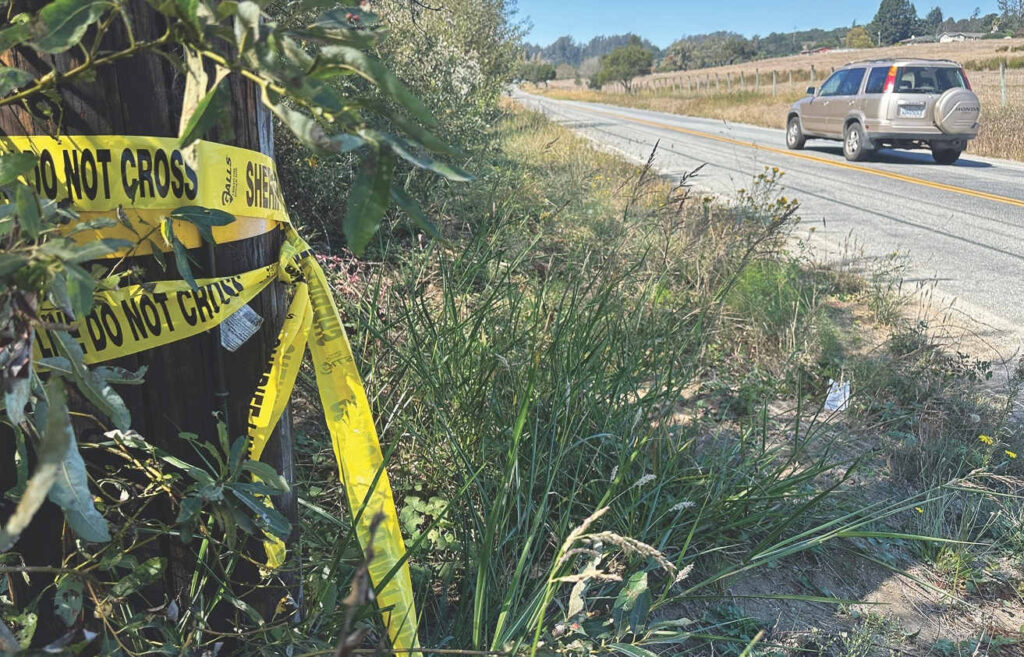
The Santa Cruz County Sheriff’s Office has opened an investigation after deputies found a body on Larkin Valley Road.
On Oct. 3 at approximately 6:59pm, deputies responded to reports of an unresponsive male on Larkin Valley Road near Windsong Way in the unincorporated area of Watsonville.
When first responders arrived they found the victim dead.
The death is being investigated as a homicide, The Sheriff’s Office said.
The victim’s identity will be released once family members have been notified.
No arrests have been made.
Anyone with information is asked to call 831.471.1121.
PVUSD Superintendent Heather Contreras leaving for San Luis Obispo district

Two and a half years after taking the helm of Pajaro Valley Unified School District, Superintendent Heather Contreras will be leaving for a new post.
Contreras has been selected to become superintendent of San Luis Coastal Unified School District on July 1, 2027, following the retirement of current Superintendent Eric Prater, according to a Facebook post by SLCUSD Trustee Michael Glavan.
The SLCUSD Board of Trustees is scheduled to vote on her appointment Tuesday night.
“We are excited to welcome Dr. Contreras to San Luis Coastal Unified School District (SLCUSD),” Glavan wrote. “With 25 years of experience in public education and a strong commitment to students, educators, and community, she brings a wealth of leadership and dedication to our district.”
Contreras did not respond to a request for comment Monday.
Her departure will come a little more than three years after she took the helm of PVUSD on May 1, 2024.
Contreras began her tenure with what she called a “Look, Listen and Learn” tour, meeting with students, teachers, community members, nonprofit organizations and law enforcement officials to assess the state of the district.
In a 2025 interview with The Pajaronian, Contreras said those meetings generated more than 1,500 responses that helped shape district goals covering academics, professional development, fiscal responsibility and employee recruitment and retention.
Much of Contreras’ tenure has been dominated by PVUSD’s financial challenges, including declining enrollment and the expiration of one-time federal Covid-19 relief funding that had been used to pay for employees.
As the district faced millions of dollars in reductions, Contreras oversaw the creation of the Sustainable Budget Team, a 24-member group tasked with examining the district’s finances and recommending cuts.
Contreras told The Pajaronian in 2025 that the process was designed both to involve the community in difficult budget decisions and to help the public better understand school finance.
“School finance is really complex,” she said at the time. “There are so many rules that govern how we spend our money. So I think it’s been a real educational tool for people.”
Her tenure also included the passage of Measure M, the $315 million general obligation bond approved by voters in November 2024 to fund construction and renovation projects throughout the district.
Contreras has also worked to increase student involvement in district governance. That included creating the “Core Six,” a group of students who meet with the superintendent before Board of Trustees meetings to review agendas and provide feedback to the district’s student trustee.
PVUSD has also worked under Contreras to address declining enrollment by expanding programs and looking for ways to keep students in the district. Those efforts have included expanding Mar Vista Elementary School to serve transitional kindergarten through eighth grade, restructuring Pacific Coast Charter School and exploring an early-college partnership with Cabrillo College.
At the same time, the district has continued to struggle with academic performance, particularly in math, as students recover from learning losses associated with the Covid-19 pandemic.
Contreras’ time with the district has also been marked by turmoil on the Board of Trustees, where discussions have at times veered away from district business and into disputes among board members.
The Pajaronian will update this story as more information becomes available.