


PVUSD Superintendent Heather Contreras leaving for another role

Superintendent of Pajaro Valley Unified School District, Heather Contreras, will leave her position once her contract ends in June. (Amaya Edwards — Santa Cruz Local/CatchLight Local)
WATSONVILLE >> Superintendent Heather Contreras is leaving the Pajaro Valley Unified School District after her contract expires in June. It was announced Monday afternoon that Contreras will be taking up the role of superintendent at San Luis Coastal Unified School District.
The announcement came after Mandy Dawson, executive assistant to the current Superintendent at SLCUSD, sent a message to San Luis Obispo families and the community announcing Contreras’ new role.
“Following a comprehensive search and input from parents, students, employees, and community members, our Board of Education has selected Dr. Heather Contreras,” the statement read. Contreras will begin her position as new superintendent at San Luis Coastal Unified School District July 1.
(function() { window.mc4wp = window.mc4wp || { listeners: [], forms: { on: function(evt, cb) { window.mc4wp.listeners.push( { event : evt, callback: cb } ); } } } })(); Stay informed on Santa Cruz County’s biggest issues. Santa Cruz Local’s newsletter breaks down complex local topics and shows residents how to get involved. Email address:mc4wp.forms.on('subscribed', function(form) { // gtag.js if(form.id == '6954') { gtag('event', 'subscribe', {'event_category': 'newsletter_prompt', 'event_label':'top_of_story'}); } }); Leave this field empty if you're human:
Contreras, who began her term as PVUSD superintendent in May 2024, agreed to a three-year contract with the largest school district in Santa Cruz County, with an annual base salary of $242,000 a year, with a 2% raise after one year.
Contreras and Alejandro Chavez, PVUSD’s public information officer, did not respond to repeated requests for comments.
In her nearly three years in the role, Contreras found herself at the center of many difficult decisions. She came under scrutiny concerning the overall health of the school district, and faced scrutiny from the Board of Trustees and the Pajaro community on many of her decisions.

Pajaro Valley Unified School District Superintendent Dr. Heather Contreras listens as community members speak at a PVUSD Board of Trustees meeting in Watsonville on Oct. 22, 2025. (Amaya Edwards — Santa Cruz Local/CatchLight Local)
One decision that upset community members was the hiring of Mark Herbst as deputy superintendent, after many stated that the job position was not made available to the public to review. Those in opposition also took issue with his $228,000 annual salary, saying those funds could have been better used elsewhere in the district.
Other decisions helmed by Contreras in the last year included laying off 130 full-time equivalent staff positions district-wide — jobs in special education, mental health and counseling clinicians — as well as numerous consultant contracts that came under scrutiny.
Contreras was responsible for the passage of Measure M, the $315 million bond that was approved by voters in 2024 to help fund construction and renovation of projects throughout the district. She also encouraged student involvement in district boards, and was essential in creating the “Core Six” — a group of students who met with her before board meetings to review agendas and provide feedback.
At the time she took the role, Contreras was the school district’s third superintendent within a three-year span. She’s focused much of her time on trying to fix a $15.3 million shortfall as a result of declining enrollment and the expiration of pandemic-era funding.
Brandon Diniz, president of the Pajaro Valley Federation of Teachers, told Santa Cruz Local that he could not comment on pending employment decisions regarding other districts, but that “our focus remains on collaborating with the PVUSD on our members’ working conditions, our students’ learning conditions, and advocating tirelessly that our students be put first.”
Prior to joining PVUSD, Contreras was an elementary school principal and assistant superintendent at Modesto City Schools, and was hired as PVUSD’s superintendent after Michelle Rodriguez announced her departure in June 2023.
The SLCUSD Board of Trustees is meeting on Oct. 6 to publicly announce Superintendent Contreras’ new appointment and contract. The search for a new superintendent came after Eric Prater, the longtime leader of San Luis Obispo schools, announced he will be retiring.
Questions or comments? Email info@santacruzlocal.org. Santa Cruz Local is supported by members, major donors, sponsors and grants for the general support of our newsroom. Our news judgments are made independently and not on the basis of donor support. Learn more about Santa Cruz Local and how we are funded.
Learn about membership Santa Cruz Local’s news is free. We believe that high-quality local news is crucial to democracy. We depend on locals like you to make a meaningful contribution so everyone can access our news. Learn about membershipThe post PVUSD Superintendent Heather Contreras leaving for another role appeared first on Santa Cruz Local.
Watsonville Hospital leaders say they must shutter their maternity ward or face imminent closure

Watsonville Community Hospital has struggled to maintain fiscal sustainability. (Contributed)
Pajaro Valley Health Care District Hospital Board Meeting- Oct. 28, 2026 from 5-6 p.m.
- Attend at Watsonville Community Hospital in the Community Room, 85 Nielson St., Watsonville CA 95076 or join on Zoom.
WATSONVILLE >> Watsonville Community Hospital is running out of options and may shutter by April if its financial situation does not improve, hospital leaders said last week.
This comes as the Pajaro Valley Health Care District board members, the agency that operates the hospital, find themselves at a financial impasse — keep the neonatal intensive care unit closed and shut down the labor and delivery unit, or face potential closure within the next six months to a year.
The hospital was more than $23 million in the red in 2025 and so far this year has, at least on paper, turned a profit of about $10 million. But day-to-day operations still fall short of covering operating costs — by about $85,000 a day or roughly $2.5 million a month, according to a presentation by Chief Financial Officer Julie Peterson at a Sept. 22 meeting.
A $10.6 million state grant and a hodgepodge of smaller loans and payment plans have helped keep the hospital afloat in the short term, but the state money has already run out and the operational deficit remains.
It has been operating for months with between a couple of days’ and a couple of weeks’ worth, whereas hospitals ideally have months’ worth of cash at any given time.
The 2025 Republican-backed budget reconciliation bill, known as the One Big Beautiful Bill Act, decimated funding for government health care and is one of a number of reasons the hospital has struggled. Roughly 85% of Watsonville Hospital’s patients use Medi-Cal or Medicare health insurance, making the financial impacts for the hospital significant as more uninsured patients seek care in the emergency room.
Hospital leaders have sought a solution to the financial challenges in a partnership with a larger health care system that can take over the hospital’s daily operations and financial ups and downs, and allow it to stay open. Potential partners included Sutter Health, Kaiser Permanente, UC San Francisco, Salud Para La Gente and CommonSpirit Health.
After negotiations fell apart with one potential partner, which hospital leaders announced in May, there have been no updates shared with the public. Hospital leaders have not shared details about which potential partner fell through and which — if any — still remain on the table.
Tim Moran, the hospital’s interim CEO, declined an interview with Santa Cruz Local, but wrote in an email, “The hospital is running with approximately eight days of cash on hand. Growth initiatives and partnership are being actively pursued, but the results of those efforts will not benefit the hospital for months to come.”
All five potential health care partners stated that they could not comment on where negotiations stand with Watsonville Hospital.
(function() { window.mc4wp = window.mc4wp || { listeners: [], forms: { on: function(evt, cb) { window.mc4wp.listeners.push( { event : evt, callback: cb } ); } } } })(); Stay informed on Santa Cruz County’s biggest issues. Santa Cruz Local’s newsletter breaks down complex local topics and shows residents how to get involved. Email address:mc4wp.forms.on('subscribed', function(form) { // gtag.js if(form.id == '6954') { gtag('event', 'subscribe', {'event_category': 'newsletter_prompt', 'event_label':'top_of_story'}); } }); Leave this field empty if you're human:
For Nora Yerena, founder of Central Coast Doula Services, a Watsonville-based program offering Santa Cruz County mothers labor support, the potential hospital closure hits home. Fifteen years ago, Yerena’s child was born more than two months premature.
“If I had to go through the hour-long drive of traffic, at that time, the chances of me not making it there conscious, better yet alive,” said Yerena, who delivered her baby at Watsonville Hospital.
Her baby was born at just 31 weeks and was transferred to Dominican Hospital’s neonatal intensive care unit. Yerena commuted from Castroville to visit the infant. Keeping Watsonville’s NICU closed, which treats some premature babies, and closing the maternity ward would be devastating for Pajaro Valley families, she said.
If the board decides to close the maternity ward, a 120-day notice to the state is required, and the board is obligated to have one public hearing during the first 60 days “while this decision making is being undertaken,” according to Moran.
Questions or comments? Email info@santacruzlocal.org. Santa Cruz Local is supported by members, major donors, sponsors and grants for the general support of our newsroom. Our news judgments are made independently and not on the basis of donor support. Learn more about Santa Cruz Local and how we are funded.
Learn about membership Santa Cruz Local’s news is free. We believe that high-quality local news is crucial to democracy. We depend on locals like you to make a meaningful contribution so everyone can access our news. Learn about membershipThe post Watsonville Hospital leaders say they must shutter their maternity ward or face imminent closure appeared first on Santa Cruz Local.
Greensite endorses Coonerty as he shifts his tone on ‘oversized’ housing


Ryan Coonerty in an interview with Santa Cruz Local on Sept. 19. (Amaya Edwards — Santa Cruz Local/CatchLight Local)
SANTA CRUZ >> Ryan Coonerty has secured the endorsement of Gillian Greensite, a former opponent in the June primary, in the race for Santa Cruz Mayor. Greensite said she chose to endorse him over his opponent Ami Chen Mills because he shifted his attitude towards large new developments, a core frustration of Greensite and her supporters.
As a staunch environmentalist, Greensite has at times opposed large new housing developments. Conversations between her and Coonerty, and recent proposals for large housing, have led him to take a more aggressive attitude towards what he sees as oversized developments, the two said in a press conference Thursday.
Her support is “because of the issues I ran on,” she said. “I think he’s the best person, as well as being very experienced, to bring them to fruition.”
Coonerty said his overall position on housing has remained the same, and that he evaluates housing proposals “project by project.”
“The change of the rhetoric,” he said, is because “some of these projects are so incredibly bad that they deserve to be called out.”
(function() { window.mc4wp = window.mc4wp || { listeners: [], forms: { on: function(evt, cb) { window.mc4wp.listeners.push( { event : evt, callback: cb } ); } } } })(); Stay informed on Santa Cruz County’s biggest issues. Santa Cruz Local’s newsletter breaks down complex local topics and shows residents how to get involved. Email address:mc4wp.forms.on('subscribed', function(form) { // gtag.js if(form.id == '6954') { gtag('event', 'subscribe', {'event_category': 'newsletter_prompt', 'event_label':'top_of_story'}); } }); Leave this field empty if you're human:
Greensite won 11.1% of the vote in the June primary. Coonerty had 47.8%, and Chen Mills had 20.5%.
Greensite’s endorsementA core plank of Greensite’s campaign was her concern that the city was allowing too much housing. While Coonerty didn’t share that rhetoric during the primary, “everything that I brought forward that had helped him change his mind about that issue, and in talking about it with him, I feel that we have common ground,” she said.
Greensite has been called a progressive activist, a label she shares with opposing mayoral candidate Chen Mills, and the three other candidates of the June primary.
But, “right from the beginning of the campaign,” she said, “I made it very clear to everybody that I was running an independent campaign on specific issues, and that I was not wanting to be part of any slate, or group.”
Greensite has supported Coonerty’s push for more data-gathering about the city’s housing — she remains skeptical that below-market-rate housing is being occupied by people who already lived in Santa Cruz — and his history of negotiating with UC Santa Cruz to protect the city’s interests.
Coonerty also has close ties with some local developers. He helped scout a site for affordable housing developer The Danco Group — eventually landing on the Downtown location of Dell Williams owned by Coonerty’s wife and mother in law.
He was hired by RedTree Partners to help them close out lease negotiations between them, the City of Santa Cruz and UCSC for a 161-unit housing project for UCSC students and staff on Delaware Avenue. He’s also helped in negotiations about the proposed Downtown hotel, and a proposed Warriors stadium redevelopment.
He doesn’t see a conflict of interest with his potential role as a mayor, “I see it as really relevant experience,” he said in September.


Ryan Coonerty was hired by RedTree Partners to help with negotiations between the developer, the city and the university for Delaware Addition. The project finished construction in May. (Nik Altenberg — Santa Cruz Local file)
As a consultant, “my role was to work with the city, when relevant with UCSC, and with the building owner to get to a solution,” that would allow the project to move forward, he said. “In some ways, that’ll be the same thing that I’ll be doing, but on behalf of the residents.”
He added, “there are projects and developers that I have turned down over the years working with because I don’t believe they’re doing the right thing.”
Coonerty’s views on housingAhead of the June primary, Coonerty said that city leaders must be realistic about their ability to block or change new housing developments.
“When the city has authority, we need to use it to protect neighborhoods from out-of-scale development,” Coonerty told Santa Cruz Local in May. At the same time, “pretending like we can go back and just stop every project is lying to people, and it’s not how you should be running a government.”
In a September interview, he said that recent housing proposals, including a six-story project in Seabright, has led him to reconsider his attitude.
“The city has to be more aggressive in pursuing legal options” to stop or curtail projects with large amounts of community pushback, he said.
A full description of Coonerty’s platform is forthcoming in Santa Cruz Local’s Election Guide on Oct. 5.
At the Thursday press conference, Coonerty said that his overall political view of housing policy remains constant, and that he’s opposed some projects in the past.
Greensite’s influence, he said, is more about the strategies the city could use to push back on state mandates. “What are the levers we have? What is the data we need to provide? Where are the opportunities to fight?” he said.
The two aren’t aligned on all issues — Greensite opposed the Downtown library and affordable housing project, which Coonerty supported — but Greensite said she believes Coonerty is best positioned to shape the future of housing in Santa Cruz.
“I feel Ryan is the stronger, the better candidate,” she said.
The post Greensite endorses Coonerty as he shifts his tone on ‘oversized’ housing appeared first on Santa Cruz Local.
A candidate running for a PVUSD seat arrested for alleged fraud, but still on the ballot

There are four open seats on the Pajaro Valley Unified School District board up for election on the Nov. 3 ballot. (Amaya Edwards — Santa Cruz Local/CatchLight Local)
WATSONVILLE >> All three candidates vying for the Pajaro Valley Unified School District’s Trustee Area 5 seat will remain on the November ballot, despite one candidate being arrested for allegedly lying about living in the district and the other withdrawing.
Candidate Curt Wilcox was arrested Sept. 18, Lookout Santa Cruz first reported Tuesday. He now faces multiple felony charges related to his candidacy filing paperwork, according to court records.
Candidate Jennifer Schacher withdrew from the race last month and endorsed Alicia Jimenez, citing family obligations in an emailed statement. Schacher served on the board from 2018 to 2022, but lost her reelection bid to Olivia Flores, who is not seeking reelection.
Wilcox, Schacher and Jimenez will all still appear on voters’ Nov. 3 ballots because the deadline to change anything was Aug. 12.
(function() { window.mc4wp = window.mc4wp || { listeners: [], forms: { on: function(evt, cb) { window.mc4wp.listeners.push( { event : evt, callback: cb } ); } } } })(); Stay informed on Santa Cruz County’s biggest issues. Santa Cruz Local’s newsletter breaks down complex local topics and shows residents how to get involved. Email address:mc4wp.forms.on('subscribed', function(form) { // gtag.js if(form.id == '6954') { gtag('event', 'subscribe', {'event_category': 'newsletter_prompt', 'event_label':'top_of_story'}); } }); Leave this field empty if you're human:
Court records show that Wilcox is currently facing felony charges including false affidavit as perjury, voter registration violation and false declaration of candidacy. On Sept. 21, Wilcox was ordered to undergo an evaluation by a psychiatrist or psychologist as the court declared doubt about his mental competency. He’s been assigned a public defender.
Tricia Webber, Santa Cruz County Clerk, said that Wilcox can only be removed from the ballot by a court order. She said the Santa Cruz County Sheriff’s Office and the District Attorney’s Office were aware of her scheduled ballot printing deadline of Aug. 26, but did not receive a court order to remove him.
“We will tabulate any votes that are cast for any of the three candidates,” Webber said. “The person with the most votes is declared the winner of the contest.”
In Santa Cruz County, every candidate running for office signs a declaration of candidacy and takes an oath to officially become a candidate, which promises that if they are nominated and elected, they serve their role in office.
Jimenez, who actively remains in the race, said, “I’m not going to take for granted that Jennifer withdrew or that there are controversies around Curtis’s candidacy.”
Jimenez, who worked for the district for 25 years, hopes that the community will get out and vote.
“It’s the only privilege we have as citizens and the one opportunity we have to make a change,” she said.
Jimenez also shared that Schacher endorsed her in August. “In that essence, I felt very comfortable afterwards,” she said. “ But until then, I knew that she was a very strong opponent.”
The Area 5 race is one of four Pajaro Valley school board races that will be on the November 3 ballot. Santa Cruz Local’s Election Guide will be published Oct. 5, and will highlight candidates and elections throughout the county.
Questions or comments? Email info@santacruzlocal.org. Santa Cruz Local is supported by members, major donors, sponsors and grants for the general support of our newsroom. Our news judgments are made independently and not on the basis of donor support. Learn more about Santa Cruz Local and how we are funded.
Learn about membership Santa Cruz Local’s news is free. We believe that high-quality local news is crucial to democracy. We depend on locals like you to make a meaningful contribution so everyone can access our news. Learn about membershipThe post A candidate running for a PVUSD seat arrested for alleged fraud, but still on the ballot appeared first on Santa Cruz Local.
Monitoring invasive beetles in Santa Cruz County

Blake Shaw points out an invasive beetle’s bore hole. (Amaya Edwards — Santa Cruz Local/CatchLight Local)
Help report suspected infestations- To report suspected damage from invasive shothole borers, property owners should call the Santa Cruz County Agricultural Commissioner’s Office at (831) 763-8080
- Resources on the monitoring, detection, and management of the pests are available at ISHB.org, or by contacting your local Cooperative Extension Forest Advisor.
FELTON >> Zayante trail starts off like most in Henry Cowell. On a recent afternoon, chirping birds fluttered about a box elder tree’s branches, the leaves providing the birds and the hikers refuge from the sun. But just a few meters down from the trailhead, something changes. The treecover disappears abruptly, and the sun beats down.
Blake Shaw, a forest health surveillance coordinator with Santa Cruz County Agricultural Commissioner’s Office, said the lack of canopy is a symptom of an ongoing infestation of invasive pests. The culprit is a beetle species called the Greater shothole borer. It’s no bigger than the tip of a pen, but it can wreak havoc on native tree species like the box elder.
“This is kind of the future,” Shaw said, gesturing toward the fallen corpse of a box elder tree on the trail. “These are the oldest infestations, and as you can see, they’re all dying.”
(function() { window.mc4wp = window.mc4wp || { listeners: [], forms: { on: function(evt, cb) { window.mc4wp.listeners.push( { event : evt, callback: cb } ); } } } })(); Stay informed on Santa Cruz County’s biggest issues. Santa Cruz Local’s newsletter breaks down complex local topics and shows residents how to get involved. Email address:mc4wp.forms.on('subscribed', function(form) { // gtag.js if(form.id == '6954') { gtag('event', 'subscribe', {'event_category': 'newsletter_prompt', 'event_label':'top_of_story'}); } }); Leave this field empty if you're human:
Since its discovery in 2024, the county has been monitoring an ongoing infestation of the invasive species, which is likely new to California. The beetle is attacking native tree species important for ecosystems near rivers, and with every fallen tree, the risk of fire and damage increases for communities in the Santa Cruz Mountains, where the problem started and is spreading outward.
The county’s Agricultural Commissioner is collaborating with University of California scientists to better understand the infestation and its leading edge — the advancing border of the beetle’s territory. The team hopes to manage the local infestation by focusing efforts on community engagement and proper disposal of infested trees.
The beetle was first identified two years ago, when an arborist hiking near Zayante Creek noticed trees filled with tiny holes. But Brian Woodward, a regional forest advisor with the University of California, said the beetles have likely been here longer. “We caught this a little late in Santa Cruz, it’s likely been in this area for a number of years.”

Blake Shaw, a forest health surveillance coordinator with the County of Santa Cruz, examines a dead box elder tree in Henry Cowell. (Amaya Edwards — Santa Cruz Local/CatchLight Local)
Southern California has seen its own infestation of invasive shothole borer beetles, where two species of the beetle have collectively killed hundreds of thousands of trees. But Santa Cruz’s shothole borer is a species completely new to California, distinct from ones identified in Southern California and San Jose. The Greater shothole borer also boasts a slightly larger size than the other two species, reaching roughly the size of a grain of rice.
“Because this is a brand new species of pests, we really don’t actually know what tree species are most susceptible in our communities,” Woodward said. The most impacted trees so far have been box elders, which provide shade for fish along rivers.
Scientists believe the beetles, originally from Southeast Asia, were introduced to California with shipping materials. Shannon Lynch, an assistant professor of forest pathology UC Davis, said that while native beetles go after stressed and dying trees, the invasive shothole borers are more problematic.
“This class of ambrosia beetle actually tends to attack apparently healthy trees,” she said.
The beetles bore holes into the bark where they grow their main food source, a fungus called Fusarium. Once beetles emerge from the holes, they don’t go far, often drilling holes into the same tree, reproducing incestuously with siblings and spreading Fusarium further throughout it. As Lynch explained, the fungus acts as a pathogen, causing an immune response that eventually kills the tree.
The UC scientists explained that this quick propagation within the same tree can create “amplifier trees” that drive the infestation. “One tree can have 10,000, 20,000 holes supporting many hundreds of thousands of beetles,” Woodward said
Santa Cruz County Agricultural Commissioner David Sanford said that managing the issue is paramount for protecting native tree species and preventing costs related to dead trees — things like damage to homes and powerlines from falling limbs and increased fire risk.
“What we’re dealing with is a pest that’s not your typical pest that we deal with in the ag world,” he said. He also explained that because the beetles don’t go after agricultural plants or timber, less assistance comes from the state’s Department of Food and Agriculture for dealing with the infestation.
His team is working with a “small amount” of grant money from the Invasive Species Council of California, which has granted funds to counties dealing with invasive pests. “Really, it’s strictly like a surveillance and monitoring kind of grant. It’s not a lot of money to do management and mitigation work,” he said.
His team is also looking for grants through Cal Fire and state parks for actual mitigation efforts, which involve taking down amplifier trees and disposing of them properly by burning or shredding them. Both methods, Sanford underscored, are costly.

Kristy Swor points out a new infestation in a tree in Paradise Park. (Amaya Edwards — Santa Cruz Local/CatchLight Local)
In places like Paradise Park along the San Lorenzo River, residents like Kristy Swor have had to come together with their communities to pay for the removal of infested trees.
“The problem with at least our community is we don’t have a budget to deal with this,” Swor said as she pointed out a nearby tree that recently became infested.
In the meantime, Sanford and Shaw are focusing on educating residents about how to identify infested trees. “Outreach is one of the most important aspects when dealing with an invasive pest,” said Shaw. “We need that momentum and that word of mouth and everything to kind of create action.”
The team held meetings last week to inform community members about the issue and encourage them to report infested trees to the county. They recommend residents to use an online ISHB Detection Assessment to see if their trees are suffering from the pest, and recommend calling the county directly to report infested trees at (831) 763-8080.
Signs of an infestation may include “small, round entry holes, wet staining, gumming, boring dust or sugary buildup on trees,” according to a county press release.
For her part, Lynch explained that while there’s no eradicating the beetle from California, aggressive monitoring and management can make a difference. “This is something to take seriously, and being proactive is the best way to take it seriously, but it can be managed,” she said.
Questions or comments? Email info@santacruzlocal.org. Santa Cruz Local is supported by members, major donors, sponsors and grants for the general support of our newsroom. Our news judgments are made independently and not on the basis of donor support. Learn more about Santa Cruz Local and how we are funded.
Learn about membership Santa Cruz Local’s news is free. We believe that high-quality local news is crucial to democracy. We depend on locals like you to make a meaningful contribution so everyone can access our news. Learn about membershipThe post Monitoring invasive beetles in Santa Cruz County appeared first on Santa Cruz Local.
Watsonville City Council Approves New Restrictions on Flock Cameras
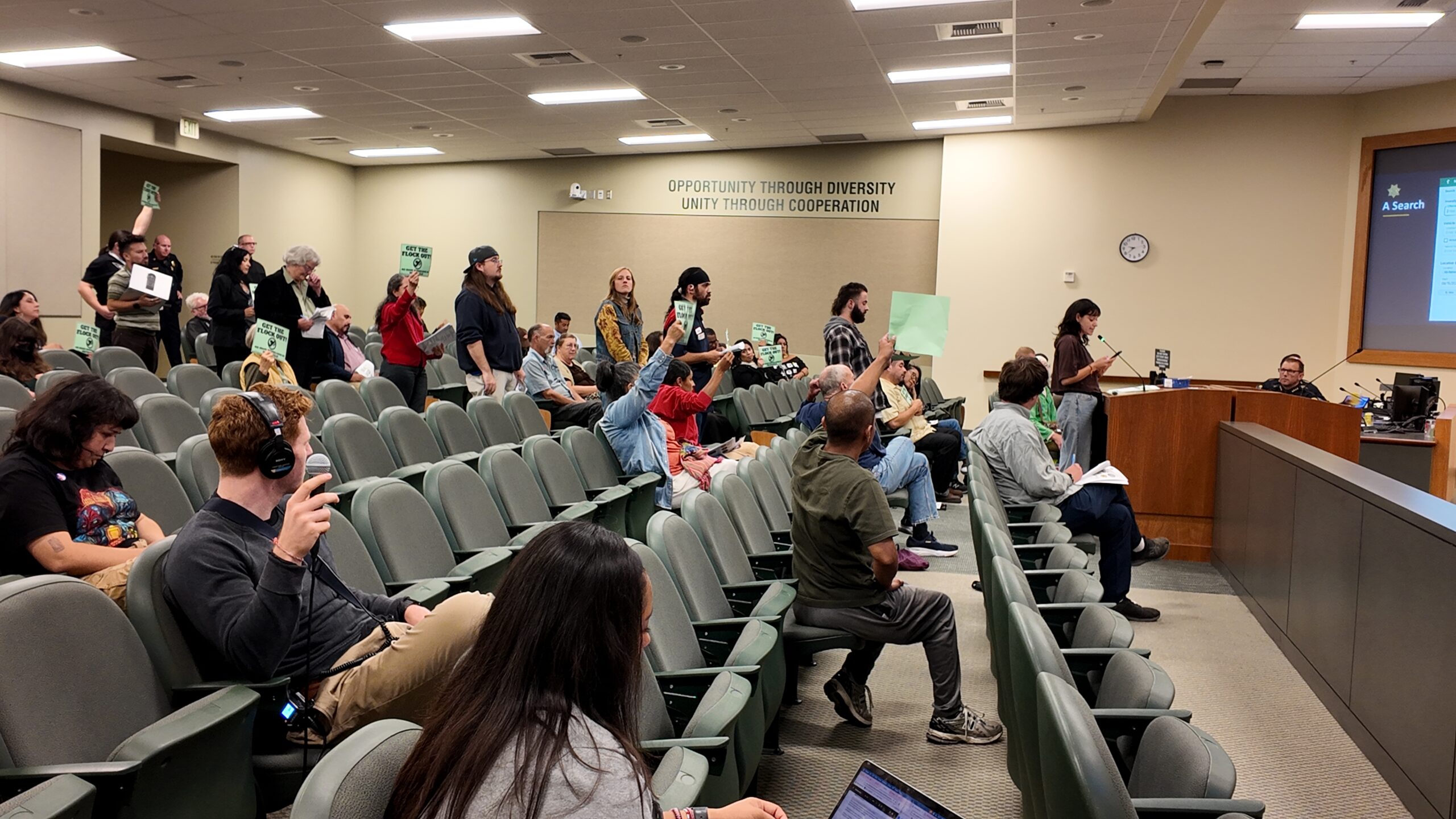
The Watsonville City Council on Sept. 22 adopted tighter restrictions on the use of automated license plate readers. (Erandi García — Noticias Watsonville)
WATSONVILLE >> Amid heated public debate over safety and surveillance, the Watsonville City Council on Tuesday adopted tighter restrictions on the use of automated license plate readers. Council leaders renewed the contract with Flock Safety for the ALPRs last September, but as scrutiny increased nationwide, Councilmember Ari Parker brought the issue back to the council for consideration.
The vote at Tuesday’s meeting reduces the number of Flock cameras in Watsonville to 20 from 37, limits data retention to seven days from 30 and ends the sharing of information with other jurisdictions, including neighboring law enforcement agencies. The council also mandated quarterly independent audits and community engagement — including a town hall for residents with the CEO of Flock Safety and the Watsonville Police Chief.
ALPRs track people by capturing images of cars, including the license plate, make, model, color, bumper stickers and other identifying features. Police searching for a suspect can look up a car by its license plate or with a description of the car and track potential matches.
Investigations by CalMatters and Santa Cruz Local revealed how ALPR data in California, including Capitola and Santa Cruz police’s data, had been accessed on behalf of federal immigration agents by other law enforcement agencies in California in 2025. Santa Cruz voted to end its contract with Flock in January 2026.
Watsonville’s current contract with Atlanta, Georgia-based Flock Safety expires in September 2027.
The 5-2 vote followed more than four hours of discussion and public comments in a meeting that ended just before midnight. Councilmembers Maria Orozco, Ari Parker, Casey Clark, Jimmy Dutra and Vanessa Quiroz-Carter voted in favor of the restrictions. Councilmember Eduardo Montesino and Mayor Kristal Salcido voted against it.
(function() { window.mc4wp = window.mc4wp || { listeners: [], forms: { on: function(evt, cb) { window.mc4wp.listeners.push( { event : evt, callback: cb } ); } } } })(); Stay informed on Santa Cruz County’s biggest issues. Santa Cruz Local’s newsletter breaks down complex local topics and shows residents how to get involved. Email address:mc4wp.forms.on('subscribed', function(form) { // gtag.js if(form.id == '6954') { gtag('event', 'subscribe', {'event_category': 'newsletter_prompt', 'event_label':'top_of_story'}); } }); Leave this field empty if you're human: Watsonville Police defend Flock cameras
Watsonville Police Chief Brian Shab said in a presentation to the council that the cameras can help an investigation progress more quickly. He cited examples where the cameras aided in identifying vehicles or suspects in investigations of homicide, sexual assault, indecent exposure and vehicle theft.
“The responsibility of the police department to use this technology lawfully, narrowly, transparently, and with meaningful oversight and it has serious consequences for misuse,” Shab said, adding that the department conducts audits twice a month to review unusual activities and verify that its personnel are complying with the rules of use.
He also said that not all employees have access to the system and there is no evidence that any employee has misused it.
The chief presented statistics that, he said, in the past year from September 2025 to September 2026, reflect the system’s usage. The department conducted 7,813 internal searches that resulted in 894 cases in which Flock assisted the department.
During the presentation, he also noted that Flock currently uses a default retention period of 30 days and prior to the council’s motion said he would be willing to evaluate whether seven days would be appropriate for Watsonville.
“A shorter retention provides greater identity protection, but it also means [it] reduces the window in which that information is available to investigators,” he said, in particular for crimes that are not reported immediately.
Questions about oversightCouncil members had questions about how the system is monitored and who has access to the data.
Quiroz-Carter asked Shab to explain how investigations were conducted before Watsonville began using Flock. She also asked for details about the department’s policy governing the system’s use.
Shab said the policy was available online but was unable to specify at the moment where precisely on the website it could be found. Visibly displeased, Quiroz-Carter said she could not find it and questioned why more detailed information and the policy itself had not been brought to the meeting.
Orozco asked how many agencies in California have access to Watsonville’s data. Shab was unable to provide that number during the meeting.
Parker asked what happens when a user violates the system’s rules and what the consequences are.
Shab said the city could completely eliminate data sharing with other agencies or limit it to nearby jurisdictions. Reducing data sharing, he said, could affect the system’s usefulness for some investigations.
Parker also stated that her trust in the police chief was separate from her opinion of the technology.
“I don’t believe in Flock. I believe in you, but I don’t believe in Flock,” Parker said.

Watsonville’s current contract with Atlanta, Georgia-based Flock Safety expires in September 2027. (Erandi García — Noticias Watsonville)
The public was divided on FlockThe council chamber was initially full during the discussion, but as the conversation continued, some people began to leave. At least 30 people spoke in person, with another 20 or so speaking via Zoom.
The comments reflected conflicting positions. The vast majority expressed their opposition to Flock. Those opposed raised concerns about privacy, data sharing and potential misuse of information.
“The question is not do we trust the Watsonville PD, the question is should Watsonville participate in a system where the data we collect could be vulnerable to misuse beyond our local control” a community member commented.
Yesenia Jimenez, a District 7 resident, said the department’s defense of Flock was undermining trust and questioned whether officers should have spent time at the meeting rather than patrolling the streets.
“I get that you’re trying to save a tool that is helping you. You are eroding trust right now” Jimenez said. “I would rather you have spent less time here, or whoever, whatever officers are back here, to be out on the street patrolling than to be wasting their time listening to this.”
A mother of two girls said she would feel safer knowing the cameras were in place and that she did not see surveillance as a concern given how common cameras and smartphones already are in the community.
“If Flock is a safe thing for my kids, I agree with you guys,” she said.
Watsonville began using 20 Flock Safety cameras in June 2023. In September 2025, the city council voted 5-2 to renew the $251,000 contract for 24 months and increase the number of cameras to 37.
Questions or comments? Email info@santacruzlocal.org. Santa Cruz Local is supported by members, major donors, sponsors and grants for the general support of our newsroom. Our news judgments are made independently and not on the basis of donor support. Learn more about Santa Cruz Local and how we are funded.
Learn about membership Santa Cruz Local’s news is free. We believe that high-quality local news is crucial to democracy. We depend on locals like you to make a meaningful contribution so everyone can access our news. Learn about membershipThe post Watsonville City Council Approves New Restrictions on Flock Cameras appeared first on Santa Cruz Local.