


Antichrist, Hitler and JD Vance’s 2028 problem
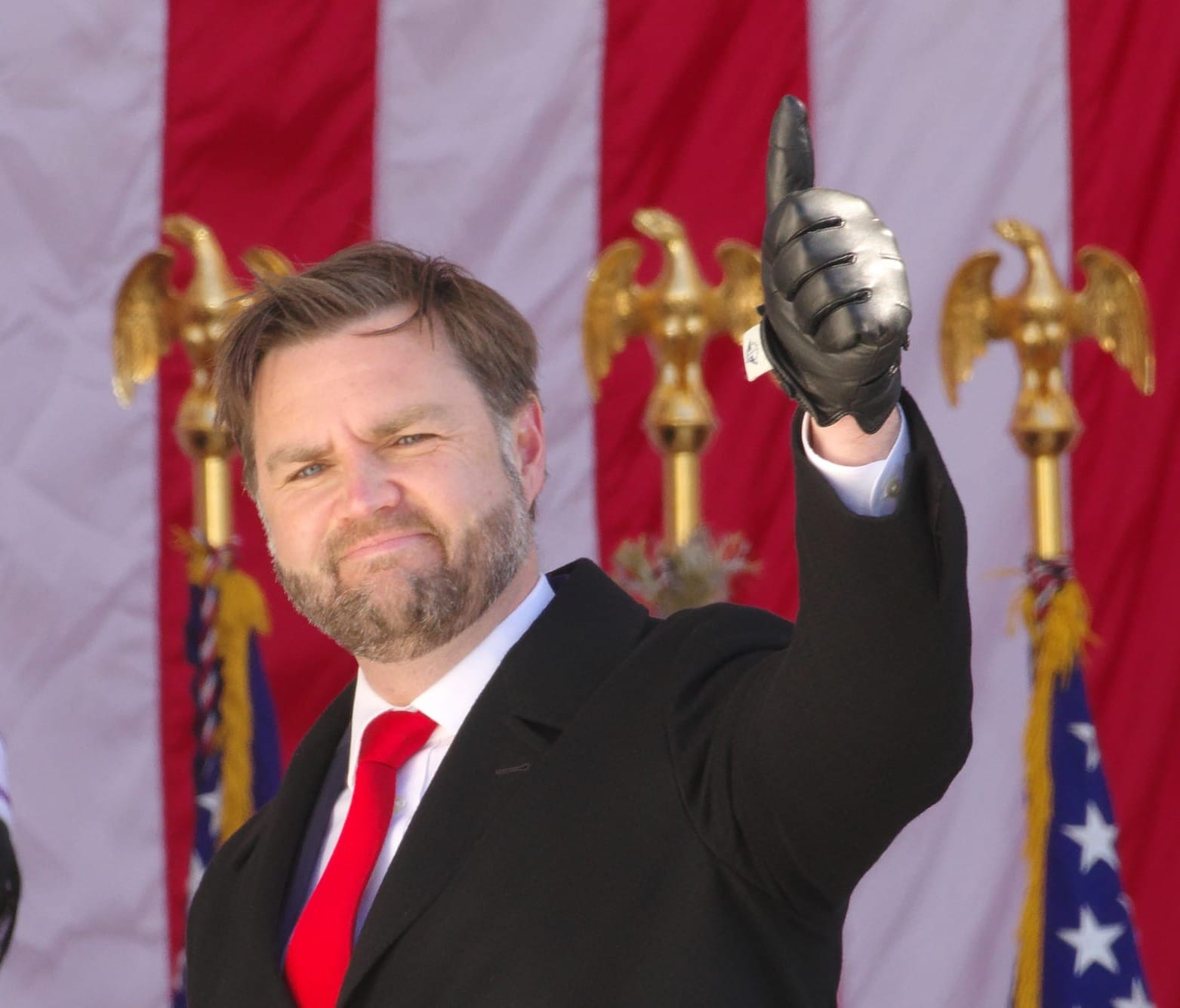
Peter Thiel says evil is “maybe kind of good.” Curtis Yarvin says Hitler was a genius. And the mainstream press has barely asked their intern, JD Vance, about either.
This fierce newsletter covers what mainstream journalism won’t. Please become a paid subscriber to support this work. We can’t do it without you. Click here to join.
JD Vance’s Gurus Celebrate EvilPeter Thiel and Curtis Yarvin aren’t doing Vice President JD Vance any favors as the 2028 presidential election looms. The duo—both mentors to Vance—appear to be having a contest to see who can be more outrageous and shocking in public.
Thiel, who has embarked on a new career as the world’s premier Antichrist enthusiast, ignited a firestorm of controversy last month by praising the virtues of evil. During an interview in his native Germany, the Palantir billionaire said being evil is … “maybe kind of good.”
“So I'm going to get in trouble for what I'm about to say, but I think we moralize...way too much,” said Thiel in an interview with Mathias Döpfner, CEO of media giant Axel Springer SE. “And there's always a question I like to ask: what is the antonym of good? The moral antonym is evil; the functional antonym is bad. A Ferrari is an ‘evil’ car because it doesn’t get many miles per gallon. A Trabi is a ‘bad’ car—it works, it's less good than a golf cart, you know, the former East German car.”
“And so, if you're evil, you're at least competent,” said Thiel. “And if you’re evil, you’re not bad, and therefore you’re actually maybe kind of good, because you’re at least getting something done.”
Thiel offered a clarification: “I think it’s better to be good than evil, I want to be very clear.”
By this point, however, he had already equated good with evil, as long as you get things done. Clips of his comment went viral around the globe, sparking mockery, outrage, and concern.
Not to be outdone, Yarvin took to Twitter this week to wonder aloud whether AI might “solve the Jewish problem.” A few days earlier, he evoked Hitler in a rant focused on how Europe should deal with immigrants. This echoed a comment from late 2025, when Yarvin complimented Hitler.
Yarvin “has questioned the mainstream historical consensus on World War II history and described Hitler's military actions as self-defense, and he has repeatedly praised the Nazi dictator's leadership,” reported Raw Story.
“Germany got Hitler because there were too many subjects about which only Hitler spoke the truth,” Yarvin posted in December 2025. “This made a lot of Germans regard Hitler as an infallible genius. Hitler was a genius—all serious historians agree. He was not infallible.”
Yarvin, a professional edgelord, specializes in flamboyant provocations, as does Thiel. Their public outbursts could complicate Vance’s 2028 presidential run. Thiel essentially created Vance, using his money and influence to turn an unknown law student named James David Hamel into a venture capitalist, a Catholic, a Trump supporter and politician named JD Vance. In 2021, Vance cited Yarvin—a fascist blogger and fellow Thiel beneficiary—as an influence on his political thinking.
In Berlin, where Thiel received the 2026 Axel Springer Award, CEO Döpfner asked about his relationship with Vance.
“You were an early supporter of JD Vance, you worked with him, you basically saw something in him that other people didn't see then,” said Döpfner. “Can you describe what it was and why you supported him?”
Thiel responded:
I’m always hesitant to overrate my role in these things. I probably always have a very soft spot for smart people, so I thought he was thoughtful, open-minded, charismatic. And he was working for one of the venture funds I had helped start called Mithril, and then wanted to write this book on the side, and I encouraged him to do that—it became this bestseller in 2016. And I helped him out financially when he ran for Senate in 2022. But I think I’m always hesitant to answer this question because I think it just detracts from his achievement in many ways.But Vance’s main achievement was attracting Thiel as his benefactor, since Thiel bankrolled and guided his entire career. (Thiel has also invested heavily in Döpfner’s son, Moritz, known as “the German JD Vance.” A German magazine reported last year that Thiel invested $50 million in a venture capital fund started by the younger Döpfner.)
In the interview, Thiel also expressed doubt about the future of the Republican Party. He complained that the Trump administration was “staffed by not very smart” people and said he wished Trump had “appointed more competent people.” (Translation: The Trump administration isn’t being evil enough?)
Thiel, who recently bought a mansion in Argentina, also worried that American voters are “exhausted” by the Republican Party and that the country will undergo a major shift.
“We are going to get this disruption, and there’s a risk that the U.S. will shift very far to the left,” he said. “That’s the real disruption we’re going to get.”
That’s bad news for Vance. His own creator says Trump’s Republicans have “exhausted” the American people. As vice president, Vance will inherit the Trump regime’s nightmarish legacy and historically dismal poll numbers.
So far, the political media establishment has mysteriously avoided pressing Vance on his ties to Thiel and Yarvin or the unhinged things they say in public—even as some Democrats are required to answer for every remark by leftist podcaster Hasan Piker.
But Vance’s immunity is unlikely to survive a presidential campaign where Republicans and Democrats alike will have every incentive to expose and exploit those ties. And one can only imagine how Thiel and Yarvin will escalate their respective Antichrist and Hitler meltdowns between now and November 2028.
Peter Thiel Takes Antichrist World Tour to NashvilleThiel is currently delivering his Antichrist sermons in Nashville, Tennessee. On Monday, he delivered the second of four planned weekly lectures.
I bought a ticket to attend, but it was canceled without explanation the night before his first lecture. Nonetheless, I have been able to obtain full recordings of his supposedly secret talks. For the most part, he’s saying what he already said in previous lectures.
Still, it is very kinky and strange for a billionaire with Thiel’s power and influence to force hundreds of people to listen to his hours-long rantings about the Antichrist in select venues all over the world. He seems to be confessing something.
While his long-winded ideas do not deserve serious intellectual consideration, they provide a window into the existential and apocalyptic psychology of Silicon Valley billionaires in the Year of our Lord 2026.
As such, I will soon be headed to Nashville to investigate. Details below:
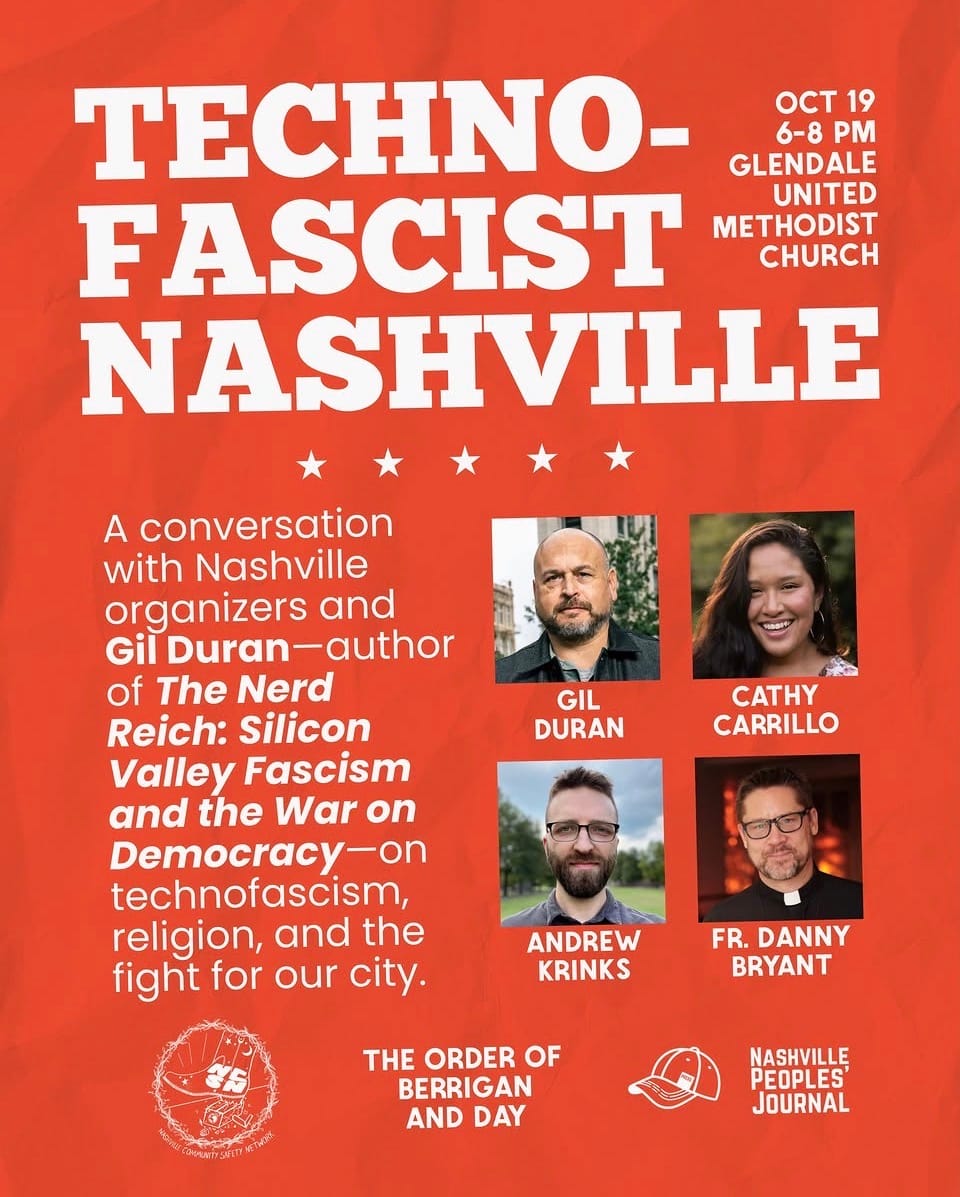 October 16: Nerd Reich LIVE
Now that the book is finished, I’m going to add more regular live chats for our 1,095 paid subscribers.
Mark your calendars for 12 p.m. (Pacific) on Friday, October 16. We’ll do a live Zoom chat with amazing special guests and answer your questions.
If you’re a paid subscriber, please click here to RSVP.
Not a paid subscriber? It’s a great time to join us!
‘The corruption is the point’
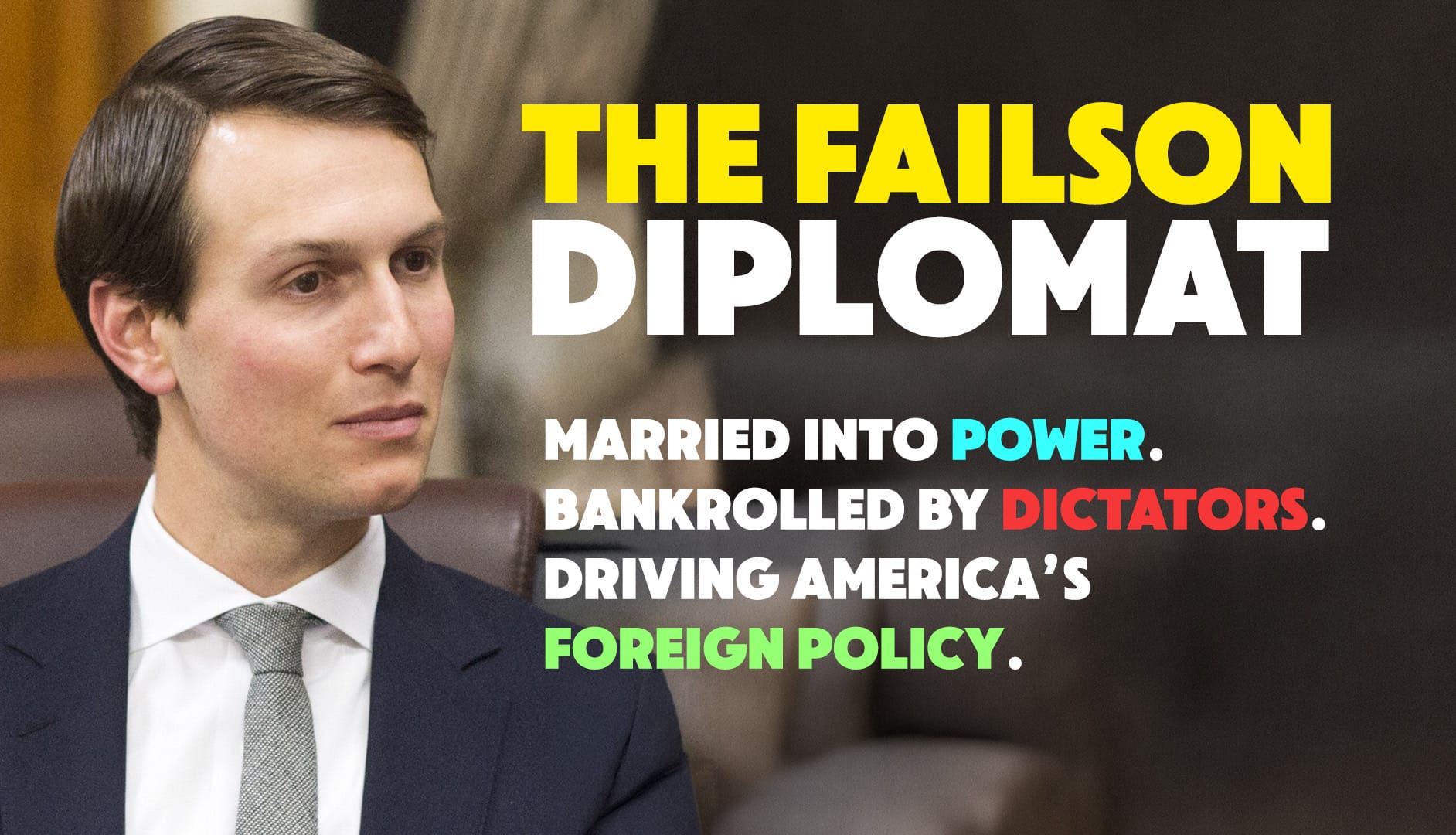
“The corruption is the point,” writes Casey Michel in United States of Oligarchy: How America's Wealthiest Ally with Dictators, Weaken the U.S., and Destroy Democracy.
The book exposes the staggering corruption of the Trump regime and how dictators and oligarchs around the world are betting on Trump—and betting against democracy. In the latest episode of The Nerd Reich podcast, I interview Michel about how oligarchy took control of the United States, and what we can do about it.
“An expert on money laundering, tax evasion, and other financial crimes, Michel offers a blistering account of how a full-blown oligarchy has formed in the United States,” wrote Foreign Affairs of his book.
Michel is a writer, journalist and director of the Combating Kleptocracy program at the Human Rights Foundation. He’s also the author of American Kleptocracy: How the U.S. Created the World’s Greatest Money Laundering Scheme in History and Foreign Agents: How American Lobbyists and Lawmakers Threaten Democracy Around the World.
Click below to watch our conversation on YouTube.
Click here to listen on Apple podcasts
Click here to listen on Spotify
Full transcript below
The Corruption is the Point: Casey Michel on America's New Billionaire OligarchsTranscripts may contain errors.
Gil Duran: With billions flowing directly into his own pockets, Donald Trump is the most corrupt president in American history. He's not even trying to hide it. He and his family are openly cashing in, and the White House is for sale. It's a spectacle of greed so massive and transparent that the corruption is the point.
That's the conclusion of today's guest, Casey Michel. He's the author of a new book, United States of Oligarchy: How America's Wealthiest Ally with Dictators, Weaken the US and Destroy Democracy. His must-read book exposes how villainous billionaires around the globe are betting against democracy and paying off the Trump regime.
Our conversation covers how Elon Musk has been beholden to Beijing for a decade while calling Democrats communists, how Jared Kushner became a billionaire the same day a report concluded Israel had committed genocide in Gaza, and a warning for Democrats: how these oligarchs planned to escape accountability by writing checks to politicians from both parties.
Casey Michel heads the Human Rights Foundation's Combating Kleptocracy program. He's the author of American Kleptocracy and Foreign Agents, and he's an expert on the transnational corruption and illicit finance that links dictators and oligarchs around the world. Oligarchy is back, and it's worse than ever. Here we go.
Gil Duran: Casey, welcome to the Nerd Reich Podcast. We live at a moment when billionaires have declared war on American democracy and on democracy around the world, and both of our books talk about that. We take different parts of the story, but there's a lot of overlap. And it's interesting. So I definitely wanted to have this conversation because at a moment when a lot of people are reading my book, I've been reading yours and listening to it on long road trips. And it's amazing the amount of detail there is. And I think what United States of Oligarchy does is put these facts together in a very compelling way that helps people understand exactly what we're up against in terms of how oligarchy is shaping and destroying our country. An oligarchy is essentially a poison that kills democracy. It allows a handful of people to use their wealth to buy influence and control supposedly democratic systems. And that corruption, coupled with economic inequality that's spiraling out of control, can lead people to stop believing in democracy altogether. And then what you have is some kind of strongman, authoritarian who rises up and says, forget about this system that's corrupt and fake and bought and sold, I can fix it with simple answers, with brutal answers. And so you write about this in your book about studies that show that oligarchy and especially economic inequality, which is always a byproduct of it, can erode democracy over time, make people less committed to democratic systems. That's why I say it's a poison. And it seems clear that democracy and oligarchy can't coexist. Let's dial it back a little bit and start with the basics. Explain to us what oligarchy means and how it works.
Casey Michel: Yeah, Gil, I should say at the outset it is an honor to be here with you. I've been reading your work on these topics for at least the last few years. I cite your work in the new book itself. And I just got back from the first leg of the book tour for this new book. I've plugged yours at every single one of them. And I have to tell you, anytime I tell people the name and the title of your new book, there is a knowing chuckle that I get, and that much more excitement to read your book as well. So look, my book, yes, it's about this theme, this topic of oligarchy, which literally means the rule of the few. So if you have a number of, you know, a small number of people, three people, five people, ten people running a country or a nation or an empire, yes, technically that would make it an oligarchy.
But Aristotle, who first popularized the term thousands of years ago, said it's not just an amount of people, it's not just that small number. They have to have an additional component, and that has to be wealth. It has to be the fewest and the wealthiest running a country or a nation or an empire. They don't have to technically be the president or the prime minister. They can be behind the throne, behind the scenes, using that wealth to run a place. But that is the combination of wealth and that small number of individuals running a place. That is an oligarchy. And of course, here we are in the 2020s in the United States of America with a figure like Trump and backers like Elon Musk and Mark Zuckerberg and plenty of others who make up this kind of new oligarchic class that we are dealing with. And yes, as you just said, there's a direct relationship between the rise of oligarchy and the decline of democracy. Of course, you have written about this, and there have been a number of others who have increasingly begun writing about this, including some scholars that are finally beginning to analyze that relationship between economic and wealth inequality, the rise of oligarchy and the decline of democracy. And yes, there is a very direct relationship.
Gil Duran: Some people use the word plutocracy, which is rule by the wealthy. I use fascism, but I think the key is that these terms are not mutually exclusive. And so I like what you did there with oligarchy. I think if we're gonna pick a Greek word, oligarchy is the one to pick and it encompasses all of them and we don't need to be too academic about making these gradations. It's the rule of the wealthy. Right now we're watching the rise of the billionaire and sometimes even trillionaire class, who basically have this very ancient idea of using their wealth and power to seize control over democracy, which typically historically results in tyranny. That tyranny results in a revolt or rebellion against tyranny, and then we have a bloody cycle and we start all over again. And largely our system of democracy that we have, with however imperfect they are, system of checks and balances, developed out of thousands of years of trying every other way to do things.
And the Greeks understood that oligarchy was bad, but it's a lesson we seem to keep relearning in human history. One of the amazing things about your book is that you start with history. This is not new. This is not a new problem in the world, and this is not a new problem in the United States. You know, you start by talking about Hawaii and how oligarchs seized Hawaii for themselves and declared they were creating a new country, which made me immediately think of the network state stuff I write about. So even the idea of rich guys trying to start their own countries is not new. There is nothing new under the sun...isn't that Ecclesiastes, I think? Give us a sketch of some of the worst excesses of oligarchy in American history. Like what are some of the big things that happen that eventually resulted in a backlash? And then we'll talk about how our country fought back against oligarchy, how the people rose up against it.
Casey Michel: I mentioned a couple terms there, Gil. Oligarchy, plutocracy, another one that comes to mind is aristocracy. These are all basically related terms that are describing the same things, and of course the kind of tech fascism that you write about as well, being just one more model of what we have seen previously. I mean, the founding of this country was, in certain ways, an uprising against the kind of British aristocracy. And yes, the founders were extremely wealthy themselves, but there are at least elements of pushing back against the kind of wealthy families that passed down their wealth to their children, which is why in the United States, as opposed to the Britain of that era, we saw legislation that broke up those kinds of deep-pocketed property estates in the late 18th and early 19th century.
We fast forward to the Civil War, we don't really describe it as much this way anymore, but at the time and even afterward, that was called a slave oligarchy, this kind of class of plantation owners that preferred to shatter the United States rather than go along with any kind of new regulations or limits on their power. The thing that people think of most often when they talk about oligarchy, talk about plutocracies, of course, the Gilded Age, the era of robber barons or tycoons as they were described at the time. And yes, plutocrats as well, which is the thing that you can compare most clearly to where we are now in terms of that wealth inequality. There's a couple key differences. Where we are now is even beyond what we saw in terms of the scope and the scale of that wealth inequality of the Gilded Age, but what we did see then was the kind of pushback, was the kind of even uprising from the American body politic that resulted in all kinds of reforms, all kinds of new types of taxation, new investigations, new enforcement that eventually gave way to the progressive era. You had figures like Teddy Roosevelt, who was a one-man wrecking ball against many of these figures. And of course, you had legislative allies as well. So I write relatively extensively about the lessons of the Gilded Age, what we can look at now. Because you mentioned it, one of the other elements that isn't usually associated with the Gilded Age was, among other things, the annexation of Hawaii.
And the reason that I wrote about that and the role of American oligarchs in toppling and seizing the nation of Hawaii and then taking it directly to the United States of America was because of your reportage on the network state in places like Greenland and what those significantly wealthy funders are trying to do, still to this day, in Greenland, in terms of toppling the actual government that is there, eliminating any kind of Greenlandic sovereignty, and yes, leading it to American annexation. But even going beyond that, this kind of network state ideology of creating even potentially a post-American future, which they are reigning as their own kind of kings on Greenland and elsewhere. I mean, you've written about this, a number of others have written about it now as well, but it was that idea. And then realizing, you know, I was relatively familiar with the annexation of Hawaii. My goodness, look at the kind of historical echoes that we saw back in the 1890s to where we are now. And again, what kind of lessons and implications are there for that?
Gil Duran: Some other words come to mind as well: kleptocracy, kakistocracy, and all of these are worthy of consideration. Kakistocracy is that rule by the shittiest people?
Casey Michel: Yes, the shittiest or the idiots, yeah.
Gil Duran: But this can all be one thing as well. They're not mutually exclusive. I did see that in writing about Hawaii, the degree to which colonialism and imperialism and wealthy people seeking to somehow create their own zones where they can be the power, where they can be in charge, is this recurring idea we see even happening now, as you mentioned, with the network state. And one of the things that is interesting to me is that right now we're largely dealing in this country with these tech oligarchs, Silicon Valley billionaires. They claim to be leading us into the future with technologies like crypto and AI. But at the same time, it seems like most of their ideas are pretty firmly rooted in the past. They're not creating anything new. It's just a high-tech version of very old oppressions and tyrannical fantasies, specifically how oligarchy were beaten down in earlier eras. Let's drill down a bit on what were the specific things that happened to reduce their power and put them back on a leash. Right now there's a lot of talk about wealth taxes, about higher income taxes, about finding ways to prevent these billionaires from having so much power in our democracy. And again, these are not new conversations. These are very old conversations. We've had these all before. So tell us a bit about what were the main ways in which the billionaires were brought to heel in the twentieth century.
Casey Michel: So there were two primary ways that they did this. And again, Gil, you're absolutely right. These ideas are just kind of warmed-over versions of what we've seen from authoritarian movements throughout history, not least the fascists of the mid-20th centuries, which is why the title of your book, Nerd Reich, is not only so clever, but spot on in the way that it describes what we're seeing right now. But the solutions that we've seen through previous iterations of this same fight that we're going through right now are twofold. On the one hand, it was increased taxation, including the introduction of new taxes. And if you go back to the 1900s and the 1910s, these are things like the introduction of an income tax and the introduction of an inheritance tax. They were two sides of the same coin. These specifically targeted the wealthiest figures of the day. They were not applied to every American, they applied only to that small sliver of tycoons or robber barons that we saw back then. Because at the end of the day, what we're talking about is wealth inequality. And the easiest way to mitigate wealth inequality is to tax those that are at the highest end of the spectrum. And again, the figures we're talking about right now are not only wealthier relative to what we saw then, but are also, of course, wealthier in terms of nominal wealth itself.
John D. Rockefeller died worth the modern equivalent of thirty billion dollars. And now we're talking about Elon Musk kind of fluctuating between trillionaire status. They are significantly more wealthy in terms of real value as well as relative to the rest of us. But the taxation back then it was one of the key sources, one of the key reasons that we saw them cut down to size. But you also have to have a conversation about campaign finance because it's not just the money that they have. It's how easily they're able to inject it into American politics and American campaigns. We saw this, of course, most especially in 2024 with Donald Trump. This goes back to things like the Citizens United decision, but even decades before that, the degradation of American campaign finance regulations, the end of the Gilded Age, there was a key piece of legislation that Teddy Roosevelt signed that banned corporate financing of American politics. Now that didn't last forever and of course has been effectively eliminated now. You can't tackle wealth inequality and oligarchy without also tackling campaign finance regulations in the United States in the 2020s. They go hand in hand if we are ever to try to actually restore our democracy here in the United States.
Gil Duran: So basically, after all that work to crack down on oligarchy and the tyranny of the wealthy, there was decades of work to undo those rules and to basically arrive at this point in history where we have oligarchs who are richer than ever going full bore without any reservation, trying to buy our democracy in order to break it, in my opinion, because you can't really have a democracy if it's an oligarchy. And some people argue that it's been oligarchical all along to some degree. Money does buy power and influence in this country. And, you know, if you've got a few million dollars, you've probably had dinner with senators and congresspeople and governors, and if you don't, you've probably never met those people.
So there's a degree to which our political system is based on politicians begging rich people for money. And I know this having been in politics for a lot of my career, that's an important part of every politician's day. They have to get on the phone with some flavor of oligarch and ask them for a big check. And the oligarchs don't give that check for no reason. They give that check because it buys them influence, it buys them access. They get to help decide what happens. Their voice has to be heard more than the voices of everyone else, which is the opposite of democracy where everyone is supposed to have an equal vote. And so they have been able to use the levers of democracy to undo the reforms that constrained oligarchic power.
And it's a big problem. It feels to me like they're just trying to win the whole game and put an end to any further attempts to restrain their power. The idea that billionaire spending in politics is some version of speech, right? It was a way to lock it down and make it a right that can't be taken away. But one of the most disturbing parts of your book, I think, is the degree to which you detail how foreign oligarchs and foreign authoritarian governments are funneling money into our political system, often with the help of American oligarchs who are more than happy to be corrupt. And so basically we have a global mafia of oligarchs who have declared war on democracy and are able to meddle even in our system and corrupt it. Give us a sense of what are these other countries, who are these other figures, and how does foreign money come into our political system?
Casey Michel: Yeah. It's not just the domestic oligarchs that have realized just how open and available American politics are to those with the deepest pockets. It is those foreign governments that realize just how much American politics have become effectively an open-air bidding racket for whatever policies they want to see pursued. This is again for a few reasons. One, yes, the transformation of the current crop of American oligarchs, the Elon Musks, the Mark Zuckerbergs, other figures that you've written about as well, who have become these kind of middlemen, these kind of handmaidens to foreign governments looking to meddle in American politics. And yes, it's the Russias and the Chinas, but it's also the Turkeys and the Azerbaijans and the Egyptians, places that we don't necessarily think of, but that still have access to hundreds of millions, if not billions, if not more, their own wealth that they are willing to spend for a relative pittance on American politics and American politicians. That's one element of it, of course, is also the decline of campaign finance regulations, which we just talked about a moment ago, the lack of any kind of investigations or oversight. There's an additional element, and that is corporate secrecy.
You know, I've written about this in previous books. This has been an ongoing development in the US, this transformation of the US into becoming the world's go-to provider of anonymous shell companies, which has really been ongoing since the 1980s or 1990s. But because of corporate secrecy, and because of the corporate rights, right? We just mentioned that the money is speech and corporate money is perfectly allowable in American politics. These parallel realities have just opened up the American corporate sector to taking money from foreign sources to inject it into American politics. As one example I write about in the book, this company called American Ethane, based out of Texas, and donated significant money to a number of legislators. I mean, it's one of the most American-sounding companies you could think of, right? American Ethane, as we now know, was secretly controlled by a number of Russian oligarchs, not those ones that were paying for Donald Trump Jr.'s wedding, which we just learned about, but a number of other Russian oligarchs themselves, getting their money right into American politics, right? And this is just one example from one country for one company that we're talking about. There's every reason to think this is far broader than just that one company.
Gil Duran: You also talk about the degree to which the United Arab Emirates, Israel, and Saudi Arabia have become major power players in the oligarchic politics of the United States. Give us a sense of what they're up to because my next question is going to be about somebody who's really at the center of your book, Jared Kushner, and I think it's important to understand the role of Saudi Arabia, Israel and the UAE before we delve into his role in all of this.
Casey Michel: Well, Gil, I'm sure you've seen this in your reporting as well. You know, places like Saudi Arabia have especially taken the lead on funding and financing some of the leading venture capital firms and even individuals associated with Silicon Valley. It's fascinating because if you go back five, six, seven years ago, right after the assassination of Jamal Khashoggi, the Saudi journalist who was dismembered on orders of the Saudi leadership for his critical reporting. The Saudi regime was kind of persona non grata, at least for a little bit in Silicon Valley. A lot of firms were saying, No, no, no, we're not gonna take Saudi money anymore. But you know, a couple of years go by and people assume the public has forgotten or that kind of distance begins to shrink. And the next thing you know, by 2022, 2023, 2024, you know, you got folks like Marc Andreessen and Ben Horowitz, two of the most prominent figures out of Silicon Valley, talking about how great the regime in Saudi Arabia is, and then opening up their firm to Saudi investments. And you have, of course, others saying, Saudi Arabia doesn't have a dictator, they have a founder, right? You see this kind of this ethos, this familiarity, even using the same language to describe a dictator in Saudi Arabia saying, no, actually he's just like us. And of course this goes for the Emiratis, this goes for the Israelis, the list goes on and on.
Gil Duran: In your book you detail how these countries buy up influence and lobbyists and PR firms to work on their behalf. And it was amazing reading that because maybe about nine years ago, I was contacted by a consultant I knew in Sacramento, California. And he was like, Hey, would you be willing to do some work for the Saudis? They're hiring up here and it's like a lot of money. And I was like, No way on earth I would do that. I was like, are you crazy? I was like, this'll stain you forever. I don't think he did it either. Even in Sacramento, throwing their money around trying to hire top talent. You know, I was the former press secretary to the governor, former communications director for attorney general Kamala Harris, former spokesman for Senator Feinstein. And so somebody was like, Ask him if he wants to make, you know, thirty or fifty thousand dollars a month to completely ruin your reputation. I know from first-hand experience when I was still in consulting days that they were creeping around trying to snatch up the talent and the spokespeople to advocate on their behalf. Well, I turned it down.
A lot of people did not. And one of the people you really focus on. And I was glad you did it because I wasn't able to dig deep enough into that story in my book. But that's why a lot of books get written, because there's a lot of parts of the story to tell. And I learned a lot from your book, even though, you know, some of the stuff I felt like I knew. But when you get into the details and also when you see the story presented in a linear narrative and realize with rising horror how bad the situation is, you get a different level of understanding. Let's put it that way. And speaking of the morally compromised, Jared Kushner. I think most of us know his name because he's Ivanka Trump's husband and his dad went to prison. There was always this game in the first term of, well, Jared and Ivanka don't approve of what Trump's doing. There was always this little managing their image as if they're kind of in the Trump family but not a part of the Trump regime. They were gonna get away from politics for a while, but now they're back in a big way. And really, Jared Kushner is the linchpin of the Trump family corruption, one might say. He literally became a billionaire after Trump returned to office. Not only that, but in your book, this is just an amazing detail, he became a billionaire on the day that there was an official report that said Israel had committed genocide in Gaza. Is that right?
Casey Michel: Yeah, same day, September sixteenth of last year.
Gil Duran: So on that very day, he officially became a billionaire. And this is a guy with his fingers in every pie. Peter Thiel's going around preaching about the Antichrist. Jared Kushner is traveling the world making awful deals with these terrible governments. And also his major real estate investment was 666 Fifth Avenue in New York, which is kind of hilarious. Give us the thumbnail sketch of who Jared Kushner really is. What are his talents and skills? Why has he gotten so far? And what is he up to?
Casey Michel: Confess, I hadn't made the connection between Peter Thiel's talks about the Antichrist and Kushner's purchase of 666 Fifth Avenue. You can't script some of this stuff. To take your questions in no particular order, Jared Kushner, as far as I can tell, he's one of the primary figures in the book, has no skills to speak of whatsoever. He was a failed real estate investor. Of course, that investment in 666 Fifth Avenue is one of the most notoriously failed investments in New York history. He failed as a real estate mogul around the same time as well. The only good thing he ever did was marry Ivanka Trump, because that allowed him to become the gentleman who oversaw Middle Eastern policy during Trump's first term, despite the lack of any kind of background, the lack of any kind of expertise, the lack of any kind of knowledge whatsoever. And as we know now, someone who is specifically targeted by regime after regime after regime for his gullibility and just for how easy it would be to potentially buy him off, which by all appearances, many regimes have now done.
After Trump left office in early 2020s, Kushner opens up a brand new private investment firm, even though he has no private investment experience whatsoever, and he goes around the world asking foreign regimes for billions of dollars. Even in Saudi Arabia, they initially said no, we don't want anything to do with the guy. He doesn't have any experience. This could be a PR disaster, but getting back to someone we talked about a moment ago, the crown prince, Mohammed bin Salman, the head, the dictator of Saudi Arabia said, No, no, let's give him some serious money. Let's give him a billion, maybe two billion dollars, because this might pay off for us in the long run. And of course, fast forward to 2025, Trump is now back in the White House, and here comes Jared Kushner back in once more, still taking billions of dollars and managing that for his firm, saying he's not a public official and therefore doesn't have to disclose any of this money.
But in the process, in 2025, and now here we are in 2026, Kushner has become the single most important diplomat in the United States, even potentially in 21st century America, overseeing everything from Israel and Gaza policy to Russia and Ukraine policy to, of course, the failed negotiations for the Iran war, taking all of this money from Saudi and Emirati and Qatari partners, investing it in places like Israel, only making money if Israeli expansion in the West Bank continues. And with all of these reported deals out of Russia as well, they can convince the Ukrainians to roll over. I struggle to think of a more prominent and obvious example of corruption in American history. And this is still ongoing in September of 2026.
Gil Duran: So basically he's just a fail son whose talent is being gullible and corrupt.
Casey Michel: If there's a talent, it's a willingness and almost kind of unabashed willingness to sell out to anyone and everyone who's willing to pay him, most especially from foreign government.
Gil Duran: And the Kushner story connects to the Nerd Reich story in a few ways. But one of the major ways is Gaza. Kushner has been a major advocate for purging the Palestinians from Gaza and building a new city there that would be controlled by some mix of Silicon Valley oligarchs and the state of Israel. He's, I think, even proposed an Elon Musk innovation zone be built on what is essentially the ruins of genocide. Tell us a bit about Kushner's tight connection to Israel, there's an amazing anecdote in your book where he's a teenager and yet here he is playing basketball with an influential figure who becomes very important later in the story as well.
Casey Michel: Folks may have heard of that figure. His name is Benjamin Netanyahu, who Kushner's father was close to back in the 1980s, 1990s, even hosted Netanyahu at their New Jersey home, where Netanyahu even slept in Jared Kushner's bed. Jared was sleeping elsewhere that evening. But that relationship has continued for decades. And it is very clear, it was clear in Trump's first term, and most especially now in Trump's second term, that the Israeli government views Jared Kushner as their best friend in the administration. It was Kushner, and I got to listen to the audio of this conversation that Kushner was having right before the Iran War. It was Kushner who was one of, if not the only, other people outside of Israel claiming that the Iranians were weeks, if not days away from a nuclear bomb and therefore had to be brought to heel.
Of course, we've seen how that has turned out. Kushner and the Israeli government have had an extremely tight relationship for years, and that has manifested in everything from supporting or overlooking the ongoing violence in the West Bank to, yes, advocating for policies that would lead to ethnic cleansing, if not worse, in Gaza and have all of that waterfront property then sold off to whatever developers may be in that orbit. Of course, none of this is anything the Palestinians want. I've never talked to a single Palestinian who wants any kind of Elon Musk Innovation Center. But again, to bring things back to what you have written on, this is how you get directly to the intersection of oligarchy, the kind of tech fascism you write about, and imperialism, which is something, certainly in the American context, we thought we had just left it to the late 19th, maybe even early 20th century, but we would never see this kind of territorial expansion, whether it's Israel and Gaza and the West Bank, whether it's of course Russia and Ukraine, China and Taiwan, or the US in places like Greenland, and yet here we are. And you know, Gil, I gotta tell ya, you know, you must have felt like you were howling into the wilderness for a while. I'm sure people called you like some kind of conspiracy theorist, pointing out the financial connections and realities behind some of these tech oligarch figures and territorial expansion, let alone threats to democracy. And yet here we are now, all Americans have heard of Greenland. They know where it is, they know why it's important in a way that if you had this conversation two years ago would have felt insane. And whether it's Greenland or Gaza or, you know, the list goes on, these are the reasons why we're here now.
Gil Duran: Well now they call me a New York Times bestselling author, so I was just a little bit ahead of the curve.
R.R. Robbins voiceover: And speaking of books, that brings us to the plugs by Casey's book, United States of Oligarchy. An amazing book, but don't take my word for it, Publishers Weekly gave it a starred review, calling it eye opening. Readers will be outraged by the egregiousness of it all. Go get your copy today. Casey is also director of the Combating Kleptocracy program at the Human Rights Foundation and a fantastic journalist. Keep up with his work at caseymichel.com.
Also, if you haven't gotten Gil's book yet, well go pick it up, The Nerd Reich: Silicon Valley Fascism and the War on Democracy. And as Gil mentioned, now a New York Times bestseller. But let's go back to the pod for more conversation with Casey and Gil.
Gil: And as you know, because of the stuff you work on, a lot of these things are conspiracies. A conspiracy is a plan, a conspiracy is a plot. And when you're dealing with oligarchs and kleptocrats and corrupt regimes, it's often a conspiracy of money, of financial flows, of corruption. And part of the problem is that I think it's hard for a lot of people to follow the money, to understand how these things intersect. And so the challenge becomes telling a story in a way that is for the lay reader simple enough to grasp quickly and easily in order to tell other people about it. Because if you can't tell a story that makes people want to tell that story to others, then the information doesn't travel.
And I think that's one of the flaws sometimes of academic writing, which is very, very important. Academics cover some important topics and in great depth, but sometimes academic writing isn't open to the lay reader. It's not a compelling narrative. It's more of a conversation between many other essays and books more than it is a conversation with the reader. It's just a different genre. But I think what you've been able to do in this book has been to illuminate the way that oligarchy is working in the United States right now, and the way that it's not just the American oligarchs, but also a whole range of foreign oligarchs conspiring against democracy at a moment when it's very, very vulnerable.
I also read a few years ago Autocracy Inc. by Anne Applebaum, which tells a very related story about the degree to which the autocrats, the oligarchs who want to be authoritarians, are sharing tactics and strategies and information because it is sort of a gang of oligarchs, a mafia of oligarchs who are trying to do this. And I think more and more now the American people are waking up to the fact that there is a problem and it is the billionaires and they are doing really bad things. The corruption under the Trump regime has been so open and so flagrant that even people in the Trump base are noticing it and being upset by it. And that may be one of the saving graces of Trump is that he got so arrogant and flagrant about the corruption that it took the mask off of it. We realize what's happening. You know, our country's being eaten alive, betrayed, and destroyed by the wealthiest people in our society.
And that's an important reason why I think people who read my book should also read your book, and they even have matching color schemes. This seems like a very popular color. You know, you get the rise of fascism and suddenly everything's red, white, and black. There's a bunch of books out there that are following this color scheme, and we're both on those. Before we get to the last question, I want to bring up another person who plays a major role in your book, Elon Musk. I know we're all kind of tired of hearing about Elon Musk, but I thought you brought the focus back to something really interesting and early in his turn to the dark side, if it was even a turn.
I mean, a lot of us can remember a time when Elon Musk seemed like a humble, self-effacing guy who wanted to stop climate change by getting everybody to use electric cars. I remember that very clearly. It's like a Twilight Zone episode now, where that guy ends up being perhaps one of the worst villains in history. But it didn't happen overnight, and there were early signs that Elon Musk was not a good person, specifically his relationship with China, which you illuminate in your book. Elon Musk calling Democrats communists. At the same time, he's been on his knees to the Chinese Communist Party for years, despite a very big problem that most other corporate leaders decided was a deal breaker with China. Tell us the story of Elon Musk and China.
Casey Michel: So relationship with a decade back to the mid-2010s, when he realized he needed to expand his production of Tesla. There were restraints in the United States of America, and he was looking abroad for places where he could expand the production of all of the cars he was hoping to generate his significant wealth behind. And like many other heads of corporations past, he turned to China, and the Chinese Communist Party welcomed him with open arms.
They granted him a significant land holding in Shanghai, where Musk and his co-workers at Tesla were able to build the world's biggest production facility of Tesla automobiles. Now, of course, in the grand scheme of things, this is a basic corporate decision 101. But what officials in China realized is that that is an incredible piece of leverage to hold over a man who was even by then becoming one of the most prominent corporate figures in the United States. Even at that point, one of the most prominent oligarchs in the US. It wasn't just the fact that this was the biggest Tesla production plant in the world. It was also about the fact that both then and up until at least extremely recently, Tesla was the predominance of Elon's personal net worth. It's kind of a basic, you know, domino theory. The biggest Tesla production facilities in China.
The predominance of Musk's wealth is reliant on Tesla. Therefore, Musk's relationship with China is key to his own personal wealth. And China was more than happy to use that leverage time and time again. By the late 2010s and especially early 2020s, there was Musk becoming one of China's biggest cheerleaders. And again, this is a guy who says he's some kind of supporter of market capitalism, some kind of supporter of, you know, free speech. And here he is talking about how China rocks and how the world should be built around a Chinese model.
And by the way, these are when the revelations about everything that China is doing to its Uyghur population in Xinjiang or East Turkestan are coming out. All of the revelations of the world's biggest concentration camp system since the Holocaust. Again, getting to your allusions to the Third Reich and now the Nerd Reich, Gil. And here's Musk saying, Well, why should we believe that reporting, and by the way, aren't there two sides to this story? As if there were two sides to the Holocaust. And again, all of this is ongoing and it's just hasn't really been pieced together in a cohesive, coherent story, which is what I tried to do in this book.
And that is just one example of many, whether it's out of China or whether it's related to figures like Musk, this dynamic of these figures, these oligarchs, selling out to the highest bidders abroad and then opening up the doors of American policy to them simply in pursuit of their own wealth. This is the story of American oligarchy. Of course, this intersects with your work as well and really cuts down any claims that these tech figures, these oligarchs, are in any way supportive of basic liberal rights, basic constitutional rights, let alone American interests or let alone American patriotism at the end of the day. They're only in it for themselves, for what they can get. And of course, all the better if there's an authoritarian movement they can get behind or even lead.
Gil Duran: So I'm going to ask you an unfair question that a lot of people are asking me these days. Give us some hope. Where's the hope in all of this story? What can people do about it?
Casey Michel: This is kind of what I wanted to ask you about. The hope that I tried to highlight in the book is that no, this is something new in many ways in terms of the scope, the scale, and of course the usage and relationship of foreign networks. But in some ways, some ways, we've seen elements of this throughout the past. You know, we talked about the Gilded Age earlier.
That did not last forever. That gave rise to figures like Teddy Roosevelt, muckraking journalists, and eventually the kinds of policies that were needed to bring down those oligarchs of yore, or even stories like Watergate, right? Credible abuses of power that eventually fell apart and gave rise to a number of anti-corruption policies, which, yes, are now being gutted themselves. But this is a kind of a pendulum story, a pendulum swing. There is a rise, there is pushback, there is a flip, and all of a sudden there's an opening for reform. Gil, what I wanted to ask you, and again, this is the optimistic, the sunnier outlook moving forward.
I think maybe there will be blowback and pushback opportunity for reform from what you have seen, Gil. Is that too Pollyannaish? Is that too optimistic? But also, do you have a sense whether or not these figures that you write about have any idea of the kind of blowback or pushback that they are really kind of sowing the seeds for? Do they just think that they'll get away with this and get away with this forever? Or do they at least wrestle with in some kind of intellectual way the fact that these decisions, this prominence, and the kind of anti-democratic efforts they're leading, yes, there will be a pushback and they need to get ahead of it.
Gil Duran: It gives me hope that Peter Thiel just bought a twelve million dollar hideout in Argentina. He's definitely hedging his bets. I'd say now it's nothing for a billionaire to buy a twelve million dollar mansion in Argentina. He made a big to-do about moving his family down there and testing it out. So he's definitely looking for exits, and that's a long running theme with him. In addition, his Wormtongue character, Curtis Yarvin, has taken to openly weeping in interviews and saying that he thinks the Trump regime is gonna fail. He's not gonna go far enough to claim power, and there's gonna be retribution and punishment and accountability for all of those who participated in the worst parts of this regime. And so they're starting to worry a little bit.
And I think they should, because this thing is very unpopular. This regime is very unpopular. Billionaires have become very unpopular. AI, data centers have become very unpopular. And it looks like both on the left and on the right, we're seeing a sort of natural pincer movement formed that's coming for billionaire power. But there's a big problem with that, which is that a lot of the establishment politicians on the Democratic side, especially, we already know about the Republicans, but on the Democratic side, most of them have not shown an interest in challenging billionaire power. And so the way out of this, the way the billionaires and oligarchs and the fascists escape accountability is by giving money to Democrats and allowing those politicians to ignore their complicity in the destruction of our country and to launder their reputations over a period of time until the pendulum swings the other way, and they get another chance to try to destroy the country under a worse, potentially more competent authoritarian in the future.
I think we have the makings of a full scale revolt against oligarchic fascist power in the United States. But we have to focus some fire on the establishment politicians who are not speaking directly to this issue. Because the only people more addicted to billionaire money than Republican politicians are, are Democratic politicians? And right now we already see the billionaires lining up again behind the Democrats. I think a lot of this whole AI slowdown thing is about a political realignment because they know the Democrats are likely to reclaim power if, big if we have a free and fair election, the Democrats are clearly going to reclaim power, but they have to use that power to fight against the billionaires, or else the cause is lost. I think the politics of the future is a war against billionaires and billionaire power. And anything that falls short of that is just prolonging the process. Because we see these guys can't, it took them a century to get back to where we are now. And it's worse than it's ever been. They're wealthier than they've ever been.
So I think it's a mixed bag. I don't want to leave people hopeless, but we have to be realistic that if we're going to fall for politicians who just want to look ahead and don't want to look backward and don't want to hold the billionaires to account and name names and shame shames, then they're gonna come back, they're gonna be better at it, and they might even win. So we have to wake up and get active.
Casey Michel: Gil, this reminds me of some of the things that you've been writing about and speaking about with figures like Gavin Newsom, of course, out of Sacramento. I mean, you're more familiar with his career than I am and his potential future than I am, but my sense is he may have single-handedly kind of poleaxed his opportunity at 2028 by coming out against the proposition for that one-time wealth tax on California billionaires.
Newsom seems like one of these figures who's kind of from 20 years ago, doesn't realize which way the winds are blowing. Of course he still has a shot. Who's to say what the future holds, but in terms of the energy, the activity, the excitement, and the anger, I mean, you I'm sure you've seen this on all your conversations you've had about your book. I've certainly seen it on my book tour as well. People are more angry about the kind of corruption, about the unfairness, about the of course the wealth inequality, and about this kind of billionaire class that acts with impunity. There is no accountability. And of course, the kind of parallel term is this Epstein class, which has also generated significant even bipartisan pushback, that is going to be front and center for at least the Democratic Party in '26, and I imagine in '28 as well. And yeah, I mean, look, you're I think you're right to say there is reason, there are opportunities for optimism. That doesn't make any of this easy. You know, these billionaires, these figures are never, ever gonna go down without a fight. It didn't happen at the end of the Gilded Age. It certainly didn't happen before the end of Watergate. And you can look throughout history at other nations that have undergone similar dynamics. None of this will be easy, but it is certainly a fight I look forward to joining you in and having these conversations more in the future.
Gil Duran: Casey Michel, thank you for writing your book and thanks for joining us.
Casey Michel: Gil Duran, thank you for everything you do, including the new book, and I'm happy to join ya anytime.
R.R. Robbins: And that's the show. Thanks to Casey Michel, follow his work at caseymichel.com and buy his book, United States of Oligarchy. Also, buy Gil's book if you haven't yet. Now, a New York Times bestseller. Get your copy today at bookshop.org. Today's episode was written and hosted by Gil Duran. It was produced, edited, and announced by me, R.R. Robbins. Additional editing by Chi Wee Lim.
Please subscribe to our newsletter at theNerdReich.com. Your paid subscription makes a big difference and lets us continue this work. Also, subscribe to our YouTube channel at the Nerd Reich News. Also, leave some comments and questions. We're going to be doing another mailbag episode soon. Today's final words on oligarchy from Aristotle: "The character of democracy creates democracy, and the character of oligarchy creates oligarchy." See you next time.