
Trump suggests rebranding AI with a new name, says he’s also creating an AI Force
Missed opportunities prove costly for Aptos in loss to King City | High school football roundup
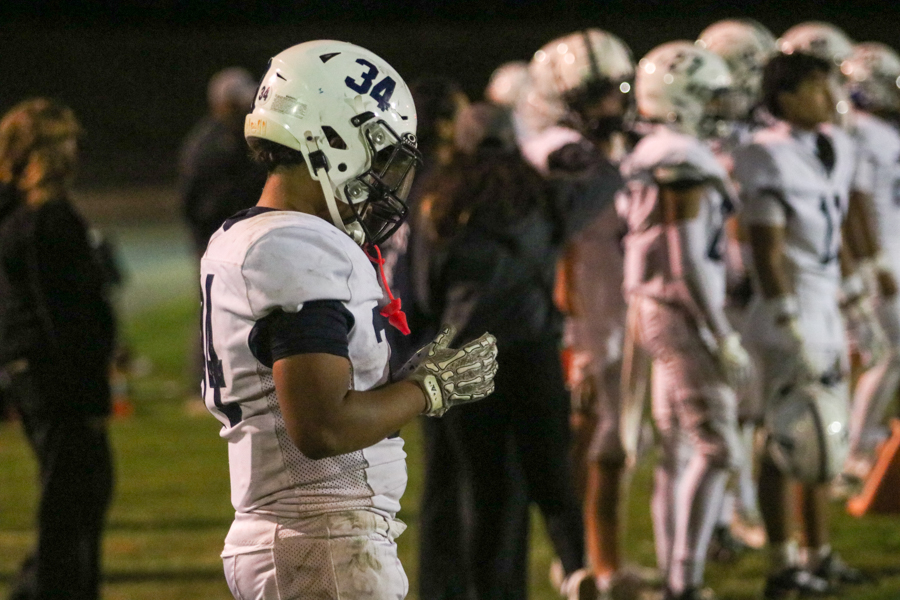
At times, all it takes is one or two lucky plays for a team to catch momentum at the right time.
That wasn’t the case for Aptos on Friday night as it saw numerous opportunities slip away in a 28-13 defeat to King City in nonleague play.
In the second quarter, the Mariners turned the ball over on downs when junior fullback Anthony Najera tripped over his own lineman on a 4th and 1 play, stopping him just short of the line of gain.
Then there was the fumble that resulted in a King City touchdown, while junior quarterback Jared Verdia-Moya tossed an interception that sealed the game for the opposition.
“When you play a good team, you can’t make the mistakes that we made,” Aptos head coach Zach Hewett said. “Ball security is in our control. There’s busted assignments, those are all things that are in our control.”
With the loss, Aptos dropped to a 1-3 overall record this season.
King City kept its unblemished 4-0 record intact, which will now set up a battle of the unbeatens at Monte Vista Christian (4-0) in Watsonville on Sept. 25 at 7:30pm.
The Mustangs of Watsonville have outscored opponents 103-15 in four games played thus far.
“We know they got athletes,” King City head coach Mac Villanueva said. “We know they run a really good defense, so we know we have our hands full. It’s going to be a good game, and it’s over there.”
Villanueva said he enjoys the trek up north on Highway 101 and it’s a beautiful stadium, but it’s been 13 years since King City beat MVC on its own home turf.
MVC has also won the previous four meetings between both teams, including a 37-20 victory on Aug. 25, 2017.
“I love going over there, but we don’t have a good track record of playing over there,” Villanueva said. “So, we got our work cut out for us.”
On Friday night, King City jumped to a 14-0 lead on a pair of touchdowns from senior running back Nathan Vega.
Vega stepped in for senior star running back Carson Tidwell, who was ready to play but Villanueva ruled him out minutes before kickoff.
“We decided, it’s a non-league game, let’s rest [Tidwell],” Villanueva said. “He could have played, and he practiced all week. But we decided let’s hold him out. We felt really good with our defense.”
The Mustangs had no trouble marching down the field with Vega and teammate sophomore RJ Ayon, who had a huge 47-yard run that set up the first TD in the first quarter.
“It’s really a statement piece because I don’t think [Aptos] thought we were that good,” Vega said. “This one really solidifies that we’re a good team and we’re physical, even with or without our star player. We can still handle it.”
Aptos was gifted with a golden opportunity late in the first half when King City’s special teams unit mishandled a punt attempt deep in its own territory.
The Mariners nearly capitalized on the mistake, but a goal-line stand by the Mustang defense prevented any points from going on the scoreboard.
“They came out [of halftime] fired up, and they took that opening drive almost the whole quarter and marched it down,” Villanueva said. “That’s a potential tying touchdown if we don’t have that goal-line stand. So, that was huge.”
During their first scoring drive, the Mariners were slapped with several penalties that made it more difficult to move the ball downfield.
Still, they managed to orchestrate a 14-play, 80-yard drive that was capped off with Najera’s first rushing TD of the night, and cutting the deficit in half at 14-7.
But, that momentum swing was cut short on the ensuing kickoff as King City returned it to Aptos’ 30-yard-line. Three plays later, Vega rushed in for his third score that put them ahead at 21-7.
“There’s only so many times you can do that,” Hewett said. “Where you save yourself, but then you put yourself in jeopardy again, and you save yourself, and you put yourself in jeopardy again.”
Hewett mentioned they were very efficient when the offense was able to execute their assignments. However, there were just too many costly errors in the end that made it challenging to catch up.
Najera finished with more than 100 yards rushing and a pair of touchdowns, including one in the fourth quarter.
“Just mistakes and mistakes, and not finishing drives,” Hewett said. “A little bit unlucky, but that’s why the ball’s not round.”
Next up, Aptos (1-3) hosts Alvarez (1-3) in nonleague play on Homecoming Night on Sept. 25 at 7:30pm.
Hewett will try his best to block out all the headaches and distractions associated with the Homecoming festivities.
He said at the end of the day it comes down to the constant and never-ending process of improving, which starts by looking in the mirror.
“If you’re not a good practicing team, then it’s really hard to come out and perform on game day,” Hewett said. “The ideal scenario is that this is a shock to the system and a wake up call of we’re pretty good, but we’ve got plenty of stuff that needs fixing.”
Monte Vista Christian 36, Alvarez 0: The Mustangs recorded their second shutout of the fall campaign following a crushing victory over the Eagles in nonleague play Thursday night.
MVC remains as one of three schools — King City (4-0) and Harbor (3-0) — in the Pacific Coast Athletic League with a perfect record this season.
Sophomore Gabe Figliomeni finished with a team-best 108 yards rushing and one touchdown on seven carries for the Mustangs, while teammate junior Brandon Hagen had 67 rushing yards and one TD on 13 carries.
Junior Reece Walker put MVC on the scoreboard early with a pair of rushing touchdowns in the first quarter. He finished with 56 rushing yards on eight carries, along with 10 tackles.
Senior quarterback Evan Vessey completed 8 of 14 pass attempts for 147 yards and one touchdown— a 53-yard strike to wide receiver James Tipton that put MVC ahead at 22-0 in the second quarter.
Blaise Borjon had a strong performance on defense with six tackles, one sack and one fumble recovered, while teammate Johnny Finney recorded one interception.
Next up, MVC (4-0) hosts King City (4-0) in nonleague action Sept. 25 at 7:30pm.
St. Francis 13, at Soledad 6: Jacob Fonseca and Frankie Ortiz each recorded touchdowns to help lift the Sharks past the Aztecs in nonleague play Friday evening.
Fonseca had a 2-yard run score that gave St. Francis a 7-0 lead in the second quarter.
Ortiz extended the lead in the fourth quarter on a 15-yard sprint into the end zone. They missed the extra point, which put them ahead at 13-6 with 1:13 remaining in the contest.
But the Shark defense shut down any type of a comeback en route to their second straight win. They improved to a 2-2 overall record this season.
St. Francis senior linebacker Nicky Fantl recorded one interception in the third quarter.
“Defense played lights out and I’m proud of how our guys kept playing the next play,” St. Francis head coach John Ausman said in a text message.
Next up, St. Francis (2-2) hosts Stevenson (2-1) in nonleague play Sept. 26 at 2pm.
Saturday’s games
- Watsonville (1-2) at Stevenson (2-1), 2pm
- Pajaro Valley (2-1) at Santa Cruz (2-1), 6pm
 Aptos High junior Jacob Kissinger, No. 44, makes the tackle during Friday night's nonleague game at King City High. The Mariners fell to the Mustangs, 28-13, dropping them to a 1-3 overall record this fall season. (Juan Reyes/The Pajaronian)
 King City High sophomore RJ Ayon had one rushing touchdown in Friday night's nonleague game against Aptos High. The Mustangs defeated the Mariners, 28-13, to remain undefeated with a 4-0 overall record this fall season. (Juan Reyes/The Pajaronian)
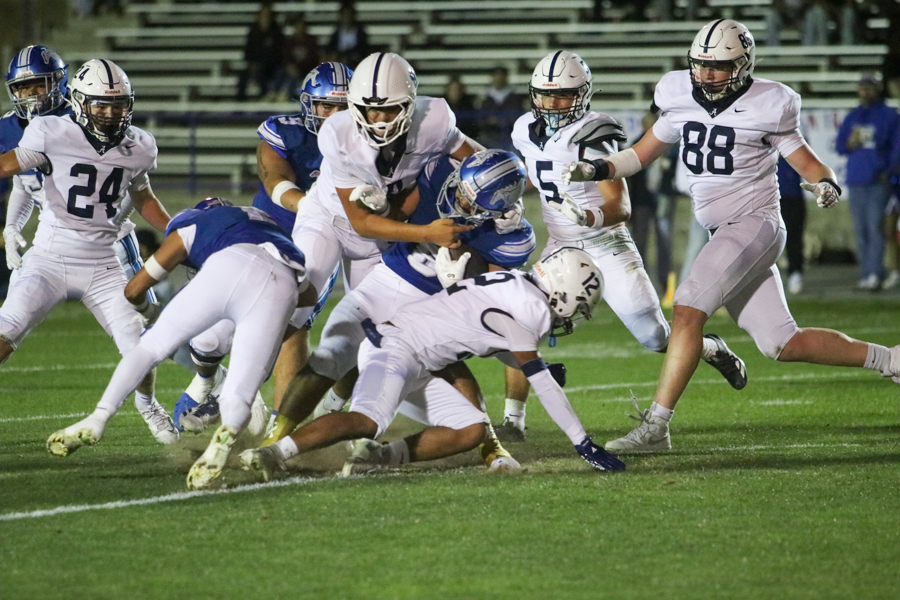 Aptos High's defense gang tackles King City High senior Nathan Vega during Friday night's nonleague game. The Mariners fell to the Mustangs, 28-13, dropping them to a 1-3 overall record this fall season. (Juan Reyes/The Pajaronian)
 Aptos High senior Ben Martin, No. 88, stiff arms a defender during Friday night's nonleague game at King City High. The Mariners fell to the Mustangs, 28-13, dropping them to a 1-3 overall record this fall season. (Juan Reyes/The Pajaronian)
 King City High senior Nathan Vega had three rushing touchdowns in Friday night's nonleague game against Aptos High. The Mustangs defeated the Mariners, 28-13, to remain undefeated with a 4-0 overall record this fall season. (Juan Reyes/The Pajaronian)
 Aptos High junior Johnny Martinez looks for some open space to run through during Friday night's nonleague game at King City High. The Mariners fell to the Mustangs, 28-13, dropping them to a 1-3 overall record this fall season. (Juan Reyes/The Pajaronian)
 Aptos High senior Preston Carvalho looks for an open lane to run through during Friday night's nonleague game at King City High. The Mariners fell to the Mustangs, 28-13, dropping them to a 1-3 overall record this fall season. (Juan Reyes/The Pajaronian)
 Aptos High sophomore Xander Gonzalez stands on the field as the final seconds tick away on the scoreboard during Friday night's nonleague game at King City High. The Mariners fell to the Mustangs, 28-13, dropping them to a 1-3 overall record this fall season. (Juan Reyes/The Pajaronian)
Aptos High junior fullback Anthony Najera stands on the sideline as the final seconds tick away on the scoreboard during Friday night's nonleague game at King City High. The Mariners fell to the Mustangs, 28-13, dropping them to a 1-3 overall record this fall season. (Juan Reyes/The Pajaronian)
Aptos High sophomore Xander Gonzalez stands on the field as the final seconds tick away on the scoreboard during Friday night's nonleague game at King City High. The Mariners fell to the Mustangs, 28-13, dropping them to a 1-3 overall record this fall season. (Juan Reyes/The Pajaronian)
Aptos High junior fullback Anthony Najera stands on the sideline as the final seconds tick away on the scoreboard during Friday night's nonleague game at King City High. The Mariners fell to the Mustangs, 28-13, dropping them to a 1-3 overall record this fall season. (Juan Reyes/The Pajaronian)
What to Know About Trump’s New “Infinite” Greenland Deal
President Donald Trump announced on Friday that the United States has reached an agreement with Denmark and Greenland to give the US “permanent control over security, and all other needs,” in Greenland, which is a semi-autonomous territory of Denmark home to 56,000 people.
“This is an “Infinite Life” Agreement, there is no end!” Trump wrote on Truth Social. “From now on, no U.S. adversary can EVER have a base in Greenland, have a military presence in Greenland, or make sensitive investments in Greenland, without our express written approval.”
The US military already enjoys sweeping access to Greenland under a treaty that dates to the 1950s.
The agreement has not yet been signed, and little is known about it beyond Trump’s social media posts. Denmark and Greenland said on Saturday that any agreement with the United States would not compromise Greenland’s sovereignty. And Trump’s words about expanding American military presence in Greenland may not mean much, considering that the US military already enjoys sweeping access to Greenland under a treaty that dates to the 1950s. Service members are, in fact, the single largest group of Americans currently present in the territory.
Greenland’s prime minister, Jens-Frederik Nielsen, wrote in a post on Facebook that he is pleased with the potential deal. “The agreement recognizes the sovereignty and territorial integrity of our kingdom and the right of the Greenlandic people to self-determination,” he said. That suggests the agreement, whatever its specifics, does not involve fully annexing Greenland as Trump has repeatedly threatened to do in the past.
President Trump started floating the idea to annex Greenland in 2019, and he’s been saying that “the ownership and control of Greenland is an absolute necessity” since at least 2024. His threats against Greenland ramped up in early 2026. He has claimed that Greenland is “surrounded” by Russian and Chinese ships, and has said he wouldn’t rule out military force or economic coercion as strategies to try and take over the territory.
Why is he so dead set on gaining more access to Greenland? Trump has sometimes said that the US must seize Greenland so Russia or China don’t. Other annexation threats have focused less on military dominion, and more on control over the area’s rare earth minerals and oil reserves. Several US companies already mine in Greenland, and 17 days ago, the US-based company Greenland Mines signed a deal purchasing the Sarfartoq Rare Earths Project in southwest Greenland for over $35 million. As my colleague Schuyler Mitchell wrote early this year, “from Venezuela to Cuba to Greenland, this administration is committed to bolstering the financial interests of US companies through imperial aggression. Political control over a foreign nation is less important than making sure Americans can profit there.”
President Trump, despite his ongoing interest in Greenland, sometimes confuses it with Iceland and once said he “hasn’t spoken to” any Greenlanders, thousands of whom protested against his threats in early 2026. Ninety percent of Greenland’s population is Indigenous, and a majority of Greenlanders support independence from Denmark—to say nothing of the United States.
“My immediate reaction [to the deal] is that it makes me nervous and skeptical,” Ellen Frederiksen, a retired teacher in Narsaq, a town in southern Greenland, told the New York Times.
“The way Trump presents it, it sounds as if he is being given a monopoly over Greenland,” she said. “I sincerely hope that isn’t the case.”
FBI at the polls? And another Jan. 6 rioter is up to no good.
Injustice for All is a weekly series about how the Trump administration is trying to weaponize the justice system—and the people who are fighting back. This week, we visit with some old friends, talented types like Lindsey Halligan and John Eastman. Also? FBI Director Kash Patel continues to be one of the dumbest guys in the administration. You might have forgotten all about…
Baaaaaad FBI
A cartoon by Clay Jones. Related | Kash Patel defends FBI’s questionable hiring standards…
 ALT
ALT In Rare Move, Democrats Try to Block a Sale of Bombs to Israel
The top Democrats on the House and Senate foreign affairs committees this week announced their intent to block a $2.8 billion sale of 60,000 one-ton bombs to Israel. It’s an unusual move—and one with limited power beyond the procedural sphere. But it shows that even pro-Israel Democrats are concerned that US-funded weapons are being used to commit war crimes.
Congressman Gregory Meeks (D-N.Y.)—a longtime supporter of Israel, and ranking member of the House Committee on Foreign Affairs—invoked what’s known as an informal committee hold on the bombs sale. This type of hold essentially puts a transaction on pause so that lawmakers have time to acquire more information.
Even pro-Israel Democrats are concerned that US-funded weapons are being used to commit war crimes.
“The Trump administration has not provided sufficient assurances that these weapons will be used by the Netanyahu government in accordance with US law and with appropriate protections for civilians,” he told The Guardian. “I therefore will not clear this sale at this time.”
On the Senate side, Sen. Jeanne Shaheen of New Hampshire has been withholding her consent for the arms sale since July. Shaheen, ranking member of the Senator Foreign Relations Committee, “has unresolved concerns about how the bombs would be used in Syria, Lebanon, and Gaza—as well as to intensify the war with Iran,” as Semafor reported.
This bicameral opposition does not fully kill the sale, because the President can still override the hold.
But it complicates the path for what would be the largest single taxpayer-funded arms transfer to Israel in years, and it showcases the Democratic Party’s increasingly total break from the government of Israeli Prime Minister Benjamin Netanyahu, who is wanted by the International Criminal Court for the crime of genocide in Gaza. At least 73,000 people have been killed in Gaza since October of 2023, according to the Gaza Ministry of Health. In April 2026, a Pew Research Center poll found that 80 percent of Democratic voters held an unfavorable view of Israel, up from 53 percent in 2022.
“Netanyahu needs to hear from America that we don’t like what he’s doing,” Shaheen told CNN. “We don’t like what’s happening in the West Bank where settler violence is killing Palestinians, sending them out of their homes, disrupting basic infrastructure. And the Netanyahu administration has basically done nothing to address that.”
Netanyahu himself, meanwhile, is preparing for a trip to the United States, where he’s scheduled to speak on September 23rd at the United Nations in New York City. The Israeli Prime Minister will face protests upon his arrival. New York Mayor Zohran Mamdani, who threatened to arrest Netanyahu during his campaign, no longer believes he has legal jurisdiction to do so. However, he has said Netanyahu is “not welcome in New York City.”
Google’s Gemini is the latest AI model to hack other companies
These state elections could reshape climate and energy policy
The prospects for state-level climate and energy legislation could hinge on the outcomes of just a few races. By Dan Gearino for Inside Climate News Democrats are poised to achieve trifectas—control of the governor’s office and both legislative chambers—in at least three states in this year’s midterm elections, and maybe even more. This matters because states play an outsize role…
Even mid-sprint to a secret flight, the Navy’s tech chief has a pitch for investors
Vance is unpopular as ever, and Trump holds Kennedy Center hostage
As chaotic as the Trump administration is, there are a few things that always remain consistent: Rising costs due to Trump’s idiotic tariffs and the Iran war, and a Cabinet filled with dunderheads—Vice President JD Vance chief among them. And it’s all on video. JD Vance handles a heckler about as well as you’d expect Vance hit the stump in Kansas for GOP Sen.
Petlibro’s new AI-powered feeder is a game changer for multi-cat homes
AI safety conversations have gotten unbelievable
Agentic security is the billion-dollar challenge for some clever startup to solve
Prices go up in 7 days. Get your Disrupt ticket now.
AI boom could leave an e-waste trail that wraps 6 times around Earth
The anti-Trump wave keeps building
The Conversation is a weekly dive into the most popular stories on Daily Kos and what it tells us about the national political environment. It’s been a brutal post-Labor Day polling landscape for Republicans. Conventional wisdom is that voter sentiment gets locked in during the summer months, but rising gas prices and inflation are fueling deeper discontent as more voters begin tuning…
Vals, backed by Andreessen Horowitz, is looking to become the gold standard for AI benchmarking
In 45 words
A cartoon by David Horsey. Related | Trump keeps failing to crush free speech…
The Trump Dividend Checks Have Already Gone Out. Just Not to You.
Last week, President Donald Trump announced that if Republicans prevail in this year’s midterm elections, he would provide everybody with a $5,000 dividend check. People reacted as if he’d said something crazy, like “Barack Obama was born in Kenya and is ineligible to be president of the United States”—by which I mean they dismissed his ravings as one more Trumpian oddity and not what it really was: the disqualifying lunacy of a corrupt jackass. A few brave souls gently raised concerns that this was tantamount to a bribe. Those who wanted to add something substantive to the conversation pointed out just how much this idea would cause inflation to spike. I don’t recall anyone saying the obvious thing: A $5,000 payoff would be an implicit admission that he and his party’s reckless policies wrecked the economy and spawned a nationwide affordability crisis.
House Speaker Mike Johnson, whose flock of lawmakers would ostensibly be the people who would find this money—more than $1 trillion—and appropriate it, told Kristen Welker in an interview that the so-called “Trump dividend” would be something lawmakers would “process through Congress and talk through and debate and discuss.” That said, nothing is happening anytime soon, because Johnson is sending lawmakers home until the midterm elections so as to avoid having to vote on GOP Representative Thomas Massie’s proposed impeachment of Secretary of “War” Pete Hegseth, who, between psychosexual panic attacks about the masculinity of the soldiers in his presence, is currently getting the belt-to-ass treatment from Iran.
So you might have to wait a while for your $5,000 check. But that doesn’t mean that the Trump dividend hasn’t already been paid out. To the contrary, the president and his congressional enablers have been handing out money left and right. They’ve made people very rich, in fact. It’s something that they’re quite good at doing—at least for a few.
Once upon a time, Trump claimed that shared prosperity would come in the form of tariffs, which he believed would rake in such a large amount of revenue that the income tax could be abolished. This was insane in theory; in practice, Trump’s tariffs only followed the logic of the president’s ire—whatever nation was pissing him off that week would get tariffed. The Supreme Court eventually ruled that most of this nonsense was illegal, not that it diminished Trump’s yen for trade war.
But it’s not all bad news. As ABC News reported last month, the administration has paid out $100 billion in tariff refunds. That ought to excite everyone. After all, the Tax Foundation estimates that the tariffs that the Supreme Court ruled to be illegal cost every household $700, so a reimbursement might be helpful in filling up your gas tank three or four times. But as ABC News notes, “most consumers—who paid higher prices from the tariffs—aren’t seeing that money go back into their pockets.” In some instances, firms have plans to repay some of that money to consumers. But in other cases, that money is being pocketed, with some corporations earmarking the money for “reinvestment” and others putting it toward offsetting the other high costs they face because of Trump’s handling of the economy and the Iran war.
And for small businesses, these mini windfalls have arrived too late. Per ABC, one fortunate recipient of a $50,000 refund says “she was forced to cut staff and use her retirement savings to keep the business afloat” while waiting for her refund pittance. That’s wreckage the check won’t cover. All in all, Trump’s “Liberation Day” mainly liberated money from your pocket. Whether it makes its way back to you or remains in the coffers of corporations is anyone’s guess.
Meanwhile, people seem to be forgetting that Republicans in Congress have already passed a measure that put $5,000 in Americans’ pockets—or to be more precise, $5,190 to Americans earning between $153,600 and $361,400. That law is called the One Big Beautiful Bill Act, which has been one big beautiful means of cementing income inequality across the country. As the Institute on Taxation and Economic Policy reports, the OBBBA “favors the richest taxpayers and provides working-class Americans with relatively small tax cuts that will in many cases be more than offset by the import taxes, or tariffs, imposed by President Trump.” The richest 1 percent got way more than five grand in this deal—their tax savings were in excess of $66,000. At the other end of the spectrum, the poorest 20 percent got a paltry 40 bucks. Don’t spend it all in one place! (Actually, many folks cannot because the same bill ended the Affordable Care Act subsidies they were using to purchase health insurance.)
Republicans’ monomaniacal focus on re-enriching the already rich is doing much more than thieving money from your pocket. Wealth concentration is increasingly locking most of us out of the American dream. As a 2024 study from the Institute for Policy Studies and Popular Democracy found, wealth concentration is “supercharging existing problems of gentrification, homelessness, unaffordable rental housing, and out-of-reach homeownership.” Across the country, predatory billionaires are buying up single-family homes, keeping many of these properties vacant so as to “profit from real estate speculation,” and invading the short-term rental market to play the same tricks, thus keeping units at arm’s length from would-be renters. Trump and GOP lawmakers have enabled all of this through policies that have—as of Tax Day 2026—grown billionaire wealth 30.6 percent.
If you’re like most people, you could use $5,000 right about now. As a recent memo from Americans for Tax Fairness noted, “Working Americans have had to pay more for health care, gas, and food while their paychecks have remained stagnant or fallen while [Trump has] been in office.” Meanwhile, as Republicans wiggle and dodge on the Trump dividend checks, they’re out in public touting the very bill that led to all of this widespread immiseration—and hiding the fact that when the Medicaid work requirements slated to be imposed after the midterms go into effect, an estimated seven million people won’t have health insurance anymore.
Lots of people have gotten the Trump dividend: Trump himself, his family, billionaires, many corporations, even that weird Dick Tracy villain guy who broke the Reflecting Pool. But Trump’s long history of stiffing people should be more than enough to dissuade you from the belief that a check is coming your way if the GOP retains its majorities in Congress. If history is any guide, the Republicans would keep fleecing you. But the Trump dividends will continue to flow, and many people will keep getting richer. As they say, it’s a big club, and you’re not in it.
This article first appeared in Power Mad, a weekly TNR newsletter authored by deputy editor Jason Linkins. Sign up here.