
TechCrunch Mobility: How do we know when an AV is safe enough?
A small but growing number of founders are betting on bringing people together offline
Killing us softly with AI
If Elon Musk’s pedophile/Nazi robot is a sign of what’s to come in the world of artificial intelligence, then it certainly isn’t looking good. And as AI develops more quickly than we can regulate it—that is, if we even do regulate it—the future is looking more and more dicey, fueling the already intense opposition to AI. So before the robots kill us all, let’s have a laugh at some of…
6 days left to get ahead at TechCrunch Disrupt 2026
The musical essence of autumn
This story originally ran Sept. 21, 2025. Black Music Sunday is a weekly series highlighting all things Black music, with over 270 stories covering performers, genres, history, and more, each featuring its own vibrant soundtrack. I hope you’ll find some familiar tunes and perhaps an introduction to something new. Tuesday, the autumnal equinox will occur at 8:05 PM ET, and we here in…
Biden’s monster
A cartoon by Drew Sheneman. Related | Why Republicans care about the national debt—except when they don’t…
Capitola council candidate concerned over indoctrination of children by pro-LGBTQ+ educators, governments
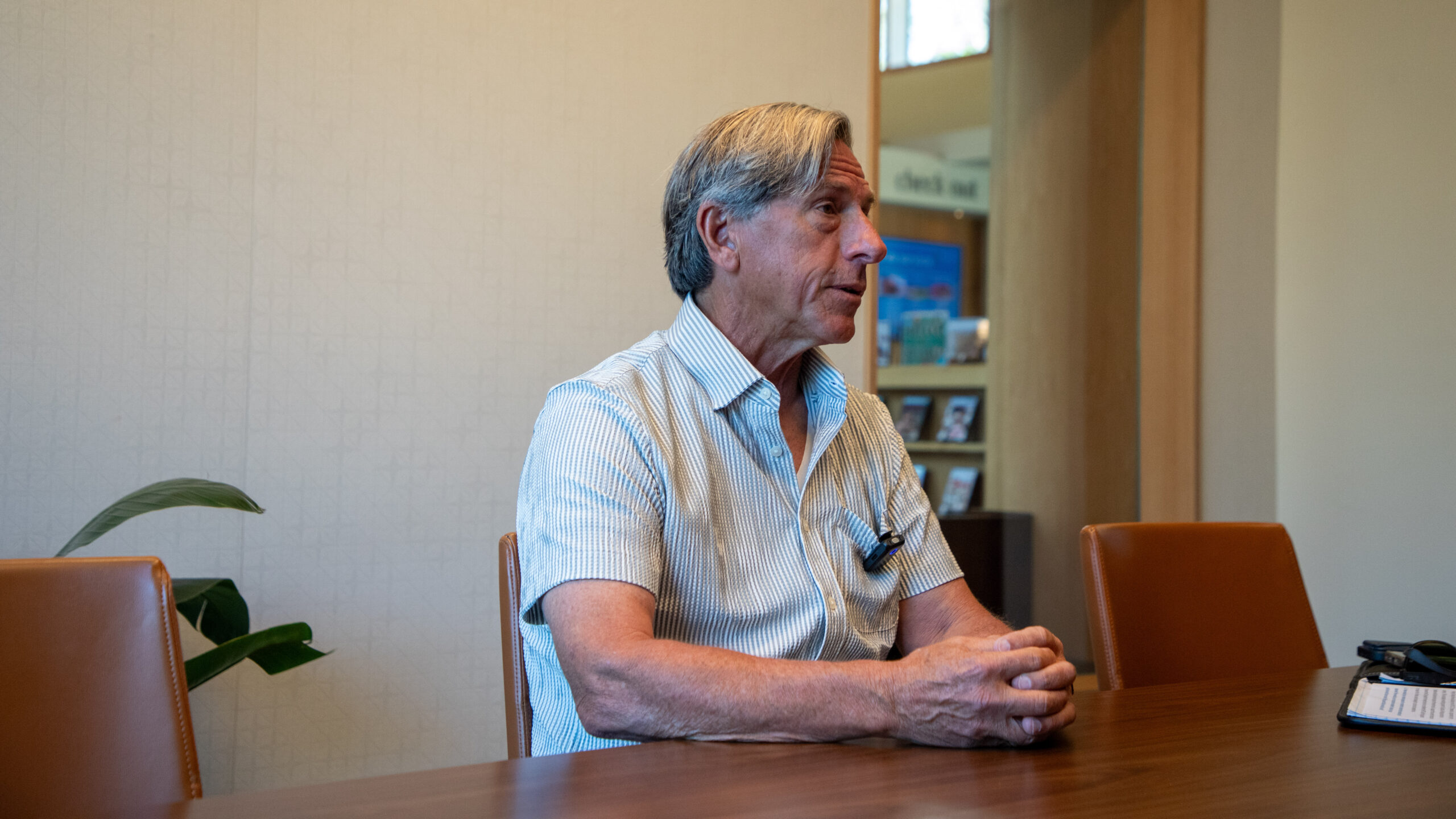
Retired fire battalion chief and Capitola Planning Commissioner TJ Welch is running for Capitola City Council. (Amaya Edwards — Santa Cruz Local/CatchLight Local file)
CAPITOLA >> TJ Welch, a candidate for Capitola City Council, has focused his campaign on preserving Capitola’s eroding coastline, supporting small businesses, and trying to limit outsized housing developments.
His long record of civic involvement includes another concern — the belief that children are vulnerable to indoctrination by pro-LGBTQ+ educators and governments.
In a 2022 letter to Capitola City Council, Welch cited a 1988 study that said most child molesters identified as gay or bisexual. The letter argued that the city’s policy to fly the Pride Flag, and its rejection of his request to fly the Blue Lives Matter Flag, demonstrated a double standard for issues that could be divisive in the community.
Welch said that he stands in support of the LGBTQ+ community, and has no problem with flying the Pride flag — he just believes parents, not schools or governments, should control what their children learn about issues of gender identity or sexuality.
“I think there’s just an overzealous response to push some of these issues that aren’t really issues,” Welch said in an interview with Santa Cruz Local. “I don’t know of any gay person that I know of that feels persecuted.”
One of Welch’s key endorsers said that he has always felt accepted and supported by Welch as a gay man.
But for some, the language of indoctrination evokes a rising cultural and legislative tide against the LGBTQ+ community.
(function() { window.mc4wp = window.mc4wp || { listeners: [], forms: { on: function(evt, cb) { window.mc4wp.listeners.push( { event : evt, callback: cb } ); } } } })(); Stay informed on Santa Cruz County’s biggest issues. Santa Cruz Local’s newsletter breaks down complex local topics and shows residents how to get involved. Email address:mc4wp.forms.on('subscribed', function(form) { // gtag.js if(form.id == '6954') { gtag('event', 'subscribe', {'event_category': 'newsletter_prompt', 'event_label':'top_of_story'}); } }); Leave this field empty if you're human: Welch’s beliefs
In February 2022, Welch requested that the city fly the thin blue line flag during National Police Week in support of the Capitola Police Department. In a March 2022 report, city staff recommended that the request be denied because the flag could create an “us versus them” mentality, and had become associated with white supremacist ideology unrelated to the flag’s original purpose.
Staff recommended that the city instead fly an “In Memoriam Flag” during National Police Week to honor law enforcement officers who have died in the line of duty — a suggestion that the council approved in a meeting March 24, 2022.
In response to the city staff’s recommendation, Welch wrote a letter arguing that the recommendation vote was hypocritical, and that the council had already approved the Pride flag in support of the LGBTQ+ community. Capitola started flying the flag during June to celebrate Pride month in 2021.
His letter intended to highlight the unfairness of the flag policy — not to argue against flying the Pride Flag, or to malign the LGBTQ+ community, he said.
“The gay community, the progressive community, transgender community — I’m very involved with a lot of them,” he told Santa Cruz Local. “I consider them all brothers and sisters, and I love all of them.”
He said that city leaders equating the Blue Lives Matter flag with racism and divisiveness was unfair — especially given their support for a flag celebrating LGBTQ+ individuals. “How do they say that about one flag when [police] are out there protecting us every day, but yet they’re okay with a flag that is based off someone’s choice in life?”
Welch said he is also concerned that children are being indoctrinated in school about LGBTQ+ issues. Issues of sexuality or gender identity should not be discussed in school, he said, and children should not be permitted to dress or act “as another gender” without their parents’ knowledge or consent.
Similar concerns have driven a wave of state legislation and federal executive orders aimed at restricting educators from discussing LGBTQ+ topics or affirming a student’s professed gender identity without parental consent.
In 2021, Welch and other Capitola residents urged the City Council to reject or modify a proposed resolution against book bans. Welch said at the meeting he did not want to ban any one book entirely — but he did want to restrict some books to adults only. Those books included the adult autobiographical graphic novel Gender Queer: A Memoir, a frequently-banned book that he characterized as pornography aimed at children.
“My issue is, the pedophile industry is huge,” he said in an interview. “But obviously, I don’t have an issue with gays.”
Welch said that LGBTQ+ issues have nothing to do with his campaign, and he wouldn’t try to alter the city’s flag policy. “It’s not something I think is an issue of the city council right now,” he said. “Our issue right now is one, getting a new city manager, two, getting a budget.” City Manager Jaime Goldstein has announced that he will retire in December.
A full description of Welch’s platform is forthcoming in Santa Cruz Local’s voter guide.
Rodney Wartzok, the owner of Capitola Candy Co. and wine bar Cocoa Vino, said that he has always felt accepted and supported as a gay man by Welch. During floods and other crises affecting Capitola Village businesses, Welch has been an unfailing “first responder” to fill sandbags, and has advocated for businesses to city leaders, he said. Wartzok said he and his partner have never felt judged by Welch for their sexuality.
“I know he doesn’t have all the same views we do,” Wartzok said, “but he’s never pushed that on us.”
Watzok is concerned, he said, about a statement from an opposing candidate for Capitola City Council, Peter Wilk. In a comment on the social media site Nextdoor in early August, Wilk wrote that he had disagreed with the city flying the Pride flag, “correctly predicting that it would create division in the community.”
In an interview Friday, Wilk said he no longer stands by that statement. He said that while he has always firmly supported the LGBTQ+ community — his daughter is married to a woman — he used to think that the city should concern itself only with local issues. His views have changed, he said.
“Although we’re a small part of government, we nevertheless are part of the bigger picture, and we need to stand up for the things that we believe in,” he said, “not just locally but nationally and at the state level.”
Welch and Wilk are running alongside incumbent City Councilmember Joe Clark, human resources manager Tory Del Favero and business owner Cami Corvin. The five candidates are vying for three seats.
‘That’s just fear’For Scotts Valley City Councilmember Derek Timm, conversations about the potential divisiveness of the Pride flag are familiar. In 2022, Timm successfully advocated for the City Council to approve flying the flag during Pride month. Timm is gay, but pursued the policy, “more because I care about the community, not because I’m part of it,” he said.
Other council members raised concerns that the move would legally force the city to fly any kind of political flag, but Timm’s proposal ultimately gained unanimous support.
While some could see a policy allowing the Pride flag as exclusionary to other groups, “I think the difference in a case like this, is the Pride flag is about building inclusion in your community,” he said.
As to the alleged indoctrination of students with LGBTQ+ beliefs, “that’s just fear, and it’s fear without basis in fact,” Timm said. The rhetoric comes from “people who may not understand someone’s sexual orientation, choosing to think that this is a choice.” he said.
“We’ve seen an uptick in online hate and bullying and fear around this subject,” he said. “I think that’s why it’s even ever more important for us as communities to stand up against fear and hate. That’s what we should do as local electeds.”
Questions or comments? Email info@santacruzlocal.org. Santa Cruz Local is supported by members, major donors, sponsors and grants for the general support of our newsroom. Our news judgments are made independently and not on the basis of donor support. Learn more about Santa Cruz Local and how we are funded.
Learn about membership Santa Cruz Local’s news is free. We believe that high-quality local news is crucial to democracy. We depend on locals like you to make a meaningful contribution so everyone can access our news. Learn about membershipThe post Capitola council candidate concerned over indoctrination of children by pro-LGBTQ+ educators, governments appeared first on Santa Cruz Local.
An Idaho County Banned Wind and Solar Projects. Some Locals Regret It.
This story was originally co-published by Canary Media and the Daily Yonder, and is reproduced here as part of the Climate Desk collaboration.
Jeff Hough did not pull any punches. What his fellow Republican county commissioners were about to do, he said to the packed courthouse, would violate America’s founding ideals. He quoted the Declaration of Independence to make his case.
The three-person commission was about to vote on an ordinance that would ban utility-scale solar and wind development in Bannock County, Idaho.
“We cannot deny the entire county the opportunity to exercise their property rights,” Hough said. “That goes against the principles this country was founded on.”
A few minutes after Hough’s emphatic speech, the ordinance passed by a 2–1 vote. Hough was the lone dissenter.
Since that consequential vote in March 2024, Hough has become the chair of the county commission and has dedicated himself to overturning that ordinance. He will soon have a chance to make that happen. This fall, Hough and the other two commissioners are set to vote on an ordinance with new language that would allow the development of solar and wind, along with nuclear energy, in the county.
The Bannock County vote is a test case of whether—and how—a community can revisit its assumptions about the costs and benefits of clean energy and decide to welcome development it once swore off.
In 2025, nearly one in four US counties had some kind of ban, moratorium, or impediment to clean energy development, up from 15 percent of counties in 2023. More than 60 percent of counties with bans are rural, according to a Daily Yonder and Canary Media analysis of data from USA Today and the Sabin Center for Climate Change Law at Columbia University.
Bucking this national trend and reversing the ban would put Bannock County back in play at a moment when Idaho needs all the energy it can get. Idaho Power, the state’s largest utility, expects electricity demand to grow by 1 gigawatt by 2030, a roughly 26 percent leap from current levels.
“The need to build stuff now is critical to Idaho’s economic future,” said Aaron Menenberg, the Idaho policy manager for Renewable Northwest, a nonprofit working to decarbonize the region’s grid. “We can’t afford to say no to anything.”
Bannock County, nestled in a valley a few hours north of Salt Lake City and 100 miles west of Wyoming’s Teton Range, is a prime location for new power plants. It’s home to the Populus substation, a critical juncture for getting electrons onto the grid and into Idaho, Utah, Wyoming, and the Pacific Northwest. Building new power plants near a substation is cheaper, and those savings can help bring down costs for utility customers.
But the biggest opportunity for county residents, as Hough sees it, is not utility-bill savings: It’s economic development. In recent years, Bannock County’s population has grown far more slowly than Idaho’s. The county’s rural communities, meanwhile, are watching essential services disappear, and drought worsened by climate change is making it difficult for family farms to stay afloat.
Hough believes renewables would bring money into the community. Bannock County’s neighbors offer local proof: In 2024, projects in nearby Power and Bingham counties generated $909,000 and $639,000 in tax revenue, respectively. Hough wants to send a message—to the renewables industry and others—that Bannock County is “open for business,” too.
 County Commissioner Jeff Hough in his office in Pocatello, Idaho.Otto Kitsinger
“Rural America is in a transition state,” Hough said from his office in Pocatello, the county seat, in July. “How do we make or help rural America…transition to this new way of life, so that they can thrive and prosper?”
Not everyone shares Hough’s vision of prosperity. In south Bannock County, Hough’s campaign has met with fierce opposition. Two camps exist: On one side are residents who are willing to lease their own land to solar energy developers or stand by their neighbors’ right to do so. On the other are those who are skeptical of renewables and believe that leasing land to developers is equivalent to selling out—many of them do, however, support nuclear.
Steve Criddle, a third-generation farmer and lifelong resident of south Bannock County, voiced his support for solar in 2024 before the ban passed. He described the situation today simply: “It’s confrontational.”
Bannock County’s moratorium on solar and wind stemmed from an unlikely source: Hough himself.
It was the fall of 2023, and he had just attended a conference of the Idaho Association of Counties in Boise.
At the conference, the Lava Ridge Wind Project, a 1 GW development slated for more than 57,000 acres of federal land in southern Idaho, dominated the conversation. County leaders from around the state were concerned about clean energy developers running roughshod over their communities. (President Donald Trump’s Interior Department canceled Lava Ridge in August 2025.)
The discussion got Hough thinking. Months before the conference, he had learned that several developers, including Chicago-based Hecate Energy and Moab, Utah–based Balanced Rock Power, were approaching landowners about solar projects in Bannock County.
When Hough returned from Boise, the cautionary tale of Lava Ridge fresh in his mind, he took action. “I realized that we didn’t have any kind of ordinance,” Hough said. “So I knew they’d come in and do whatever they wanted.”
On October 12, 2023, spearheaded by Hough, the county commissioners voted unanimously to enact a six-month moratorium on large-scale energy projects. The idea was not to ban solar and wind, but simply to give the county time to regulate the developments and ensure they balanced economic opportunity with responsible land stewardship. A public hearing on the topic was set for the following February, and the commissioners would vote on the future of the moratorium in March.
But Hough’s moratorium took on a life of its own. In the months that followed, a group of concerned residents organized to make it permanent.
Rebecca Falcon led the charge. A decades-long resident of Downey, a town in south Bannock County, Falcon had been approached by Balanced Rock in September 2023 about leasing a portion of her 80 acres for solar. Appalled, she turned the company away. But Balanced Rock’s proposed Harmon Solar Project (aka Harmon I), a 300-megawatt solar facility with a 1,200-megawatt-hour on-site battery energy storage system, included her neighbors’ land. Stopping it would take more than just Falcon saying no.
Falcon and another neighbor, Dez Hauser, who had also turned away Balanced Rock, encouraged other concerned community members to show up to the February 2024 public hearing about the future of the moratorium.
 Rebecca Falcon and her cat, Baby, in her living room in Downey, Idaho.Otto Kitsinger
By the time the hearing rolled around, residents had sorted themselves into two groups: for solar and against it. The meeting attracted such interest that it was moved from the county courthouse to a local high school auditorium in south Bannock County. The venue was still packed.
More than two dozen speakers, nearly all of them from south Bannock County, showed up to say their piece. The vast majority testified in opposition to solar.
The commissioners convened the next month to decide what to do with the moratorium. Hough voted to repeal it. The other two commissioners voted to extend it. The commissioners framed it as an additional pause to study the potential effects of large-scale renewable energy development in the county. Yet as the controversy mounted through the spring and summer of 2024, the county declined to take further action.
The ban stayed in place. Falcon, Hauser, and the other opponents had won.
Dale Lish, a grain farmer based in Downey, was frustrated with the decision. Recently retired from a career at the US Department of Agriculture, Lish became familiar with solar while working on projects in Idaho and Washington through the Rural Energy for America Program. He spoke in favor of the energy source at the same hearing where Falcon and Hauser expressed their concerns.
“The approach was just no to everything, which bothered me,” Lish said of the county’s decision, in a June interview on his property. “A straight-out ban—I don’t think that’s American. I think we, as private-property owners, ought to have a chance to do what we want within reason.”
In 2023, Lish signed a one-year contract with Hecate to option about 400 acres of his land for solar development. Hecate declined to renew the contract in 2024 because of the county’s ordinance.
The company has since pulled out of the county altogether. Representatives from Hecate did not respond to multiple requests for comment.
 A building on the outskirts of Downey, Idaho, a rural community in south Bannock County. Otto Kitsinger
For the two and a half years since that March vote, Hough has been beating the drum of private-property rights while also trying to educate the community on Idaho’s power needs and how they might be met in Bannock County.
While the commission won’t vote until later this fall on the new ordinance, which is still undergoing public review, at least one of Hough’s colleagues may have changed his tune. Ernie Moser, an incumbent who supported the ban in 2024, said in an interview in June that his fears about solar and wind are “not as big” as they were two years ago. Still, Moser, who’s retiring from the commission at the end of this year, stressed that he wants “to do it right” when it comes to revisiting the county’s energy policy. The other commissioner, Ken Bullock, declined to comment.
May’s primary elections offered another indication of the county’s divided views. In the Republican primary, Hough faced a challenger from south Bannock County with an anti-solar platform, and though he won his race by 14 percentage points overall, his opponent captured 70 percent of the vote in Downey. No Democrat is running in the race, so Hough won’t face competition in the November general election.
This year’s results mirror those of 2024, when former county commissioner John Crowder, who voted for the ban in March of that year, won big in Downey but lost to Ken Bullock, an ally of Hough’s. “In south Bannock County, it’s a supermajority of residents that do not want this,” Crowder said about solar development.
Steve Criddle can trace his family’s roots in Downey back to 1876, when his ancestors first filed paperwork for water rights. His grandfather farmed grain, including wheat. Criddle’s father did the same. He’s kept the agricultural heritage alive himself, but because of a changing climate, grain farming is no longer enough to sustain him.
“We don’t get enough moisture anymore,” Criddle said. The fields where he grows crops without irrigation now hardly produce enough to make ends meet. He’s turned some of his land over to cattle grazing and has worked odd jobs over the years to hold on to the farm.
On a sunny day in late June, Criddle drove me down a dirt road in his wife’s pickup truck. We were headed to one of his alfalfa fields. Three years ago, he said, the field produced some 800 bales of hay. This year, it produced only a dozen.
“The drought’s been tough,” Criddle told me. Before last year, he’d never had to buy hay for his cows. This year, he’ll likely have to buy hay again, as more than 87 percent of the county is now experiencing extreme drought conditions after a winter with record-low snowfall.
 Steve Criddle, a lifelong resident and farmer who considered leasing land to Hecate Energy for solar development.Otto Kitsinger
Dale Lish, who also grows crops without irrigation, said that wells in the valley are limited.
“That’s the Achilles’ heel of this area. There’s just a lack of groundwater, and then, of course, sparse rainfall,” he said. To accumulate enough moisture to grow wheat, Lish leaves his fields fallow every other year, allowing the soil to stock up on water.
While Criddle and Lish have fought to hang on to their land over the past six decades, climate change and the loss of small-scale farming have reshaped their community. “You don’t have family farms anymore,” said Criddle’s wife, Keedrin. “The families can’t survive on a farm.”
As neighbors sold their land to corporations or moved out of Downey altogether, the town’s services have struggled to stay open. Over the years, the rural hospital closed, along with the town’s bank, pharmacy, movie theater, grocery store, and farm-equipment shop. Gone too are the dairies and granary.
 The Old Downey Theatre on Main Street in south Bannock County. Downey has seen many services and small businesses close in recent years, and lacks a grocery store and hospital.Otto Kitsinger
So when representatives from Hecate knocked on the Criddles’ door in 2023 proposing a lease for solar development, Steve and Keedrin heard them out. And while the couple didn’t sign a contract, they realized how such a lease could bring them a stable source of income, which they could use to hire help and reinvest in the long-term sustainability of the farm.
The Criddles now have 11 grandchildren, with another one on the way. Steve thinks often about what he’ll leave for the next generations. “I don’t want my kids to have to work this hard,” he said.
Lish, who did sign a contract with Hecate, said the decision didn’t come easily. But, he added, it would have been “kind of irresponsible” to not consider the opportunity. With solar, the per-acre income projections were four to five times higher than with wheat alone, Lish said.
“Lots of people have lots of opinions on what you’re going to do to your ground. I get that, and I can appreciate it. But we love this land too, and we’re not going to do something that’s going to be harmful,” Lish said. “We’re just looking at something that’s going to help us continue on to multiple generations.”
A few years earlier, Lytton Bastian, another farmer in Downey, had found himself contemplating the same questions.
 Lytton Bastian signed a contract in 2021 to lease his “least productive piece of ground” to Balanced Rock Power for a solar development. Otto Kitsinger
Bastian, who was born and raised in Bannock County, is a multigenerational farmer and father of six. He owns over 2,000 acres in the valley. Balanced Rock was interested in 840 of those acres adjacent to the Populus substation, a parcel Bastian currently uses as a gravel pit and as cattle pasture for a month each fall and spring. In 2021, he signed a five-year contract with Balanced Rock that includes modest quarterly payments. If the ban lifts and Balanced Rock installs solar, the payments would increase.
Bastian’s neighbor is Rebecca Falcon. She criticized his decision to lease to Balanced Rock, saying that he sold out to make more money than he could with agriculture.
“My biggest issue is that it’s all ag land,” Falcon said. “They’ll take the grain; they’ll take the hay; they’ll take the cattle; they’ll take it all.”
Bastian said he only went through with the contract because Balanced Rock wanted his “least productive piece of ground.” An irrigated parcel would have been out of the question, he said. “Any normal farmer will not sell out good prime ground, because that’s hard to come by.”
At the February 2024 hearing at the high school, Bastian was among the few local farmers who spoke in favor of solar.
For Bastian, the stakes are getting higher. His contract with Balanced Rock is up at the end of this year. He thinks the renewal hinges on the county overturning the ban. Otherwise, he fears that the company could go the way of Hecate and look elsewhere.
 Lytton Bastian and one of his children in front of the land that he has agreed to lease to Balanced Rock Power for the Harmon Solar Project. Otto Kitsinger
“If the ban is lifted, the short answer is yes, we will move forward with our project,” said Katarina Bagri, a senior manager of development at Balanced Rock who’s leading the Harmon Solar Project, which includes Bastian’s land. “If there’s still a ban, there’s not many options, so we’ll just have to see what are the options left.”
It’s not just individual landowners who stand to miss out if the ban continues. Property tax payments from solar development would also deliver revenue to help the town bring back much-needed local services, like a grocery store. Balanced Rock, anticipating that the ban would be lifted, offered the city of Downey $100,000 in direct payments last fall via a community benefit program.
If Balanced Rock is unable to build, the city will not receive this money. Hough addressed this directly in an op-ed published in the local paper in February. Counties with bans in place, he wrote, “will watch the projects—and the money—go elsewhere.”
Just outside Downey, the northbound portion of Interstate 15 stretches over a pass and opens onto a sprawling valley. Golden fields give way to towering peaks. It’s part of why Falcon, who grew up in Utah, moved to Idaho: The landscape is all mountains and rolling hills. The idea that solar panels could become part of the view is unthinkable.
“I think, my goodness, why do you have to build it where we live?” Falcon said.
Falcon and her husband, Rudy, bought their 80-acre parcel of land in Downey more than three decades ago. That was before the Populus substation was built within view of their house. Now, transmission lines crisscross their land and that of their neighbors.
“It is the ugliest thing on this planet,” Falcon said about the substation. “I wish it wasn’t there.”
 Transmission lines running across the valley in Downey, near Rebecca Falcon’s property.Otto Kitsinger
In the coming years, two new high-voltage transmission lines will join the existing lines running through Populus. They’re part of the yearslong Energy Gateway project being built by PacifiCorp, one of the largest utilities in the West. The goal is to improve the region’s power transportation and reliability as energy demand grows, said Jonathan Whitesides, a spokesperson for Rocky Mountain Power, a division of PacifiCorp that operates in Idaho.
As much as Falcon doesn’t like looking at the substation, she understands the need for transporting power. Rudy works for the Bonneville Power Administration and is often on the road in Washington and Oregon building substations himself. But solar, to Falcon, is a different story. She said that she struggles with the amount of land it requires to produce power, a talking point that’s been popularized by the fossil fuel industry.
She and Hauser, her Downey neighbor, have continued to speak out against solar since the 2024 ban. Hauser is active on community Facebook pages, and Falcon runs an email chain to share information with friends and neighbors. “I wasn’t willing to be quiet about it,” Hauser said.
For years, the women have regularly filed public records requests with Bannock County and the federal government. That’s how they discovered that a month after Bannock County voted to maintain its ban, Balanced Rock applied for federal authorization for a second solar project, called Harmon II. The project, like Harmon I, was slated for 300 MW, and its application outlined solar and battery energy storage development on approximately 1,300 acres of public land administered by the U.S. Bureau of Land Management in Bannock County. Harmon II was proposed on land adjacent to Harmon I, which had stalled because of the county’s ban.
 Rebecca Falcon points out the location of the Harmon Solar Project in Downey on a printed map.Otto Kitsinger
In July, Bagri from Balanced Rock acknowledged that the company had been sitting on the application. “All of our focus is on the private land, [the] initial 300 megawatts. So once we make progress with that, we’ll figure out whether we want to pursue an expansion,” she said. In August, Balanced Rock officially withdrew its application for Harmon II.
Falcon and Hauser saw the second project as evidence of a lack of transparency from the developer.
“The public has a right to know this will change this valley for 50 years,” Falcon said. “We will have left that mess to our children and grandchildren, because who’s going to guarantee who owns it in 50 years to decommission it and clean it up? You can’t make those kinds of guarantees.”
Bagri said the guardrails the county was considering in early 2024—which are now baked into the ordinance the commissioners will vote on this fall—include provisions on decommissioning. The draft ordinance stipulates that in order to get projects permitted, developers must pay into a bond and submit a plan for the removal of all energy infrastructure at the end of the project’s lifetime. Bagri said these plans involve restoring project sites “back to as close to preconstruction condition as possible.” Today, project lifetimes range from 35 to 40 years, she said.
 Rebecca Falcon on her land in Downey, with transmission lines behind her.Otto Kitsinger
Still, for Hauser and Falcon, the feeling of disempowerment persists. Falcon pointed to other counties across the state, including Ada County, home to Boise, that have taken matters into their own hands to “put a limit” on development. In Ada County, solar is now prohibited on prime farmland, as defined by the US Department of Agriculture. In southeast Idaho, some of Bannock County’s neighbors, like Caribou County, have also banned utility-scale solar, though others, such as Power and Bingham counties, have embraced it.
“If you don’t build in the brakes, they will run you over,” Falcon said.
For all their ire toward solar, Falcon and Hauser see promise in nuclear energy. That puts them in the majority: In January, Bannock County surveyed residents to gauge public opinion on nuclear energy. Over 700 people responded, with 90% indicating favorable views toward the industry.
Hough was surprised by the results. “I didn’t think our community could agree on anything,” he said.
Southeast Idaho is home to Idaho National Laboratory, which leads the nation’s advanced nuclear research. As part of the Trump administration’s embrace of nuclear energy, the lab was given priority in May 2025 to expedite construction of on-site microreactor test beds. The Department of Energy announced in July that INL will receive $60 million as part of a public-private partnership to use AI in nuclear energy development and operation. Buzzy nuclear startup Oklo aims to build its first fission reactor there.
Plus, next door in western Wyoming, the Bill Gates–backed TerraPower is building what it hopes will be the country’s first utility-scale advanced nuclear power plant. The project, now under construction in rural Kemmerer, is expected to be completed in 2030 and will supply PacifiCorp with up to 500 MW of power.
The excitement around INL and the TerraPower project leave many in Bannock County wondering when their big opportunity might come along. In July, the Bannock County commissioners hosted a public educational forum with INL to discuss how the county could get involved with small modular reactors (SMRs), microreactors, and nuclear manufacturing.
Falcon and Hauser were both in attendance. They said they’d much rather see the development of nuclear energy in Bannock County than renewables. “If you can have 30 acres with a semitruck-size nuclear plant on it, why wouldn’t you do that? Why would you give up thousands of acres to solar?” Falcon said.
 Solar panels in Power County, Idaho, which has seen substantial tax revenue from clean energy developments.Otto Kitsinger
But the construction of SMRs and the broader nuclear revival touted by Trump remain highly uncertain prospects.
Only two next-generation nuclear projects in the U.S. have received construction permits: TerraPower’s Kemmerer 1 and Kairos Power’s Hermes 2 reactor in Oak Ridge, Tennessee. Neither has an operating license, however.
Even if more projects obtain licenses from the Nuclear Regulatory Commission amid Trump’s push to streamline permitting, the SMR industry is far from a sure thing. Most companies are proposing first-of-a-kind projects rife with engineering and economic unknowns. There’s little to no supply chain for the type of fuel many SMRs are designed to use. The United States’ first fully licensed SMR project was canceled in 2023 over cost concerns. Only two commercial SMRs operate in the world today—one in Russia and one in China.
Dustin Manwaring, a Republican state representative for Pocatello and a land-use and development attorney for Balanced Rock, is an ally of Hough’s. He said the commissioner wants to usher in a future where Bannock County leads Idaho’s burgeoning nuclear industry.
“[It’s] a worthy, noble thing to do,” Manwaring said. “If you take a step away, I don’t know how realistic that is. I love that he’s trying.”
In the near term, Hough recognizes that bringing nuclear power to Bannock County could take years. That’s why he doesn’t want to turn down other types of economic development—like solar and wind—in the meantime. “Everybody’s claiming nuclear is the future, which it is, but nuclear is 10 years away, maybe, so you’ve got to have something to help get you there,” Hough said.
Some clean energy advocates, like Linda Engle with the Portneuf Resource Council, the region’s environmental nonprofit, are optimistic that the support for nuclear energy could help overturn the ban. “With the nuclear piece in there, hopefully it gets passed,” Engle said.
 Linda Engle of the Portneuf Resource Council, an environmental nonprofit advocating to lift Bannock County’s ban on renewables.Otto Kitsinger
For all the community debate, the future of clean energy in Bannock County ultimately rests on the decision of the three commissioners. To Commissioner Moser, who in 2024 voted in favor of the ban, the choice isn’t black-and-white.
Hanging on the walls in Moser’s office are two landscape paintings depicting Idaho’s wilderness. In one, a crisp blue stream is flanked by forest and purple mountain cliffs; in another, two people perch on a log, fishing rods in hand, waiting patiently for a catch. Moser has arranged the paintings, which were created by his now-grown son, so he can see them while sitting at his desk. On another wall, a second pair of paintings depicts the American Revolution. In a snowy forest scene, George Washington kneels beside a horse, praying.
Five days before the Fourth of July, Moser sat in his office, considering the paintings. “I love our country, the freedoms that we enjoy—250 years is amazing,” he said. “God created this for us. I’m a steward now. I’ve been called to take care of it.”
It is this ethos that guides Moser, a south Bannock County native, as he contemplates the county’s new energy ordinance.
 In Pocatello, the county seat, residents are more favorable toward clean energy than those in Bannock County’s rural communities. Otto Kitsinger
Moser’s fears have to do with solar site cleanup and the risks of battery fires. Moser is not alone in these concerns; they are often cited by solar opposition groups, which point to rare but devastating instances of battery fires in California. Such anxieties are also spreading nationwide. In December 2025, the volunteer fire departments in Downey and Lava Hot Springs, another rural community in south Bannock County, sent letters to the county commissioners warning that they were unprepared to fight battery fires and would need special equipment and training to do so.
Bagri said Balanced Rock has tried to ease concerns about decommissioning and fire risk. During the numerous public hearings in 2024, representatives from both Hecate and Balanced Rock responded to the community’s concerns. “They addressed every one of those fears head-on, concisely with facts, and I thought they communicated very well,” said E.J. Zita, a rancher in Robin, Idaho, who’s had residential solar on her property for over a decade. But she said the anti-solar camp had dug in. “People didn’t listen; they just didn’t hear it.”
 E.J. Zita on her property in Robin, Idaho, where she has installed solar to power ranch operations.Otto Kitsinger
Despite his fears, Moser said he understands the weight of his responsibility.
That’s why he’s tried to educate himself about Idaho’s energy needs over the past two years. In 2025, Moser visited a 40-MW solar project in neighboring Power County, a 20-minute drive west from Pocatello. The visit was organized for the Bannock County commissioners by Balanced Rock. The same year, Moser and Hough attended the energy academy hosted by Idaho Power in Boise and had conversations with Rocky Mountain Power. Language in Bannock County’s new draft ordinance requires energy developers to help local fire departments with training and equipment for dealing with battery fires.
In June, Moser said he recognized that there’s a need for growth in Bannock County. He’s not the only one whose opinion has shifted. Wade Egan, the former chair of the county’s volunteer planning and development council, was “neutral” about the ban passing in 2024. Egan grew up next door to Dale Lish in Downey and now farms around 5,000 acres in the area. He has friends on both sides of the issue.
 Wade Egan, former chair of the county’s volunteer planning and development council, at his home near Pocatello.Otto Kitsinger
This time around, though, Egan is pro-solar. Echoing Hough, Egan said he sees it as a matter of property rights. “I really do believe the right to control and own personal property is as fundamental as speech,” he said.
Moser, meanwhile, is focused on getting things right for future generations. Pointing to the landscape paintings in his office, he spoke about the Idaho wilderness that he wants his son, and grandchildren, to enjoy.
“It’s not a personal choice. It’s hard choices,” Moser said. “We wake up at two o’clock in the morning thinking about them, and it isn’t a simple deal.”
470 empty seats make some noise: What’s next for Cabrillo’s original theater?
Apparently, 470 empty seats can make a lot of noise.
When Lookout published the story two weeks ago about Cabrillo College’s long-shuttered theater in Building 200, the question at the heart of it was fairly simple: After sitting dark for 17 years, could the original theater still have a role to play in Santa Cruz County?
We Need to Talk About the Apocalypse
“I thank you, Lord, for regime change in Iran. Yes, Lord, we cry out to you!” Cindy Jacobs’s Texan drawl arcs into an otherworldly howl as she begins to pace across the stage. “We pray for the president that he will not compromise. Father, we cry out, in the name of Jesus, that we will totally annihilate the regime!”
Jacobs does not look like most people’s idea of a prophet. She is a short, well-preserved woman in her seventies with a layered bob haircut and bright red lipstick. But her voice has become a maelstrom, and the hundreds crowded into this auditorium are on their feet and shouting “Yes!” and “Amen!” into the spaces between her words. “Lord, we pray! We push the darkness! The Prince of Persia! And we say that it has to be broken, and that it has to come down, and we thank you, Lord, that it will come down, in the name of Jesus.”
It is July 4, 2026: the second and final day of the Intercessors for America’s Rededicate America conference at Washington, D.C.’s Museum of the Bible. We have learned that the motto of the American Revolution was “no King but King Jesus”; reclaimed a 400-year-old, irrevocable covenant that binds America to Christ for all subsequent generations; and listened as IFA state leaders described doing battle—against the Masonic spirit in Kentucky and witchcraft in Wilkes-Barre. Now, as the conference draws to a close, the chairman of the Apostolic Council of Prophetic Elders is giving us a glimpse into the future.
“And, Lord, we say that Planned Parenthood will be stopped! And the Senate parliamentarian that is causing these snags—I’m going to be bold; this is Cindy praying this—she has got to be gone!” Jacobs continues. “And we say the Democratic Socialists candidates will not win! And so we pray, in Jesus’s name: Amen.”
Jacobs, the IFA, and every keynote speaker at this conference are affiliated with the New Apostolic Reformation, or NAR, an apocalyptic charismatic movement heaven-bent on transforming America into a Christian nation and thereby kicking off the end times. As Christian dominionists, NAR members believe that God wants Christians to control every aspect of society, and they’re taking concrete action to make that happen. Several members of President Donald Trump’s inner circle are affiliated with this group; other members espouse their ideas.
“Their fixation with their own prophecies, and in the way they interpret biblical prophecies, is very influential today,” theologian and religious scholar Matthew D. Taylor told me. “ I wouldn’t necessarily say, ‘Oh, Donald Trump believes in their end-times prophecies,’ but they do, and they are advising Trump.”
Those who study and write about the New Apostolic Reformation and other Christian dominionist movements mention how difficult it is to get anyone to take these movements seriously. How, with everything else going on, are we to find time to worry about self-described apostles and prophets performing miracles and fighting cosmic battles against geographically bound “territorial spirits” like the Prince of Persia, Jezebel, and Baal? Who cares if they believe they’re waging a spiritual battle against a genuinely demonic Democratic Party? That’s just ancient superstition. Demons aren’t real. Let them sing about Jesus in their megachurches and pray for policy change—what difference does it make?
That policy-focused Democrats struggle to imagine a movement more concerned with the Second Coming than with improving material conditions is not surprising. But as beliefs about spiritual warfare and God’s covenant with America worm their way deeper into both our government and our culture, as the Trump administration begins enacting Christian supremacist policy and the Department of Justice gears up to prosecute left-wing groups for “domestic terrorism,” that ignorance becomes downright dangerous.
Christian dominionist movements began decades before Trump was a twinkle in the GOP’s eye and will continue long after his passing. Earlier this year, a survey by the Public Religion Research Institute, or PRRI, found that fully one-third of all Americans partially or completely agree with Christian nationalist beliefs like “The U.S. government should declare America a Christian nation” and “God has called Christians to exercise dominion over all areas of American society.” Two-thirds of all white evangelical Protestants hold these views, as do 54 percent of all Hispanic Protestants. People with these beliefs are twice as likely as their nonsupremacist neighbors to support political violence, and they score far higher on the PRRI right-wing authoritarianism scale.
Scholars and journalists alike extensively documented Christian dominionism’s influence on Trump through his first term, its outsize role in the January 6 insurrection, and its elevation to power within Trump’s second Cabinet. Over the past two years, their warnings have been largely borne out. And, despite deep schisms over aid to Israel and the ongoing war in Iran, the beliefs that unite Christian dominionist factions pose an existential threat to American democracy.
It does not matter whether demonic influence and end-times prophecy are mass delusion or metaphysical reality: If the right people believe hard enough, they might as well be the latter. As the alleged demons in question, we are running out of time to take them seriously. Like it or not, we need to talk about the apocalypse.
In approximately 95 C.E., John of Patmos wrote the Book of Revelation. This, to paraphrase Douglas Adams, has made many people very angry and has been widely regarded as a bad move.
John prophesied the Second Coming, and also that Christ will reign with his faithful for a thousand years. For 2,000 years, Christians have debated which event will happen first—and the order matters more than one might think. Some Christians believe the thousand years is more metaphorical than exact—that we are in the middle of that millennium, no one knows how long it will last, and Christ will get here when he gets here. These are the amillennialists, and we can set them aside for this article.
Other Christians believe that the world will grow increasingly sinful until Jesus Christ’s return, followed by a utopian millennium of Christ’s rule. These are the premillennialists, and if you’re old enough to remember the Left Behind series, it’s the version you’re most familiar with. Premillennialists believe that Jesus will remake the world after the Rapture takes them away from all this: no need to do anything but wait.
The third school of thought, postmillennialism, believes that Christ will return at the end of the thousand years of Christian rule, not before. While premillennialists expect the world to grow steadily worse, postmillennialists anticipate utopia, and many want to do their part to bring it about through traditional evangelism. Starting in the 1960s, some postmillennialists began to take Jesus’s command to “make disciples of all nations” literally and advocate for full theocracy. Doug Wilson, who has served as a spiritual adviser to Pete Hegseth, is this type of postmillennialist—we will talk about him more later.
The New Apostolic Reformation has managed to carve out an improbable fourth position: shrugging its shoulders at the entire exercise. It’s a strategy that movement founder C. Peter Wagner once jokingly described as “panmillennial: believing that everything is going to ‘pan out’ all right in the end.” Whether Christ arrives before or after his thousand-year rule, the NAR believes Christians must bring about the Second Coming by making the world as Christian as possible—and they focus on making disciples of the nations of the world, rather than on individual conversion. “[Jesus] is waiting for us to do our part in bringing restoration to pass in real life. Meanwhile, he is reigning through us,” Wagner wrote in his book, Dominion! Your Role in Bringing Heaven to Earth. “It is our task to become spiritual and social activists until satan’s dominion is ended.”
“They’ve blended, I would argue, the worst elements of premillennialism and postmillennialism together,” Taylor told me: the persecution complex of the Left Behind crowd combined with a postmillennial vision of Christian conquest. “That’s what gives you this kind of chaotic, amorphous style that is obsessed with the end times, but can never quite pin down what they mean by the end times.”
Whatever the end times may be, the NAR believes we are entering into them, which is also why God has begun to once again anoint biblical prophets and apostles. The NAR maintains that its prophets are able to communicate directly with God and receive revelations of his divine plan, while apostles use their networking and leadership skills to put that plan into action. One might expect such a system to result in conflicting prophecy and internecine strife, but this is not the case; apostles and prophets are not supposed to criticize each other publicly, and they rarely break this rule.
“Their authority can’t be challenged or questioned. They answer only to God,” Holly Pivec, an evangelical Christian and an expert on the NAR, told me. “There’s really no way to hold them accountable.”
Pivec has been warning fellow believers about the NAR for over two decades. “It was Christians who really started sounding the alarm about this movement, long before the media ever started reporting it,” she told me. “The concern is that people will lose sight of what Jesus’s message was really about,” she said. “If [Christianity] is all about trying to cast out high-ranking demons, and taking dominion of nations, and apostles rising to the top of societal institutions and taking control—if that’s what people think Christianity is all about, people aren’t going to want to become Christians.”
Yet Pivec also sees the ideology’s political threat as “overblown.” Recent attempts by NAR apostles to win public office have failed, she points out. “Sure, that’s their agenda. But are they actually going to be able to achieve that in a democratic society?”
It’s true that a Christian dominionist takeover would be difficult within this democratic society, so the NAR seeks to change it from the inside out through the Seven Mountain Mandate. “That movement is intent on destroying democracy by taking dominion in these seven institutions: education, family, religion, government, business, media, and entertainment,” Matthew Boedy, professor of rhetoric at the University of North Georgia, writes in his recent book, The Seven Mountain Mandate. Their end goal, he says: “bring[ing] the Kingdom of God to America.”
Individuals affiliated with the NAR and other Christian dominionist sects already occupy top positions within the Trump administration. The most visible of these is Trump’s spiritual adviser, Paula White-Cain, a senior adviser at the White House Faith Office who sits on the Department of Justice’s Religious Liberty Commission. In 2016, she introduced Trump to other movers and shakers within the movement who ultimately delivered the evangelical vote that propelled Trump to victory—81 percent of white evangelicals cast their votes for him. Through White-Cain, the NAR can, and has, gained direct access to the president through both phone calls and in-person meetings. We do not know how often Trump has met with apostles like William “Dutch” Sheets, David Kubal, and John Garlow, but we know he has met with them multiple times during both his first and second term. These apostles had enough pull to score a meeting with White House officials with a single day’s notice on December 29, 2020, days before the January 6 insurrection—more on this later.
White-Cain is just the tip of the NAR iceberg within Trump’s inner circle. Secretary of Homeland Security Markwayne Mullin has a long-standing relationship with City Elders, an Oklahoma NAR-affiliated organization. House Speaker Mike Johnson has robust, well-documented ties to the movement. JD Vance does not, but he spoke at a September 2024 event hosted by Lance Wallnau, the apostle who has been most instrumental in popularizing the Seven Mountain Mandate, and who accused Kamala Harris of “witchcraft.”
The Trump administration also contains many former employees—76 of them in total, as of June 2025—of the America First Policy Institute, or AFPI, which advocates for the Christianization of America, and whose sister organization, America First Works, has partnered with Jim Garlow’s Well Versed, a group that ministers to members of Congress, the United Nations, and the Israeli government ministries, according to AFPI chief government affairs officer Matthew Henderson. Secretary of Agriculture Brooke Rollins was the founding president and CEO of AFPI; others in leadership positions there include White-Cain, Secretary of Education Linda McMahon, and Environmental Protection Agency Administrator Lee Zeldin.
Still other Cabinet members not directly affiliated with the NAR nonetheless share its dominionist agenda. The loudest of these is Hegseth, whose spiritual adviser, Doug Wilson, explicitly advocates for repealing the Nineteenth Amendment. And Baptist News Global, an independent news outlet, found that donor funds the National Christian Foundation, Christian Community Foundation, and the Signatry—which contributed a total of $210 million to organizations that helped write Project 2025—also donate millions to NAR-affiliated groups, including $110,000 to the IFA. Meanwhile, the Center for Progressive Reform estimates that the Trump administration has enacted over half the policy suggestions contained within the Project 2025 initiative.

This powerful coterie of Christian dominionists is using their positions at the summit of government to erode the influence of opposing ideologies across the mountain range in favor of their own, including the mountain of religion itself. Trump’s White House Faith Office is 100 percent Christian, as are a majority of the advisers to Trump’s religious liberty commission. Both the Religious Liberty Commission and the Task Force to Eradicate Anti-Christian Bias have released reports that explicitly undermine the separation of church and state and recommend using federal resources to correct this “misconception.” The Office of Personnel Management issued a memorandum that allows federal workers to proselytize at work, and the IRS has stated it will not revoke tax exempt status from churches that endorse political candidates.
The mountain of family should be restricted to heterosexual nuclear families with plenty of children who all conform to rigid gender norms, and so the administration continues its ongoing efforts to restrict access to mifepristone; has opened investigations into 13 states that require state-regulated insurance plans to cover abortion expenses; slashed Medicaid funding for Planned Parenthood; disqualified any clinic offering abortion services from receiving Title X funding; and moved to limit Title X funding for contraception.
Meantime, Trump’s administration has also erased mention of LGBTQ+ people on federal government websites and public monuments; canceled over $800 million in grants and funding from programs that track and improve LGBTQ+ health outcomes; and shut down the LGBTQ+ option on the youth suicide hotline. But the administration’s most vicious attacks focus on trans people, as it coerces hospitals across the country into shutting down gender-affirming care clinics and prosecutes doctors who provide such care. It has also moved to forcibly detransition incarcerated people on hormones and, despite multiple court rulings, to have incarcerated trans women transferred into male facilities, where they are often subject to sexual violence—especially now that the DOJ has barred inspectors from enforcing standards that protect trans people from sexual violence.
On the education front, there have been the well-documented efforts to curtail academic freedom within universities through both frivolous lawsuits and withholding funding from “woke” institutions. Many schools have chosen to settle or alter their curricula rather than to engage in expensive and drawn-out fights—which means students are learning that the most expedient response to authoritarian overreach is to knuckle under.
Ditto the chilling effect that Trump’s frivolous lawsuits are intended to have on the media. Though he has not won a single court case, Disney and Paramount both settled, as have YouTube, Facebook, and X. The administration has also defunded public broadcasting, eliminated Voice of America, and restricted mainstream media access to both the White House and the Pentagon in favor of right-wing outlets. These actions aren’t just about Trump’s narcissism, Boedy says. “They’re using the levers of government policy and bully pulpit and Department of Justice to do things that the [Seven Mountain] mandate calls for: attacking media, creating parallel Christian media that can replace it, [and] trying to kneecap independent journalists, CNN, and CBS.”
“When it comes to something like the relationship between the U.S. and Israel, I think they’ve been incredibly influential,” Taylor told me. “American bombs are accomplishing in the physical realm what they are also trying to accomplish in the spiritual realm.”
But it is in the realm of foreign policy that the NAR truly becomes the 800-pound gorilla of the Trump administration. “When it comes to something like the relationship between the U.S. and Israel, I think they’ve been incredibly influential,” Taylor told me. “American bombs are accomplishing in the physical realm what they are also trying to accomplish in the spiritual realm.”
The NAR’s support of Israel should not be mistaken for support of Jewish people, or even support for a Jewish homeland. According to the NAR’s interpretation of the Book of Revelation, Israel must exist for Jesus to return, at which point the Jewish people will convert to Christianity and live happily ever after. The NAR is very interested in bringing that prophecy to pass, which is why it both advocates for a one-state solution and actively proselytizes Jewish people. When I called into one of the IFA’s weekly Zoom prayer calls for Israel, it was opened with a virtual Communion. “We recognize that you, Jesus, the final and eternal king of the Jewish people, are the hope of Israel,” IFA Montana leader Brian Friess intoned shortly after. “Come and destroy the deep darkness that has clouded the minds and hearts of the Jewish people.”
The other prayer call leader, Tom McGovern, said he’d recently returned from a summit organized by Christians United for Israel, a group that shares the IFA’s attitude toward proselytizing Jewish people and also enjoys a robust partnership with Israel’s Likud party.
“They want to see Israel victorious,” Taylor explained, “and so they have tended to support a much more aggressive stance from Netanyahu and the far-right government of Israel, including in its domestic policy [on] the war in Gaza or the way it enforces its settlements in the West Bank.”
Part of NAR support for Israel involves opposition to Iran, and the movement’s preference for regime change over a peaceful Middle East and open Strait of Hormuz has proved influential as well. On the IFA Israel prayer call, which took place about a week before Trump’s short-lived Memorandum of Understanding crashed and burned in July, the group prayed for Congress to void the proposed $300 billion reconstruction fund for Iran. “ We pray that any agreements that are made with nefarious intentions or hidden agendas that would cause the United States to abandon Israel or to divide up their land would be revealed and be known,” McGovern said. “We ask you to keep President Trump from being deceived.”
Ultimately, the NAR’s project aims to undermine the secular humanist values at the center of American culture and change the way this country sees itself. “The idea of Christianizing the culture isn’t just about policy,” Boedy told me. “There’s policy, and then there’s this kind of—I don’t want to say vaguer, but more widespread attempt from the government to make the government, and therefore the nation, seem Christian.”
The greatest obstacle facing the dominionists is that, despite being majority Christian, America has never been a “Christian nation.” Our Constitution is a deeply secular document informed primarily by Enlightenment philosophy that makes no reference to any God, Christian or otherwise, which makes efforts to Christianize this nation feel profoundly un-American. To clear this roadblock, the dominionists must change America’s origin story—and they are doing their very best to make that happen.
“Somewhere along the way, God’s dream for America, which is not only to bless us with freedom and liberty and all the blessings that we have, but also to use us to bless the world—to take the gospel to the ends of the earth—somewhere along the way, his part of the dream was lost,” NAR apostle Sheets told the crowd at IFA’s Rededicate America. “God’s dream for America became the American dream.”
Recount, reclaim, rededicate was the IFA’s three-word agenda for the conference—and also for the country. Recounting came to us courtesy of Jim Garlow, former senior pastor of Skyline Church in La Mesa, California, and founder and CEO of Well Versed. His presentation, entitled “American Christianity, 1607 ff.; Recounting our Nation’s Glorious Founding under God,” began with the Reverend Robert Hunt arriving with the Jamestown expedition, then allegedly cutting the mast of one of the expedition’s ships into the shape of a cross and driving it into the ground (the cross story is accurate; the mast detail appears apocryphal). Later, Garlow said, St. Junípero Serra planted a cross in California. (He did not mention that Serra was a Spanish missionary, nor that “later” meant 1782.) The important thing was that “the East Coast and the West Coast had crosses staked into the ground claiming this land for our God, for our Savior: Jesus Christ.” The presentation moved quickly to the establishment of the 13 Colonies by different sects of Christians. This, Garlow said, was what America’s Framers meant by religious pluralism: the freedom to worship any version of Jesus that you want to.
After these initial settlements, Garlow told us, America went through a period of decline. He did not elaborate further. Instead, he skipped forward to the Great Awakening that allegedly saved and forged America.
At this point, the slideshow deck broke. Perhaps it contained more history—disagreements with the British Crown, maybe, or the hard-fought Revolution that followed. Instead, Garlow jumped to the Constitution, which he claimed the Framers modeled on the Book of Exodus—nary a mention of Locke, Montesquieu, or Rousseau. “We are called Judeo-Christian. Why? Because our Founding Fathers saw themselves as tied to the Sinai covenant,” Garlow told us. The theologian wrapped up his lecture with a claim that America’s Framers quoted the Bible in their writings more than any other source, and with an exhortation to pray in the lead-up to the midterms. Thus concluded the history portion of Rededicate America.
After a brief Bible reading, IFA president and CEO Kubal stepped up to the podium for the second agenda item: reclaiming America for Christ. Immediately, the reason for Garlow’s emphasis on the 1608 and 1782 cross plantings became clear. “Rabbis teach that, if land is dedicated to God, it permanently alters that land’s legal status, removing it from a family’s hereditary possession and making it holy to God through a binding agreement. This decision is irrevocable,” Kubal told us. “Covenants made by our early Founders became generational because God’s destiny for our nation is generational.”
The Museum of the Bible auditorium holds fewer than 500 people, and one could be forgiven for refusing to take this relatively small gathering devoted to biblical rules-lawyering seriously. But the IFA conference was not the only event devoted to rededication in Washington this summer. Several weeks before the conference, on May 17, the Trump administration itself sponsored Rededicate 250: a seven-hour prayer revival on the National Mall (shortly before the Reflecting Pool became a slurry of paint chips and algae). The event was not exclusively NAR—dominionists from other sects also spoke, as did a few non-dominionist Protestants, two Roman Catholic priests, and one rabbi—but to those who follow the NAR, the whole thing felt very familiar. “They’ve been doing these big events on the National Mall for more than a quarter-century now,” Taylor told me. “Rededicate 250 was the first time it was official. It was the first time they had government sponsorship.”
I attended Rededicate 250 as well. The event featured the same bizarro history, the same rhetoric, and even one of the same speakers as the IFA conference. “Brothers and sisters, this is a hinge of history moment,” Sheets told us, alongside NAR prophet Lou Engle. “What we do right here could shift America.”
White House faith leader Paula White-Cain echoed Garlow’s claim that the Great Awakening led directly to the American Revolution. Southern Baptist pastor and televangelist Robert Jeffress told the crowd that America’s Framers “would be called Christian nationalists today, and it is a title they would have gladly embraced.” Speaker Mike Johnson’s speech consisted entirely of prayer: “In recent years, we’ve seen sinister ideologies sow confusion and discord among our people. We’ve witnessed attacks on our history, on our heroes, and the cherished moral and spiritual identity of this great nation … but Father, we reject that. We rebuke it in your name,” said Johnson.

America would not need rededication if some malign force had not knocked the nation off course, and you already know what that force is. Back at the IFA’s Rededicate America, Kubal cited the biblical story of Isaac reclaiming the land promised to his father from the villainous Philistines, who had occupied that land and filled in his father’s wells, as proof of his no-takesies-backsies theory of God’s claim on America. “What the Philistines didn’t understand—what the leftists didn’t understand—was that they weren’t just filling a hole, but they were attempting to put an end to the generational blessing put in place by God,” Kubal said. “They weren’t fighting against Isaac; they were fighting against God himself.”
In other words, dominionists do not see liberals and leftists as merely misguided or mistaken, but as enemies in the cosmic struggle between good and evil, God and the devil. “The challenges of our generation,” IFA’s chief program officer Kris Kubal (David’s wife) told the conference, are simply the latest incarnation of the “evil, demonic power” behind Adolf Hitler. “Democratic socialism [is] really just a repackaged way of saying communism, which is a repackaged way of saying demonic influence and control,” she explained. “This is a spiritual war. None of it can happen without intercession.”
And she was not speaking metaphorically. The NAR believes that the world’s afflictions are tied to demonic “territorial spirits” that occupy and corrupt specific geographic regions, and only intercession—spiritual warfare—can defeat and banish these spirits. According to the IFA’s website, intercession involves more than falling to your knees and asking God for help. It is prayer for the sake of someone else and for the kingdom of God, and it cannot be “wimpy”—intercessors do not ask politely or take no for an answer. “You collide with God violently until His will is released on the earth,” the website explains. The NAR believes that God has limited his limitless power so that humans might worship him of their own free will, which also means that he does not act unilaterally to perform miracles. Instead, apostles, prophets, and intercessors enact God’s will by channeling the Holy Spirit through prayer declarations and decrees.
Sometimes, NAR leaders describe liberals and leftists as victims of demonic forces; increasingly, they are seen as active allies of these dark forces. “The left is loaded with demons,” Wallnau declared on an episode of the NAR videocast FlashPoint. “I don’t think it’s people anymore. I think you’re dealing with demons talking through people.”
Dehumanizing rhetoric can potentially be dangerous. “That’s how you get evangelicals to hate people,” Taylor told me. “You tell them there are demons that you’re allowed to hate that are inside those people, and we just need to get rid of the demons, and then those people will all agree with us.”
Some forms of spiritual warfare seem harmless, if a bit silly, at first glance. Because territorial spirits are geographically bound, intercessors must physically travel to where these spirits are in order to do battle with them, which can be as simple as a prayer walk through one’s community, but it scales up rapidly from there. One of the NAR’s more infamous intercessions took place in 1997, when Jacobs and Wagner helped organize “Operation Ice Castle,” an expedition of 26 intercessors to the foot of Mount Everest to do battle with “The Queen of Heaven,” a demonic spirit that prevents unbelievers from finding God. The global fight against territorial spirits continues to this day, both at home and overseas. “They are interceding in Mecca, walking around there in the Kabbalah [sic]. God is going everywhere!” Jacobs declared during her conference speech.
The success of intercession is in the eye of the beholder. “When we prayed during 9/11 that crime went down more than anything,” White-Cain told her congregation in 2020. “It is statistically proven because of the power of prayer that crime across this nation and across the world drastically went down.”
Spiritual warfare can also include prophetic acts. “Just like our words have the power to create reality, they think there’s certain actions you can do … that allegedly release God’s power,” Pivec told me. After making his case for America’s irrevocable covenant with God, David Kubal listed several such actions that could fit Pivec’s description. “We reclaim these covenants every time an official takes an oath of office and they place their hand on the Bible,” he said. “When the Congress opens itself in prayer every day.” Other acts of reclamation include Thanksgiving celebrations and recitations of the Pledge of Allegiance. But spiritual warfare can go well beyond symbolism, especially when it has the power of government behind it. The NAR sees the war in Iran as a form of spiritual warfare against the evil territorial spirits currently ruling that country. “I was on a prayer leaders’ gathering with the White House, and [Sheets] said: ‘I believe that the issue with Iran and the Prince of Persia is the most important thing in the world to be praying,’” prophet Engle said in an August 5 Facebook Reel, before asking intercessors to join him on August 14 “for the war to free Iran from the Prince of Persia.”
The NAR believes that the Prince of Persia is the territorial spirit over Iran, Taylor explained. “They’ll say ‘God wants revival to happen in Iran, but first we have to displace these evil demons.’ They’ll sometimes even speak of the demon of Islam that rules over the region,” he said. The IFA wants the Iran war to continue until these demons are destroyed, a point of view not exactly in line with Trump’s halting and stumbling attempts to negotiate peace.
Spiritual warfare also serves as a marketing strategy that increases engagement and opens the door for larger calls to action in the future. Prayer walks and regular phone calls build community and forge connection. “There’s nothing more precious than battle buddies,” Kris Kubal told the IFA conference. “I’ve never been in the military, OK? But this is as close as I’m going to get—my girlfriends and guys that are fighting for something bigger than ourselves.”
There’s a line between fostering community and fostering radicalization. In his book on the Capitol insurrection, The Violent Take It by Force, Taylor focused on NAR actions in the days following Trump’s election loss in 2020. Apostles mounted “Jericho marches” in swing state capitals, with “ecstatic prayers, words of prophecy, people blowing shofars, and marching around government buildings.” A movement led by White-Cain from inside Trump’s White House launched a series of massive prayer meetings on Zoom dominated by NAR apostles and prophets that blamed demonic forces for the alleged election theft. Sheets embarked on a tour of the swing states at the suggestion of an unnamed White House adviser, where he hosted “prayer meetings” that featured increasingly incendiary language and incitements to violence.
This spiritual warfare did not overturn the election or have any obvious metaphysical effects on the situation. What happened next, however, did. As mentioned earlier, apostles and prophets (including “Dutch” Sheets and his brother, Tim) managed to get a White House meeting on December 29, 2020—days before the insurrection. We cannot know for sure what happened at this meeting, but Taylor’s book quotes a sermon delivered by Tim Sheets the following Sunday. “We had a two-hour time to pray at the White House and make some decrees that God had given us,” he told his congregation. They then traveled to an undisclosed secure location, where “strategy was given to us from people in the know around there that I cannot really talk about.”
On January 6, 2021, Jacobs, Wallnau, and several other apostles and prophets affiliated with the NAR stood outside the Capitol building as “Dutch” Sheets prayed via Zoom for the people fighting their way inside. Taylor examined pictures taken on January 6 and found “dozens and potentially hundreds of Appeal to Heaven flags” within the crowd. This flag, which features a pine tree on a white field and the words AN APPEAL TO HEAVEN embroidered above, was one of many carried during the Revolutionary War. In 2013, Sheets prophesied that the flag would become the “symbol of a campaign to restore America to the Christian nation God intended.” On January 6, people carried Appeal to Heaven flags as they tore down barricades. They used flagpoles with Appeal to Heaven flags to break through police lines. At least one person wore an Appeal to Heaven flag draped over his shoulders as he entered the Capitol. To be sure, the NAR did not instigate the January 6 insurrection, but Taylor’s book makes the case that it played an outsize role. And it all started with Jericho marches and the Dems in league with demons.

Democracy depends on dialogue and persuasion, but there can be no negotiation with pure, hateful evil. So, the dominionists feel justified in discarding any statistic, study, or argument presented by someone left of center: After all, demons lie; they can’t be trusted.
Believing that people with different political views from yours are working with dark forces is, of course, completely incompatible with our current system of government. Democracy depends on dialogue and persuasion, but there can be no negotiation with pure, hateful evil. The dominionists therefore feel justified in discarding any statistic, study, or argument presented by someone left of center: After all, demons lie; they can’t be trusted. Separation of church and state is not a secular point of view they disagree with; rather, it is a malevolent lie from a force that longs only for destruction. Finally, demons cannot possibly win elections without supernatural coercion—so a Democratic win is fraudulent by definition.
Nearly six years after the Capitol insurrection, Christian dominionism no longer needs to break into the building: Some adherents are now inside, and they have spent the last two years preparing to purge their opponents. Shortly after designating antifa a “domestic terrorist organization” last year, the Trump administration issued National Security Presidential Memorandum 7, or NSPM-7, which directs federal law enforcement to target those with “anti-fascist” ideologies likely to engage in domestic terror—ideologies including anti-capitalism, anti-Christianity, and “extremism” on gender. Deputy chief of staff Stephen Miller made it clear in July that the administration plans to use NSPM-7 to go after the scourge of people and organizations that disagree with him. “One of the hallmarks of left-wing violence and terrorism is its completely pretextual and disingenuous appeal to civil liberties in an effort to shield its own violence,” he said. “When the leftist, who does not believe in freedom, who does not believe in civil rights, who does not believe in any ordered notion of justice, protests that we are violating his rights, understand that he is lying.”
The targeting of liberals and leftists is already underway. A shooting at an ICE facility in Alvarado, Texas, led to terrorism charges against what prosecutors described as a “North Texas Antifa Cell” and what was, in actuality, one person who opened fire at a protest and seven unaffiliated people who did not. The seven were found guilty, including one whose only crime was transporting leftist zines; all received sentences of between 30 and 70 years. The DOJ is currently charging 15 anti-ICE protesters in Minneapolis with conspiracy on the grounds that they, too, are affiliated with an antifa terror cell.
In August, The Wall Street Journal revealed that ICE is scraping social media platforms for posts that criticize their mission, then hiring third-party contractors to identify the posters’ personal information. Agents then track these posters down and intimidate them into silence. To summarize: A paramilitary force that abducts people off the streets and indefinitely detains them in concentration camps with no due process or recourse—an agency that, according to the Trump administration, has “absolute immunity”—is compiling lists of dissidents.
When people tell you who they are, and then show you who they are: believe them.
There is a one-panel cartoon from 2021 by @9mmballpoint that I keep in my quick-access folder so I can rapidly use it in my social media responses. A donkey in a button-down and tie with glasses and a clipboard addresses a man in a MAGA hat. “Let’s say we were to reduce the proposed spending for this bill by 15%. Hypothetically, could that be enough to earn your vote?” The MAGA voter replies, “I literally believe you rape babies to death and drink their blood to live forever.” “I see,” the donkey replies. “How about 20%?”
The Democrats have reason to be optimistic heading into the midterms, in large part because disagreements over aid to Israel and war in Iran are tearing the GOP apart. “You’re seeing this emerging, factional, ideological civil war,” Taylor said. “ Trump seems to have really, in the second term, basically thrown in with the kind of NAR faction. But that has stirred up a great deal of resentment as well.”
Yet language that links the Democrats and demons has spread far beyond the NAR—and disillusioned far-right voters are still more apt to look to the right than to the left long-term. “People who care about American democracy, who care about pluralism, who care about the rule of law—they imagine that Trump is increasingly unpopular, and therefore people are going to run to them,” Taylor said. “Democrats are also extremely unpopular. And there are other forces in American politics that people might run to instead—the Tucker Carlson and the America First crowd.”
But this battle goes beyond the midterms and the typical contours of right-left politics. We are light-years beyond politics as usual. The central political struggle of our time is not about policy or direction, but about America’s identity itself. Although our history certainly includes a heavy helping of Christian nationalism and authoritarian violence—the dominionists are not completely misguided when they lay claim to that intellectual heritage—America has been many other things, too. Ours has been a utopian project from the start: the dream of a country in which everyone is equal under the eyes of the law, where everyone can make a good living and live life on their own terms. We have never lived up to that ideal, but we have pursued it for the last 250 years with considerable success. We have a long way to go, but we’ve made tremendous progress from where we started. We must recount that legacy of success, reclaim our country from those working overtime to plunge us into a Christofascist nightmare, and rededicate ourselves to achieving the American dream.
Is artificial intelligence threatening Santa Cruz’s art scene? Could it be a first step in creation?
Have something to say? Lookout welcomes letters to the editor, within our policies, from readers. Guidelines here.
When I read that Lookout would be doing a series featuring Santa Cruz County artists, I was delighted. We are lucky to reside in a community that supports and values the creative work of the people who live here.
The Last Five Years

How Windows turned months of inactivity into a 7-hour update hostage situation
Why Republicans have icon envy
This past week, President Donald Trump shuttered the Kennedy Center because he’s mad that his attempts to put his name on it keep getting shot down. But the whole episode is shining a spotlight on the right’s considerable deficit when it comes to iconic figures—those who left a positive mark on history that garnered significant bipartisan support. The Kennedy Center is a tribute to…
The wedding photo
A cartoon by Clay Bennett. Related | Democrats demand answers on Don Jr.’s ‘wedding gift’ from Russia…

 Berlin Friedrichstraße
We have to talk about the Jon Ossoff thirst edits
“If the girls and the gays want to look at Jon Ossoff and be like, ‘Wow, he looks so good in those pants,’ let us. It benefits him, and we’re all having fun,” said one Democrat. By Grace Panetta for The 19th Sen. Jon Ossoff of Georgia is running one of the most competitive 2026 campaigns as he seeks a second term. He’s emerged as a breakout star communicator and has been floated as…
These Black Los Angeles Residents May Soon Receive Environmental Reparations
This story was originally published by Capital B and is reproduced here as part of the Climate Desk collaboration.
As a child in the 1950s and ’60s, Regina Martin became so used to the oil pumpjacks near her home that she assumed every child lived beside them. Everyone was made “sick to [their] tummy” by the sulfurous, rotten-egg smell that never seemed to leave, she thought.
Only until she was grown did she begin to see a possible connection between growing up on top of the nation’s largest urban oil drilling field and her own sickness and the asthma that affected her sister.
For over a century in Los Angeles and across the nation, Black people have been disproportionately likely to live near oil wells, the machinery that draws oil from deep underground. The pollution from these drilling sites are connected to birth complications, child development issues, respiratory illnesses, and cancer.
Now, a new California state law moves to turn that lived experience into a broader public-policy question: What does a state owe communities exposed to pollution for generations? And what happens when you can’t offer support to every family that has struggled through the harm?
“The company has essentially just been extracting from the community with no investments in the community.”
California lawmakers have passed AB 1661, which would steer $5 million collected from penalized oil wells in Inglewood into direct cash aid for 1,000 nearby households with qualifying respiratory or reproductive health impacts. Some of LA’s Blackest suburbs and city neighborhoods, including Inglewood, Ladera Heights, and Baldwin Hills, surround the oil field.
The legislation, introduced by Assemblymember Isaac G. Bryan, is expected to be signed into law by Gov. Gavin Newsom by October. It sets aside enough money for payments of up to $5,000 for 1,000 impacted households under its initial structure. The money would come from the state’s community repair and reinvestment fund for people living nearest the oil field.
For Black communities living nearest to refineries, highways, landfills, and oil wells, this fund may signal something larger than one oil field or payment. It asks whether money can begin to repair harms accumulated across generations: lives cut short by illness, household wealth drained by medical bills and depressed property values, and the anxiety of raising children amid pollution.
Bryan and other supporters are calling it environmental reparations and say it is a model that could be replicated to make industrial companies help repair the damage borne by people living closest to polluting sites.
To Tianna Shaw-Wakeman, the environmental justice program director with Black Women for Wellness in LA, the law could provide a national organizing model. “My hope has always come at the community level, at the grassroots level,” she said. “I see how grassroots organizing has created long-term change in our local communities, and I see that that can be and is being replicated all over the country.”
For Bryan, who represents the communities surrounding the Inglewood Oil Field, the cash-assistance program is part of a longer fight over the field’s legacy. Bryan, the first Black legislator to chair the California Assembly’s Natural Resources Committee, said his constituents have faced lower life expectancies and higher rates of asthma and heart conditions for decades.
“The company has essentially just been extracting from the community with no investments in the community, no care in the community and what feels like no regard at times for the broader community,” Bryan told Capital B. “The community [is] due this repair, and it’s been long overdue.”
The measure builds on Bryan’s earlier legislation, AB 2716, which Newsom signed in 2024. That law requires the Inglewood Oil Field to close by 2030 and establish a penalty structure for low-producing wells. Low-producing wells can leak methane and other harmful gases into the air and water. To push operators to curb that pollution and clean up their sites, regulators imposed a penalty on companies that keep such wells operating. Bryan said operators are charged $10,000 per well each month, with the revenue directed into a community repair fund restricted to investments within 2.5 miles of the field.
The fund could eventually support affordable housing, urban greening, park infrastructure, and other community priorities, Bryan said. He described the cash program as a pilot that could help determine whether direct payments are the form of repair residents most want. “We know people are struggling,” he said. “We know one of the biggest tools against an increasingly unaffordable society is to just put more money in people’s pockets.”
As communities nationwide press for stronger environmental protections, California’s experiment could test whether government and industry are willing to move beyond preventing future harm and toward compensating people who have already lived with its costs.
“Community members who have been deeply impacted, whose health have been deeply impacted, have never gotten restitution for that in any sort of way. We deserve more than we have been getting,” Shaw-Wakeman said. “And as we transition our city, as we transition our county, part of that story has to be addressing past harms.”
At the same time, California has passed a law that would shield reparation payments from taxation. “California is actively preparing for the implementation of reparations programs,” said state Assemblymember Tina McKinnor, who introduced the legislation. “We must ensure that recipients receive the full benefit of these efforts.”
“We can’t replace toxic oil extraction with gentrification…There is still a lot more to address beyond those 1,000 households.”
Three dozen community groups came together in support of the environmental reparations legislation. There were no groups in public opposition.
The legislation would not close the oil field or resolve the long-running fight over drilling in Los Angeles County.
Under the proposal, eligible households within 2.5 miles of the field could seek aid if a resident has experienced respiratory or reproductive health impacts. But the program’s practical reach will depend on how Los Angeles County designs the application process, what documentation it requires, and how it handles demand if more than 1,000 households apply. There are tens of thousands more households in proximity to the oil field.
Bryan said Los Angeles County was still working through how the assistance would be delivered. It could come as a lump-sum payment, monthly payments, or another structure, he said, and county officials were evaluating which approach would best serve families.
Shaw-Wakeman said Black Women for Wellness and its allies pushed for a process that does not force residents to clear burdensome or invasive hurdles to prove harm. The organization has urged officials to consider self-attestation rather than requiring applicants to produce medical records that may be difficult or costly to obtain.
That question of access may determine whether the fund actually proves relief or is another government program that excludes the people it was intended to help. Many families, particularly low-income ones, may be living with these illnesses without formal diagnoses.
The program also lands amid a larger debate over what should happen to urban oil sites once production ends. Environmental justice advocates have argued that closing wells is only the first step. They want operators held responsible for plugging wells, cleaning contaminated land, and ensuring that redevelopment does not displace the same neighbors who lived with the pollution.
As oil wells have closed in Los Angeles in recent years, rental prices and home values have risen, threatening to displace longtime Black residents.
“We can’t replace toxic oil extraction with gentrification,” Shaw-Wakeman said. “There is still a lot more to address beyond those 1,000 households. We’re trying to address the ways in which community members are still being harmed every day.”