
The Fight to Save the Census From Trump Starts Now
On September 10, in a continuation of what is now a nearly decade-long war on the national head count, the Trump administration proposed unprecedented changes to the 2030 U.S. census. Among the most important of these is a new rule that violates the Fourteenth Amendment’s command that the census count “the whole number of persons in each state” by effectively replacing the word “persons” with “citizens.”
The Trump administration defends this change with a mix of bad legal history and a convoluted argument about its need to “distinguish between foreign citizens in the United States who are counted for apportionment and those who are not counted for apportionment.” But its real goal is simpler: to build districts “advantageous to Republicans and non-Hispanic whites,” as the late Republican mapmaker Thomas Hofeller put it, which a citizens-only count would do.
Indeed, armed with census tabulations that exclude large numbers of U.S. residents, states with large immigrant populations could adopt legislative maps that significantly entrench Republicans’ power. And introducing a question about citizenship status, especially in the context of the Trump administration’s aggressive immigration enforcement policy, could deter participation in the census, even among naturalized citizens.
As other census experts have pointed out, Congress is currently abdicating its constitutional responsibility to protect the integrity of the census. If new congressional leadership is sworn in next year, that could change. But the critical task of defending the census does not belong to Congress alone. As I document in my book, Counting Like a State, states, cities, counties, tribes, and nongovernmental organizations played a central role in defending the 2020 census from the Trump administration’s assault. This time, they may have an even more important role to play.
It is already time to renew this fight. Most immediately, state and local officials must head to the courtroom—much as they did in 2020. As my book shows, coordination among state attorneys general, cities, and nonprofits played a significant role in beating back the Trump administration’s attempt to add a citizenship question to the 2020 census. These coalitions also used litigation to slow down the administration’s bid to exclude noncitizens from the tabulations used in reapportioning seats in Congress and the Electoral College.
The administration’s new rule invites similar legal challenges. It flies in the face of plain constitutional and statutory text, and rests on a frankly bizarre reading of the words “usual residence.”
The public comment period on the proposed rule, which is open until October 13, will give state and local officials their first opportunity to document the rule’s legal flaws. This period is also the time to show the potential consequences of the rule for state representation in Congress and the Electoral College, legislative maps at every level of government, and allocations of trillions in federal and state dollars.
Winning in court, however, is not the same thing as protecting the count. Even if, in the best-case scenario, state and local officials succeed in challenging the new rules—and even if a subsequent Congress or presidential administration reverses these rules—the Trump administration will have already accomplished its quiet work to eradicate trust in the census. Every signal that the census might be used to identify and detain U.S. residents teaches a lesson that it is safer not to respond to the census. That chilling effect will likely spread far beyond noncitizens, jeopardizing resources and representation for communities across the country, effects that could be locked in until 2040.
The second front for state and local officials, then, is investing in trusted, local outreach. Beyond mundane tasks like making and checking address lists, in 2020 state and local officials funded and coordinated outreach in hard-to-count communities. In doing so, they counteracted the fear spread by the Trump administration’s efforts to install a citizenship item on the 2020 questionnaire. Amid a climate of disinformation and the chaos of the Covid pandemic, these networks of officials and community partners were vital to boosting census participation and safeguarding its integrity.
Nevertheless, state and local investments in the 2020 census were uneven. Many states at risk for significant undercounts—including Texas and Florida—did not invest in census outreach. States and cities with severe resource disparities also struggled to invest in the census.
State and local officials need to take stock of the tremendous challenges that the Trump administration is creating for the 2030 count, even if its recent policy proposals are blocked. Hopeful signs are emerging in the states: Arkansas has already created its 2030 complete count committee. The Massachusetts Senate has convened a standing committee on census operations. New York and New Jersey are weighing bills to fund state census offices, and philanthropic funders are organizing to seed state coalitions before the Census Bureau’s own preparations, which lag their 2020 pace, catch up. But given the scale of the Trump administration’s attack on the 2030 count, the time to redouble these investments is now.
The lesson of the last decade is that Washington alone will not save the census. State and local officials should file comments and join lawsuits. But they must also fund outreach, stand up complete count committees, and start now. Litigation may stop this rule. Only states and cities, working with the organizations their residents trust, can make sure the count survives it.
Transcript: Are Dems Still A “Professional Class” Party?
This is a lightly edited transcript of the May 1 edition of Right Now With Perry Bacon. You can watch the video here or by following this show on YouTube or Substack.
Perry Bacon: I’m Perry Bacon, and I’m the host of Right Now on The New Republic. I’m joined by Lily Geismer. She’s a historian at Claremont McKenna College, and she’s written a few books that have been very influential on my thinking, and a lot of other people’s thinking, about the Democratic Party. There’s one about the Boston suburbs. There’s one about the Clinton administration and kind of neoliberalism. The title of it is Left Behind: The Democrats’ Failed Attempt to Solve Inequality. She has a recent anthology called Master in Drift: Professional Liberals Since the 1960s. So Lily, thanks for joining me. Welcome.
Lily Geismer: Oh, thanks so much for inviting me on.
Bacon: And so what I want to talk about is, you’ve had what I would say is—I don’t know if it’s an analysis or a critique. There’s a through line about how you talk about the Democratic Party. So explain to people this sort of professional-classization of it. Give people your general sense of where liberalism and the Democratic Party have gone since the 1960s.
Geismer: Yeah. So one of the kind of through lines or focuses of my research has been the class-based transformation of the Democratic Party, in terms of the composition of its base, moving away from union members in the Northeast to professional knowledge workers in the suburbs. And so that was the focus of my first book, and what that did to the priorities of the party.
I’ve then increasingly looked at professional classes as the leaders of the party. So how this group of people who were professionals, who went to Ivy League schools, who often are trained in professional schools, like law and various other arenas, became the leaders of the party, and what that has done to its policy priorities. And so that was one of the focuses of the last two books that you have brought up. And just what that shift has meant for priorities, but then also who’s been left behind from it.
And I think then another big question is how that focus has created a lot of animosity, actually, among voters on both the left and the right.
Bacon: Define professional class. I assume you mean college graduates, but when I read the books, I think it probably also means—you mentioned Ivy League in the middle here. So talk about professional class. I don’t want to broaden it too much, so what are you talking about when you say professional class?
Geismer: Yeah. So when I use it—there’s been this interesting question beginning in the 1970s. I can really bore you on this if you want me to go on. But there was a big question of this new class of people that had come to the forefront, who were college educated is another way of thinking about it. Often actually gone to graduate school, so even beyond just a basic college education. And how to define them.
And the famous version of this is what is now used as shorthand, the PMC, which came out of Barbara and John Ehrenreich. They had an article, and they used the idea of the professional-managerial class, this group of people who weren’t the full kind of capitalist leaders, like the millionaire, billionaire class, but they weren’t really part of the working class either. So how to characterize them. And one of the core ideas about this group is that they used their knowledge. They were in knowledge-based professions.
So I looked at it in my first book, primarily people who worked in law or academia, but also a lot of engineers, like the tech industry figures—not the Elon Musk or Jeff Bezos, but the actual engineers. So that’s a version of the professional class. And then oftentimes it’s very Ivy League educated, very committed to ideas of meritocracy. And also an idea that this works for them, so this should be reproduced by other people. So that’s who I’m thinking of.
And I think, in shorthand for the Democratic Party, you can see the leadership increasingly really taking hold in this group of people who were known first as the Watergate Babies, then as the Atari Democrats, but their embodiment is really in people like Bill Clinton. And then I actually think even more so Obama. To me, the ultimate professional class figures are Obama and the figures around him in the Obama administration. So a lot of their politics emerge from that.
And a lot of it is ideas of using rationality. So faith in meritocracy is a huge part of this. For the Clintons in particular, I looked at their uses of market-based solutions, so that you’d use the market. You can see that with Obama too. And then also things like really using tech-based ideas and data-driven solutions. I always think of this as a really powerful one. It came from somebody else, but my co-author Brett Siebel and I found that Obama used the word smart to describe his own policies 900 times.
So it’s like, what we’re doing is smart. My favorite of all of them is that there was a program for school snacks called, like, Smart Snacks or something. I looked if it was sponsored by Smartfood, which it was not. But they’re obsessed with this idea of using intelligence, and that will create the best kinds of policies.
Bacon: OK, so, professional class: Perry Bacon, graduate of Yale, writer at The New Republic; Lily, graduate of Brown. We’re in this ourselves. Does this—
Geismer: Oh, 1,000 percent. I think that’s actually one of the things. I always joke that my kids ask me, and I think I got to, like, the 24th grade or something. If you think about how much education—but yes. And I think actually that’s been an issue, going back even to the 1970s, when they were trying to figure this out. Most journalists and academics are part of this group, and so it’s an interesting phenomenon.
That’s actually its own question, that those jobs in the 1980s and ‘90s were far more secure jobs than they are today. And so that’s actually an interesting question of the class-based group. But yes, I’ve been obsessively interrogating my own class position, I think. It’s complicated.
Bacon: I think you’re describing the politics of this class, right? We’ll come into your politics in a bit. But the politics of this class as a group—Barack Obama, Bill Clinton, maybe you’d say Jake Sullivan at the staffer level.
These people have a lot of degrees from the fanciest schools, and their politics are this technocratic—you use smart. They would say themselves they’re non-ideological, or they’d say their ideology is what works, in a certain sense, right?
Geismer: Yes. And I would say actually, Clinton was slightly more ideological in his orientation. He had a kind of set of beliefs. I think for Obama, the ideology was pragmatism. That’s how they describe themselves, that this is deeply pragmatic. That’s what we’re doing. We’re finding the best solutions. We’re finding the tweaks. We’re finding the ways around it.
And so one of the things I’ve looked at, at the policy level, is the ways in which it’s led to these very incremental sets of changes and small-bore policies, away from the Democratic Party and liberalism’s commitment to a more redistributive approach to politics.
And the other side of it, actually, is a real narrowing of government. There’s been all this attention to DOGE as what has hollowed out government. But I actually think much of this comes from having 50 years of Democrats saying—it’s a bipartisan effort—that government is inefficient. The famous Clinton line, “The era of big government is over.”
You try to make government as small as possible and look to the private sector to do a lot of the work of what government once did. So that’s part of their politics, and that feeds an idea of technocratic—this is the best approach, we’re doing the best thing, we’re being the most efficient.
Bacon: So the professional class leading a sort of—I’m going to avoid that word for now, neoliberalism. But the professional class leading this kind of technocratic pragmatism. The contrast is with the New Deal, led by unions. Is that the contrast, implicitly?
Geismer: Yeah. The New Deal, Great Society—you can get into the nuances, because those were also technocratic in their own way. But yeah, so you have a big social welfare state, and your policies are redistributive. These are policies that are much more focused on a small approach.
And I think one of the things that I’ve looked at is that there are actually policies that have benefited, or stand to benefit, certain other aspects of the professional class. Especially economic policies that are much more weighted towards certain sectors, like tech, finance, and trade, and those can lead the economy in various different ways.
Bacon: I want to distinguish. There’s a whole literature, particularly after 2024, about the downfall of the Democratic Party, and I don’t think you’re doing exactly the same thing as that group.
So you’re saying college graduates have more power in the Democratic Party than in the 1940s. I think that’s true. Talk about the sort of, the wokesters have killed the Democratic Party. How do you view that?
Geismer: There’s a couple of different things going on with that kind of approach. My first book was about the ‘60s and ‘70s, and that was a period where you saw a really vibrant left. In my second book, I looked at the ‘80s and ‘90s, and one thing that was interesting is you have a real silencing of the left during that moment, the left critiquing the center, so there’s no real tension. That has reemerged.
But I think one thing that’s fascinating about this group—and I’ll use Clinton as the example—was combining that with a politics—it was a somewhat distinctive moment—of a belief in broad affirmative action. So on the question of racial equity or racial equality, if that’s wokeism, and LGBTQ rights, tolerance and things like that. But then there’s the question of who you’re actually trying to appeal to.
So the other piece of the Democrats during this period, and the particular group that I look at, is that they believed the party had become too beholden to special interest groups, primarily to labor, but also to people of color, and also made a calculation. And if I’m getting too inside baseball, I can go back.
Bacon: Let me ask the question differently. So there’s a group of people whose critique is that there are too many college graduates having too much power, and their critique is also that the Democratic Party is too left, and they want to move it to the center on economics and on race.
And I think you’re saying the Democratic Party is controlled by college graduates, but you’re not calling for moving to the right. And I think that’s an important distinction—
Geismer: No, totally.
Bacon: —between the sort of Matt Yglesias crowd and you. That’s what I’m trying to get at here. Go ahead.
Geismer: Yeah. When you think about it, if we’re parsing it out, there are different types of college-educated people. So I think the Matt Yglesias argument is, all the people like me have too much power. That like all the history professors, the American studies professors, journalists all somehow found our place and were able to ram this through. I think that’s the shorthand of that argument.
What I’m saying is—and this is another thing that I find really interesting—the Democratic Party itself has moved much more to college-educated people as its base, but that in and of itself has a lot of different variations of who that category actually entails.
So the group that I’ve looked at, this question of who’s historically had power: they saw the future of the party in moderate, college-educated suburbanites. And really, at that point in the ‘80s, they said, we have to move away from—I use the shorthand that this is when Jesse Jackson had his moment, but that’s not the future of the Democratic Party.
The Democratic Party lies with these college-educated voters, who are more centrist leaning. Our message should be, we can say we support racial equality, but we’re not doing anything beyond that.
And I think what you saw happen in the last decade has been a pushback from certain groups against those kinds of ideals. But that’s not saying we have moved to woke and that’s the problem. Actually, in so many ways, it’s the opposite—that we actually have not stood for these values for generations.
Bacon: OK, so you’ve talked about Clinton. I think everyone agrees Clinton embodies a certain kind of—I’m going to use the word neoliberalism now. Obama: meritocratic, pragmatic. OK, but was Biden—because Biden gave some speeches where he didn’t quite say, I’m done with neoliberalism, but his speeches implied we are trying to do something different.
So was Biden a break with this, or a continuation, or something in between?
Geismer: I think a combination, actually, which is really interesting. It’s fascinating to me what Biden himself believed.
Bacon: I’m not sure if he knows either.
Geismer: No, I don’t think he knows. But I actually think what he knows is that he believes he’s a Democrat. And he wanted to be a vessel for what the Democratic Party’s politics were in that moment. And so I think he did see this idea that this veneration of the market, and the various different approaches that come out of it, and the kind of techno-utopianism that you see under the Obama years—that was not what people were responding to. And because there had been a quite contentious primary, where you had these different visions out on the table, he actually seemed to embody and imbibe a lot of those kinds of things.
And then bringing in the more progressive or left side of the party, Bernie Sanders and Elizabeth Warren, actually getting their counsel on who his advisers should be. I think because they had a say over that, it actually did lead to a certain kind of moving away from the overtly neoliberal policies. I think you’re right in saying—Jake Sullivan still had a huge amount of power. So it’s not like it was entirely—I think you still see a lot of continuation. But I think in terms of some of those top lines, this is not actually our approach.
Bacon: So the reason I wanted to talk to you is, in part, because it feels like we’re in a moment of debate about these visions and about where things are. So I’m going to go through different groups of the Democratic Party.
So if you say from 1980 to 2016—I hate “neoliberalism,” but we’ll call it that for now. So how do you see Hakeem Jeffries and Chuck Schumer? Are they continuations? Are they changes? How do you see them?
Geismer: I find them fascinating, actually. I think there are continuations in certain things. I don’t think that they were ideologically committed to neoliberal policies in the same way as the Clinton-era people. My theory is they want power and they want to maintain power in some meaningful way. That’s what it seems to be.
But the idea is that how you maintain power is by this kind of message of certain kinds of continuity, and this has worked for a really long time. This is what the party and the country need, and so we need to keep that going. That’s my understanding. Schumer, probably a little bit more than Hakeem Jeffries, seems to be actually committed to Wall Street and its perpetuation, and finding policies that will pursue that. But I think that seems to be their major focus.
Bacon: In other words, they’re less pragmatic—they’re less smart, in Obama’s words, or neoliberal—and they’re probably just more status quo. Is that sort of what you’re hinting at?
Geismer: Yes. I think they’re like, the status quo has worked, we need to keep the status quo going. Both in terms of politics—this is how you win elections. And there’s been so much pushback to Schumer’s famous comment in 2016 that as many working-class voters as we will lose in western Pennsylvania, we’ll just pick them up in the suburbs of Philadelphia.
But they have not seemed to change that as their approach. It wasn’t like there was a lesson there. And so I think that’s the continuation. Another thing that’s interesting about that group is that they come out of Congress, so they think about things in terms of how you create coalitions in Congress.
But I think their policies too are such that we continue the status quo. We are broadly committed to ideas of government, and the Democratic Party should be there to help people, but in its broadest strokes.
Bacon: So they’re still doing professional class liberalism, on some level.
Geismer: Yeah, I think they’re still part of it. And both of them represent New York, which is the epicenter of this, so they have to respond to their constituents too.
Bacon: Now, how the two leaders of the Democratic Party end up being from New York might reflect what you’re getting at, right?
Geismer: Absolutely.
Bacon: OK. So talk about AOC, Bernie Sanders, and Zohran Mamdani. They’re all different people, but I do feel like the Fighting Oligarchy tour and the Zohran campaign, and now Abdul El-Sayed—I think we’re all talking about the same drift in the party. So is that a break from professional class liberalism?
Geismer: I think there are aspects of—but actually, none of them have a full Ivy League pedigree background, if you look at where they come from. That’s not the kind of world they emerged through. I don’t think any of them went to graduate school and were trained as lawyers, if that’s the baseline. So I think there’s a different mentality.
I think they come out of a much more socially democratic tradition within the Democratic Party. So I see their roots actually in certain aspects of what liberals and Democrats have stood for going back to the New Deal. But it’s an emergence of a different thing.
And Bernie Sanders is interesting, because he was like the lone voice in the ‘90s and 2000s coming out against a lot of this, but now has more people there. And then I think the other major thing that they embody is a populist tradition too. This idea of really challenging, and doing that on economic terms as well.
Bacon: You said it’s a different thing—different than the professional class liberals, or different than the New Deal, or different than both?
Geismer: I think they’re definitely different than the professional class kind of liberal approach.
Bacon: And they would define themselves as running in the New Deal way. Zohran talks about the New Deal a lot. Bernie talks about the New Deal a lot.
Geismer: Oh, totally. I think that’s the fascinating thing. I think they see themselves as carrying on a New Deal tradition, and actually see groups like DSA as a mechanism to do that, or that’s where the policies come from. But I think they’re actually deeply committed to some of these core things that the Democratic Party or liberals have long stood for.
Bacon: How are they different than the sort of New Deal liberals?
Geismer: On a couple of different levels. I think one is their own backgrounds, in composition. The New Deal was run by white men. Maybe Bernie Sanders is the most of that, but he’s probably the oldest. I think that they also combine that with what I would say is a kind of post-’60s, more left-leaning politics, especially on social issues, that the New Deal did not stand for.
The New Deal has a lot of different pieces, but that was not a core part of its tradition. So I think they combine the most left aspects of the New Deal’s economic liberalism with a different social orientation.
Bacon: We’ve bounced between defining the professional class in terms of the leaders, activists, and the voters. But talk about the voters here. What we’re seeing in these primaries is that the sort of more populist left candidate often wins postgraduates, college graduates, and the sort of non-college people, the sort of lower income, what I would define as the working class, often votes for the Haley Stevens, Joe Biden type.
So talk about why the candidates trying to do the New Deal are not winning the sort of electorate of the New Deal.
Geismer: Yeah, that’s been this fascinating question. I think there is a component of the ways in which certain candidates have been painted as too far to the left on social matters. And to certain constituencies, that is a fundamental challenge, even if you actually look at their policies and they’re doing different kinds of things.
I think there’s also, frankly—and I’m struck with this—still a lot of animosity to government. And also a lot of people who haven’t actually seen the benefits of that. And so I think that’s one of the problems.
This might be a little bit of a tangent, but you asked about Biden’s economic policies. They went away from neoliberalism, but they were still really technocratic. And if you think about something like industrial policy, it’s not saying, We’re giving you this check tomorrow. It’s saying, In 10, in 20 years, this is going to pan out and everything’s going to be great.
And I think there’s still hostility to that approach, probably with the voters who have leaned towards the Republican Party and Trump. So I don’t know. That’s not a great answer to the question.
Bacon: That’s OK.
Geismer: I think there’s a lot going on with those kinds of Haley Stevens voters. One of the things that I have been struck by is the assumption that those kinds of swing voters who would support her can carry the whole race. And that would be the Chuck Schumer or Hakeem Jeffries theory of politics: if we run exactly the same campaign we’ve been running for 30 years, we can win over those voters. Some of them are there, but they’re not responding enough.
I think the other issue, and this is where the taxonomy gets a little complicated, is there’s a lot of college-educated people who are not affluent. And so that’s an important question and distinction.
Bacon: That’s what I was trying to press you on in the beginning. Professional class, to me, might be useful distinguishing between lawyers at law firms and people with a BA who can’t get a job that has healthcare. College educated is the thing that—
Geismer: Totally. I think we have this category. Many more people are going to college than ever in the past, and actually are emerging from it with a tremendous amount of debt. So there’s the professional class, the lawyers and the private equity people. But there’s also college educated as this different kind of category, who are professionally trained but are not in jobs where they’re making a huge amount of money.
I think, frankly, unless you are working at a corporate law firm making half a million dollars a year or more, even if you’re in a job that would be considered at the top, there’s still a sense of profound insecurity around fundamental issues.
I will use our two sectors as examples of this. They’re in a state of tremendous turmoil. Wages have declined. I think journalism is actually a case study in these kinds of questions—jobs that were once somewhat—if you worked at The Washington Post, that was a stable job. And now there’s so much sense of insecurity. So I think that’s really appealing to a lot of people.
There’s the joke—I think Abdul El-Sayed won Ann Arbor, and there were, like, three voters in Ann Arbor who didn’t vote for him. But that’s not just, oh, all these fancy professors who are sitting around and don’t actually know what’s going on. I can say this—I went to grad school there, and I lived in Ann Arbor. There’s a lot of contingent faculty and grad students who are in really insecure positions, who are college educated but are not seeing their job prospects in a particularly rosy place, and are very much responsive to a lot of the things around universal healthcare, universal childcare, that have been critical to that group of Democrats’ politics.
Bacon: So unions are a big anchor for the New Deal. So how do you see unions today? Because we’ve mentioned the sort of New Deal group, and you mentioned DSA in your answer, but we haven’t even brought up unions yet. I don’t perceive unions to be a big part of politics the way they were then, or even a big part of politics, period. How do you see unions where we are today?
Geismer: One thing that’s fascinating, looking at the relationship over the course of the ‘80s and beyond between the Democrats and unions, is that in terms of donations, it actually goes up.
But unions were long essentially why Democrats felt like they didn’t need a lot of things that Republicans were going after, because they had this really strong union support that was doing a lot of their grassroots work. Union density in the United States dropped precipitously over the course of the ‘70s onward. And I think there was this idea of Democrats moving away from that as their core voter.
Or, the other side of it is, I think they thought union rank and file would always vote for them, even though that was not true. That was not true with Reagan. You can see this interesting long-term trend.
And then I think a lot of the actual policies of the Democratic Party moved towards promoting sectors that were historically quite non-union, especially when you look at tech and finance, and promoting globalization. So all of these things have actually come to harm unions. I do think unions have had a resurgence over the last decade, as a mechanism for forms of collective action.
We’ve seen a lot of big union drives, actually, among a lot of college-educated workers. Journalism especially—white-collar sectors are unionizing. I read Noam Scheiber’s book Mutiny, which is really fascinating about the college-educated drive of the Starbucks workers and various different things. So I think that has been a really powerful force, and I think it’s still one for Democrats, certain efforts to support unions. Biden famously said he was the most pro-union president ever.
But it is interesting that in this election cycle, unions have not had the kind of cultural hold that groups like DSA seem to be having. Even though, comparatively, there are many more people in the United States who are members of a union than are members of DSA.
DSA is still a really small organization numerically, compared to the amount of attention that it is getting in this particular moment. But I think also none of those people I just mentioned—Mamdani, Sanders, or AOC—are from a union background. That’s not their origin story, so that also affects this kind of composition.
Bacon: How do you see—I hate to use the term “the groups,” to reward the people who I think are doing harm—but the sort of NARALs and the Planned Parenthoods and the NDL place. The people who are demeaned as moving the party too far left, both in the ‘80s and now.
But I think there’s a legitimate critique—I don’t know how big the SCLC membership was in 1962, so I’ve always found the groups thing to be a little weird. But I think it’s fair to say a lot of the groups do not necessarily have huge on-the-ground numbers they can mobilize today. So how do you see the groups working in the party?
Geismer: Yeah, I think that is a really interesting question. They themselves have their own money bases, so that’s probably how they’re operating. And then they’re able to have an influence over policy, in shorthand, as if they represent—I think for a long time it was like NOW and NARAL represent all women, and that’s not actually the state. That doesn’t have the same kind of hold that it once did. And I think frankly that’s probably the question of not delivering the same kind of voters.
This isn’t my expertise, but just watching this, I think unlike after 2016, where you had this large surge in—to save democracy, we have to give money to the ACLU and to Planned Parenthood. That’s not happening in the same way.
I think there’s a sense that didn’t actually—not to say—I think those are amazing organizations, and full disclosure, my husband is a former ACLU lawyer. I think it’s an incredible place. But I don’t think there’s the same sense that that’s the route to protect all these different things. So I think that’s actually lessened their influence in certain ways, as far as I can see.
And I do think it’s important to acknowledge that this is a really complicated political moment on all fronts, with certain kinds of attacks from the right and from the Trump administration, where I think there’s also fear of attaching or aligning with certain kinds of groups who stand for certain types of politics. And so that’s lessened their power in certain ways as well.
Bacon: Let me talk about the Democratic electorate. Is part of the case that you’ve been making that the actual Democratic electorate has become more professionalized, or just a group of them has? Americans are becoming more college-educated. I think that’s just broadly true. But are we saying that the Democratic Party voter him- or herself has become more of a professional class liberal in their views and ideology?
Geismer: I think there’s a couple things. And I was going to say too, actually, to go back to my very underdeveloped, half-baked theory of different moments and where people are—I was struck by, post-2017, we had so much attention for these kinds of organizations. And that has gone away.
But I also think there’s a question about economic matters actually coming to the forefront at a different moment. And so groups like DSA stand for a different kind of economic message that has taken precedence right now, in a way that some of these other groups haven’t.
But yeah, I think one of the things is, you’ve seen the parties—and this is just at the presidential level, which is not always the best marker—but voters have become more college-educated. That doesn’t mean necessarily all of them share this kind of—it’s not like there are millions of little Obamas out there who are like, “All I want is—” No, I don’t think that’s what’s going on. I think that is a particular group.
One thing I’ve always said, and this goes back to my long-standing look at suburban liberals and other kinds of groups, is they’re actually a really small part of the population, but they hold disproportionate cultural capital. So I think they still hold a particular kind of cultural capital. If you read a lot of The Atlantic, that is who seems to run the world.
Bacon: So the elites have power. That’s obvious. When you say this group has a lot of power, do you mean the sort of small cohort of voters, because these people give money? They go to rallies and that kind of thing?
Geismer: Yes. They follow the news. So I think because of that. But I think it’s also the question of the Democratic voter. That’s been one of the issues, is who is actually—because there’s a lot of people who are not voting in every single election and showing up.
And one thing that has been happening is more voter turnout among certain kinds of groups and constituencies. So I think those constituencies are very much out there, of a more working class, lower middle class voter.
Bacon: If you follow the Senate race in Florida, that makes me think of it, where I assume Vindman is the MSNBC hero. He’s probably getting the professional liberal suburban vote, but Dixon is winning regular Democrats, the New Deal Democrats, in a certain sense.
Geismer: Yeah, absolutely. I think that’s a great example. And I know there’s been so much attention to Mamdani, and especially for both of us who don’t live in New York, it becomes a little bit exhausting.
But I do think there’s a question there, that he was able to win over those groups in a way that Cuomo was not. And so that’s also really interesting to see play out. But yeah, I think that’s a great example of it. Vindman very much stood for that anti-Trump thing.
And I think the other thing I will say, to go back to the Schumer, Jeffries component, is that I think there was a sense that just running against Trump would be enough. And I think the other piece of these candidates—the candidate in Florida, El-Sayed, I think Mondaire—is they’re not just saying Trump’s the problem. It’s actually about having some sort of a formative vision too, and that’s also where you can see certain constituencies responding to it.
Bacon: I think affordability is a way to bridge these things. My sense of it is, for Schumer and Jeffries, it functions like kitchen table, and you can come out with your bland expand-Medicaid-by-4-percent plan.
But it also functions as, if you want free buses, that’s an affordable—it allows both wings of the party to sound like they’re proposing something, and sound like they’re proposing something similar, I think.
Geismer: Yeah, I think that has been really interesting to see. Now that you have some of these more progressive candidates who’ve won, and because the races are so tight right now, the party has to go support the candidate in some way. And that has been a way to bring things together, which I think is a positive.
I think that’s actually a really positive thing. But the question is how that’s actually panning out, and is that just actually preventing the debate—Medicare for All, or this tiny incremental change? How are we going to find some common ground here?
Bacon: I’ll finish with looking forward a little bit, to this next year. So Buttigieg is the most in the mold of Obama and Clinton. Is that fair to say? The most technically—this is the thing you’re talking about, literally McKinsey.
Geismer: Yeah. And he embodies all of it. He’s the representation.
Bacon: Newsom and Harris, to some extent, represent those same kinds of voters you’re talking about, I assume.
Geismer: Yeah.
Bacon: Anybody beyond AOC, who we’ve mentioned, anybody else who obviously represents something different?
Geismer: Yeah, it’s an interesting question. I would’ve said Ossoff a couple months ago, but I feel like he’s not a traditional sort of professional class person. But I can’t figure out if that’s actually its own strand or not. There seems to be a kind of alignment. I think the other fascinating question, at a pure politics level, and maybe not to the question around the policies or ideologies—I think one of the problems with Democrats is they’ve waited for these once-in-a-generation talents. That’s also Clinton.
So I was probably giving the worst of Clinton and Obama, but they were also both really gifted politicians, and able, at least rhetorically, to speak to multiple different audiences. So that’s its own kind of power. And I think a lot of people look to Ossoff as standing in for that, that he can speak to a lot of different people. I think there’s actually a question of what’s the policy landscape behind that.
So those would be other people. I think there’s a question of whether AOC is going to run or not. That would be its own distinctive version. And one of the things I think happened in 2020 is that because there was no primary—or 2024, I’m sorry.
Bacon: 2024.
Geismer: 2024. I think a lot of these tensions are things that often get worked out in primaries. And because that didn’t happen, that is happening right now. But I think a primary is actually an important time to work out some of these kinds of tensions, for them to come to the forefront, so that could very well happen.
Bacon: We didn’t talk about Gaza in this conversation, and I’m not sure the most recent book you all did, the anthology, talked about it either. How do you see Gaza in this story about professional class liberalism, and whether that’s changing in the party or not?
Geismer: Oh, I think that’s a huge piece of it. That is another main fault line. I think if you go back to the question of both the status quo and technocratic, pragmatic solutions as the way you navigate these situations, there’s been a real frustration with that kind of approach. And I think it actually has been a place where you’ve seen Democrats responding to their constituencies in really important ways.
Because for so long, the Democrats took a very straight line, and I think there has been some important variation. So I think it’s a huge component of it, and it’s worth considering how it will fundamentally change this.
The other piece is, when people talk about neoliberalism, a huge part of what neoliberalism is, is foreign policy. That’s not the piece that I’ve looked at as much, but it is a really core piece of it. And so I think we’re also actually at a fundamental place of reimagining—what I have to go do after this is teach my class, Cold War America, which is all about the United States’ place in the world, and how it understands its place in the world. And this is a moment of actual transformation for that too.
So I do think that will be a major component of the 2028 presidential primaries, understanding what actually is the Democrats’ foreign policy vision. I haven’t looked at the polls of how voters perceive Democrats on some of those issues, but I think that’s an important question too.
Bacon: So let’s close with just broadly: the Democrats were this party of professional class liberalism for a few decades. Are they now? Are they drifting out of that? Are they still mostly in it? Is 80 percent of the party that, 20 percent of the party that? How would you rank it now? Because Obama’s been the most popular person in the Democratic Party by far, I think.
Geismer: I know. I think this is the question. I think there’s a really important move. I’m also really reluctant to make big sweeping claims. I’ve been really struck that after every primary vote, it’s been like, DSA is on the ascent, DSA is over.
So I think these hot takes have not been all that useful. I think it’s really interesting. I think they don’t hold the same power they once did, but I still think it’s a very dominant component of the party. And it’ll be interesting to see in the next several years how much that changes.
Bacon: OK. What are you working on now? Anything you can tell us about?
Geismer: Yeah, I’m working on a project about school politics. I’m looking at professional class anxiety around education. It’s a case study of DC. I’m looking at the professional class both as parents and policymakers, so how they are both making decisions about their own children, but then also making major kinds of education reforms. And so I’ve been doing a lot of research into DC and looking at school politics. So it’s still about Democrats. I can’t seem to get away from them. But the focus is on schools.
Bacon: Interesting. Lily Geismer, thanks for joining me. Great conversation. Good to see you.
Geismer: Thank you so much.
Bacon: Bye-bye.
To Wary Working People, AI Preemption Is the New Nafta
For years, I have looked for any excuse to redirect a conversation toward the impacts of artificial intelligence. But when I launched my campaign for Congress last December, I committed to not bringing up the topic for the first few months. I wanted to focus on the skyrocketing costs of groceries, health care, rent, and childcare to build the trust needed to raise concerns about AI.
I was wrong.
In my first week on the trail, voters asked me about AI at every event we held. With intensity in their voices, parents were asking me how to protect their kids from addiction and self-harm and to protect their aging parents from increasingly sophisticated scams. Educators are wondering what skills are still worth teaching kids when “Nafta on steroids” is hurtling toward us. More than a few pastors have suggested the devil is at work through AI.
And, yes, voters are raising more and more concerns about the potential for existential risk (“x-risk”). At a farmers market this summer, a 73-year-old watermelon grower from Halifax County, during a conversation about the suffocating costs of fertilizer and diesel, said, “Yeah, this war is killing us. But what about these rogue bots? Seems like they might just kill us all.” At a town hall in Pittsylvania County this month, one-third of all questions were about AI—over half, if you include questions about data centers.
The American people are hungry for a serious national strategy on AI. So far, neither party has offered more than table scraps.
The most obvious explanation for this gap is to follow the money. Big Tech has built a nine-figure war chest full of carrots and sticks. When state Assemblyman Alex Bores wrote New York’s AI safety law and ran for Congress, tech giants promised to make an example of him (their words!), and Leading the Future and affiliated PACs spent more than $8 million to beat him in his primary. They have already shown that they will bankroll campaigns of those who bend the knee. Certain tech titans spent handsomely on Donald Trump’s reelection, and he handed them the pen to write whatever executive orders gave them carte blanche.
But hundreds of listening sessions with Americans across political, income, and racial divides suggest a deeper divide between how the people and the powerful are thinking about AI. When I was a visiting scholar with Stanford’s Cyber Policy Center, conversations started with your “P(doom)”—a shorthand term for the percent likelihood you believe that AI will cause a catastrophic event—and went from there to predictions of thresholds and timelines for superintelligence. AI symbolized something revolutionary and without precedent, which it is.
Among tech leaders, AI conversations focus almost entirely on x-risk, and the split is between the accelerationists (mostly the investors profiting from AI who bet big on Trump and federal preemption) and the AI safety crowd (mostly those actually creating the technology who are demanding fail-safes, guardrails, and more). This clash matters, and it is escalating rapidly, but the people fighting it often fail to understand this as one major battle in the larger war over the future of AI.
Back home, Americans experience AI as an accelerant of realities already present in their lives that neither party has had the courage to face. Most people are experiencing AI as an adrenaline shot to automation trends that have been displacing human jobs for years. AI makes it even harder for parents to protect kids from dopamine and screen addiction, depression, and worse. AI is accelerating climate change, as well as the erosion of privacy and civil liberties. It has flooded what’s left of the public square with polarizing disinformation and slop.
AI is supercharging speculative market swings and private equity’s power to squeeze even more wealth from Main Street and the middle class. And America’s system of legalized corruption, known as campaign fundraising, makes it easy to translate this unprecedented concentration of wealth and data into political power.
I sincerely appreciate those inside the tech world who have spent years calling for federal action on x-risk. But their observation bias has made it harder to build the broad coalition needed to deliver those reforms. They elevate the very real risk they understand better than the rest of us, often to the exclusion of risks the rest of us know from lived experience—risks that could destroy our livelihood and lives, our agency and democracy, our planet, and even our most intimate spaces.
It is not lost on most Americans that the powerful people who have reaped the largest benefits from these trends are also the most evangelical about accelerating them. If those trends have increased your wealth or power, the logical conclusion would be to let AI rip. If you have been part of the 90 percent of Americans who have spent decades watching the gains go somewhere else, few things sound more out of touch with reality than these avatars of AI optimism wanting to pour fuel on the fire.
Voters are not asking for anything unreasonable. They want four basic things.
First, most Americans have the common sense to oppose anyone having the power to build a machine for private profit that creates the risk of human extinction. Nobody elected these companies, and they should not control the fate of humanity.
This month, the chief scientist of OpenAI wrote that “no one is prepared” for what is coming; the CEO of Anthropic called on the industry to slow itself down; the CEO of OpenAI agreed; and more than a thousand employees of the AI companies signed a petition asking the federal government to help pace the frontier. Congress should treat this like the emergency it is and set national safety standards this month—or be voted out in November to make room for leaders who will. And the tech leaders expressing such concern with one hand should stop using the other to defeat the candidates demanding such reforms.
The second request from the American people is knowing that products they buy are reasonably safe for them, their kids, and their aging parents. When folks around here buy a lawnmower, they can reasonably assume it will not blow up or chop off their leg because of regulations and liability laws that incentivize the company to produce a safe product. If we can expect that from a mower, common sense suggests we should have at least that for the most powerful tool ever put in human hands. Sometimes the exception proves the rule: Washington exempted the big internet and social media companies from that kind of liability, and families and entire countries are still paying for that choice. Congress must move to set national guardrails and liability standards that create the right incentives inside the companies to value safety.
Third, people want a say in the decisions that shape their lives. They want agency over how and when technology enters their lives, whether that is protecting privacy or preventing data centers and transmission lines. Americans have a well-founded animosity toward unchecked power and a 250-year commitment to the inalienable right of being governed only with the consent of the governed.
Fourth, and perhaps most challenging, is that Americans want jobs, they want their kids to have jobs, and they want those jobs to pay enough to support a family without going into debt. For two generations, automation, globalization, and private-equity speculation—blessed by leaders in both parties—have shrunk the middle class in size and in its share of national income. If paychecks had grown with the economy since the late 1970s the way they did in the decades after World War II, the typical full-time worker would be earning about $32,000 more a year. Where AI accelerationists say, “Don’t worry, automation has been around for years,” the American people are shouting back: We are worried precisely because we have seen what automation has been doing to our jobs and paychecks for years.
These midterms are the first American election in which AI is a defining issue. In polls of competitive House districts this spring, a new federal agency to monitor AI drew 75 to 83 percent support, including two-thirds to 85 percent of Republicans. President Trump and this Congress chose the opposite direction, siding with the accelerationists in almost cartoon-villain fashion.
While the American people are demanding protections from AI, Trump and his allies in Congress made three audacious attempts to give the AI companies a decade of carte blanche. After several tech titans bankrolled Trump’s reelection, their first priority was to roll back the modest but real safety rules put in place by the Biden administration. That was just the beginning. Their “Holy Grail” was called “federal preemption,” and it would shield AI companies from state liability and regulation for 10 years. After both red and blue states had passed laws protecting kids, Trump’s proposal would make it illegal for states to regulate AI—without providing any national standards to replace these important efforts.
The Senate stripped the ban out, 99–1, with the encouragement of attorneys general from 40 states. Undeterred, Trump delivered Big Tech’s return on political investment by executive order: the Justice Department directed to sue any state that puts up guardrails and liability related to AI, and the federal funds appropriated to expand rural broadband held hostage until states back down. Congress should not preempt states from writing their own rules on AI at the industry’s request. Let Virginia protect Virginians.
I am running for office in an area that has experienced generational economic setbacks before. When I first represented Southside Virginia in Congress, the smokestacks of Dan River Mills had just come down. For a century, that mill wove the sheets America slept on—14,000 jobs at its peak, in a city of 40,000. By 2006, the last of the work had moved overseas. Families lost paychecks and pensions, young people left to find jobs, and a proud city was told its best days were behind it.
Folks in Southside sometimes refer to AI as “Nafta on steroids.” More accurately: AI is the new globalization, and federal preemption is the new Nafta. It is the test people will remember for a generation about which leaders reached for water and which for gas when their town was on fire. Workers in the 1990s did not expect President Clinton or the Republicans in Congress to stop globalization, but they have never forgiven them for accelerating it.
People around here have never forgotten the smug certainty of those who stood to profit, personally and politically, from those votes, as they claimed that every factory worker would become a programmer and China would become a liberal democracy. It is that same smug confidence from a similar chorus of naïve geniuses that echoes through today’s evangelists of acceleration. Imagine how it lands with people I know who have a three-ring binder of certificates from every retraining program they were told to complete, while each new job paid less and lasted fewer years than the one before.
This is why the American people are not just demanding safety. They are demanding a seat at the table. They do not believe that the people who got rich off decisions that made them poor should be trusted to set the rules for something likely to change every aspect of life. We need immediate action to prevent catastrophic, personal, and localized harms. These will prove to be defining issues of this election: regulations, liability, and data centers. The next election will be defined by which presidential candidate has the most serious answer to the much harder questions of how we protect human agency and human employment in the era of AI.
The politics of AI are not yet coded as red or blue. For all that is new about AI, it elevates principles that are as timeless as they are universal—that legitimacy only comes from the consent of the governed or the inalienable rights to life, liberty, and the pursuit of happiness. The people I meet—the ones with the three-ring binders—have accumulated far more wisdom than the wealth amassed by the monotone disrupters. We are prepared to know exactly what is coming, and this time they intend to be at the table when the decisions get made. In November, they will be.
Longtime SUSE staff asked if they'd opt for 'voluntary separation'
Capitola must fix the Stockton Avenue Bridge — and explain how maintenance fell through the cracks
Have something to say? Lookout welcomes letters to the editor, within our policies, from readers. Guidelines here.
The Stockton Avenue Bridge — one of Capitola’s most recognizable landmarks — is now facing the prospect of a multimillion-dollar repair or replacement, raising serious questions about how the city got here.
El Concejo Municipal de Watsonville volverá a analizar el contrato con Flock Safety un año después de su renovación

Funcionarios de Watsonville volverán a analizar el contrato de la ciudad con la controvertida empresa de tecnología de vigilancia Flock Safety el martes por la noche, apenas un año después de que se renovara el acuerdo, en medio de crecientes preocupaciones de miembros de la comunidad.
El año pasado, el Concejo Municipal aprobó la renovación de un contrato de dos años con la empresa de lectores de matrículas y agregó 17 cámaras. Watsonville, con 37 cámaras instaladas en toda la ciudad, tiene el mayor número de cámaras de Flock de cualquier jurisdicción del condado de Santa Cruz; Capitola, la única otra jurisdicción del condado que cuenta con cámaras de Flock, tiene 10.
La concejal Ari Parker, quien votó a favor de la renovación del contrato el año pasado, propuso en reuniones anteriores del concejo volver a tratar el tema para una discusión pública, después de escuchar las preocupaciones de residentes de su distrito y realizar su propia investigación.
“Hace un año, cuando votamos para agregar todas estas cámaras de Flock a las cámaras que ya teníamos, sabía que era un tema controvertido,” dijo Parker. “Sabía que muchas personas sentían que esto perjudicaba a nuestra comunidad. Pero también había muchas personas que no lo veían así en absoluto.”
Parker dijo que el Concejo Municipal se había comprometido a continuar la conversación sobre Flock y que, ahora que ha transcurrido un año de su acuerdo de dos años, consideraba que era momento de volver a poner el tema sobre la mesa.
El Concejo Municipal tendrá la opción de tomar una decisión sobre su contrato con Flock después de la discusión y de una presentación del jefe de policía de Watsonville, Brian Shab, dijo Parker.
Según un informe del personal municipal, el Concejo Municipal podría tomar una de cinco medidas: mantener sin cambios el contrato actual con la empresa con sede en Atlanta; modificar las políticas del Departamento de Policía sobre el uso de las cámaras; ordenar al personal que “notifique” que no renovará el contrato en 2027; negociar con Flock para realizar cambios en el contrato; u ordenar al personal que entregue el aviso requerido de 30 días para cancelar el contrato.
“Creo que es importante que la gente entienda esto. No nos sentamos simplemente a escuchar y después no hacemos nada,” dijo Parker. “Podemos decidir mantenerlo sin cambios. Podemos decidir modificarlo de alguna manera. Podemos decidir cerrarlo. Hay muchísimas opciones.”
En los últimos meses ha aumentado el esfuerzo para lograr que Watsonville ponga fin a su contrato con Flock Safety, después de que la ciudad de Santa Cruz cancelara su acuerdo con la empresa. Organizadores de Get the Flock Out, o GTFO, dijeron anteriormente a Lookout que han estado conversando con funcionarios electos de Watsonville.
Parker no es la única integrante del Concejo Municipal que está reconsiderando su postura sobre las cámaras. Casey Clark dijo a Lookout en agosto que su perspectiva sobre las cámaras también está cambiando. Las principales preocupaciones de ambos se centran en la privacidad y el posible uso indebido de la tecnología.
Las cámaras registran automáticamente las matrículas y otros datos identificativos de cada vehículo que pasa por su campo de visión. Los datos no marcados recopilados por estos lectores de matrículas se almacenan durante siete días antes de ser eliminados permanentemente. Sin embargo, existe una excepción si un registro pasa a formar parte de una investigación en curso. Watsonville también puede conceder acceso a las grabaciones a organismos policiales externos cuando estos lo soliciten.
En una publicación en redes sociales durante el fin de semana, Shab dijo que “Flock ha ayudado a nuestros agentes y detectives a desarrollar pistas en investigaciones importantes” y que ha ayudado a los agentes a resolver delitos, como casos de fuga después de accidentes y tentativas de homicidio. En su declaración, Shab dijo que la “herramienta que día tras día ayuda a nuestros agentes a mantener segura a nuestra comunidad está en riesgo.”
A principios de este año, Shab dijo a Lookout que las cámaras son útiles, especialmente en un momento en que la mayoría de los departamentos de policía enfrentan dificultades de personal, y que aprovechar este tipo de tecnología de manera justa y transparente representa un cambio radical.
Los críticos de esta tecnología, tanto a nivel local como nacional, sostienen que la red de Flock permite a las agencias policiales rastrear, registrar y compartir los movimientos de una persona sin una orden judicial y con pocas regulaciones. La empresa también ha sido criticada por compartir información directamente con la Oficina de Aduanas y Protección Fronteriza de Estados Unidos.
El invierno pasado, miembros de GTFO informaron que un exjefe de policía de Georgia utilizó los datos de Flock de Capitola a principios de 2025 para acosar y perseguir a ciudadanos particulares.
Parker dijo que está preparada para la conversación del martes por la noche, en la que quiere preguntarle a Shab sobre las estadísticas relacionadas con el uso de las cámaras de Flock en Watsonville, además de escuchar lo que tienen que decir sus colegas del Concejo Municipal y la comunidad. Espera que la discusión ayude a aclarar las preguntas y cualquier preocupación que pueda tener sobre las cámaras.
“Vamos a tener una excelente conversación. Será algo divisiva para las personas que se encuentran en los extremos de ambos lados, y quienes están en el medio entenderán que la humanidad tiene una gran responsabilidad respecto a esta tecnología y otras tecnologías similares,” dijo Parker.
El Concejo Municipal de Watsonville se reunirá el 22 de septiembre a las 6:30 p.m. en 275 Main St. (último piso). La reunión también estará disponible para verla a través de Zoom.
The post El Concejo Municipal de Watsonville volverá a analizar el contrato con Flock Safety un año después de su renovación appeared first on Lookout Santa Cruz.
Commodore's forgotten Amiga Unix gets a modern revival
Trump Press Ban Backfires as Aides Leak Humiliating Motive Behind It
Donald Trump’s efforts to ban news organizations from the White House are backfiring. Trump said straight out that he barred them because their coverage displeased him, and when the outlets sued on Monday, they cited his own words as proof that he’d retaliated against their reporting. That’s likely to work. And other news outlets sided with them, suspending pooled coverage and resulting in Trump getting less TV attention. Meanwhile, Axios reports that Trump advisers confide that they fear he’s feeling “powerless” as his losses pile up and a likely midterm defeat approaches. He’s retreating “to his worst impulses” and this “helps explain” his press ban, per Axios: Because Trump feels his power slipping away, he “lashed out” at these organizations and banned them. That’s surely correct, and it’s humiliating. We talked to Kristy Parker, counsel at Protect Democracy. She explains why Trump’s ban probably won’t survive the courts, why his lashing out at moments of feeling powerless makes him so dangerous, and why she’s cautiously optimistic about our system holding. Listen to this episode here.
Newsom cites pension crisis as he vetoes bill to enhance retirement for police and firefighters

This story was originally published by CalMatters. Sign up for its newsletters.
Unions for California police and firefighters came close to sweetening retirement benefits for their members, but the memory of California’s pension crisis ultimately was too much for Gov. Gavin Newsom.
Newsom on Sunday vetoed a bill that would have enhanced retirement perks for police and firefighters despite near-unanimous support from state lawmakers and heavy pressure from public safety unions.
Newsom in his veto message wrote the bill would partly reverse a 2012 law that former Gov. Jerry Brown championed when California’s major funds were spiraling from Great Recession losses.
Brown’s law, the Public Employees Pension Reform Act (PEPRA), required civil servants to work longer to earn a full retirement and pay more money from their own paychecks toward their pensions.
“I still recall — before PEPRA’s passage in 2012 — the alarming forecasts, the fierce criticism of public employees, and the growing pressure to eliminate defined benefit plans all together,” Newsom wrote. “This is an era of California history I do not wish to repeat.”
Brown’s pension law led to a significant change in retirement for public safety employees. It requires them to work until age 57 to retire instead of 50. It adjusted their retirement formula from 3% a year to 2.7% a year.
Police and firefighters unions today say 57 is too late because of the toll their careers take on their bodies and their exposure to hazards. They backed Assembly Bill 1383, which would have lowered their retirement age to 55.
“AB 1383 gives us something important: Two more years with our families,” California Professional Firefighters President Darrell Roberts said last week at a rally with hundreds of police firefighters on the Capitol steps.
But the bill by Democratic Assemblymember Tina McKinnor of Inglewood would have done more than just lower the retirement age. It also would have increased the cap on pension earnings that Brown’s law imposed and would have allowed public safety unions to negotiate more lucrative pension formulas as high as 3% per year of service.
Those changes would have driven up annual costs for California government employers such as cities and counties by hundreds of millions of dollars a year, according to estimates from the California Public Employees’ Retirement System.
California cities and counties opposed the bill because of the potential costs.
The bill “represents the greatest long-term financial threat to the sustainability of cities in years,” La Verne City Manager Ken Domer said in a recent interview with CalMatters.
McKinnor’s bill had overwhelming bipartisan support. It passed the Senate 33-0 and the Assembly 69-2.
Several lawmakers spoke at the rally last week, where firefighters held signs that read “Firefighters deserve a safe retirement” and police carried ones that read “Keep California safe. Recruit. Retain. Sign AB 1383”
Democratic Assemblywoman Stephanie Nguyen of Elk Grove told the crowd, “This is just the beginning. After we get this signed, we will do more. We will fight for more to show you that we appreciate you.”
Roberts of California Professional Firefighters in a statement Sunday said the union was “deeply disappointed” in Newsom’s veto.
“To every CPF member, this fight is not over. I made a commitment to you all; we will keep fighting for retirement security, and we will stand together,” he wrote.
Have something to say? Lookout welcomes letters to the editor, within our policies, from readers. Guidelines here.
The post Newsom cites pension crisis as he vetoes bill to enhance retirement for police and firefighters appeared first on Lookout Santa Cruz.
GOV.UK founder warns AI gold rush could leave Britain locked in
Street Talk
Morphotonics raises €40M to expand its display tech into data centers
Alibaba Cloud plans six-year stroll to 20GW of datacenters, reveals chip to power them
Gartner predicts 55 percent of enterprise VMware users will be investigating an exit by 2029
The agonizing sameness of another ICE shooting
On Sunday, an Immigration and Customs Enforcement agent shot and wounded a Venezuelan man in Austin, Texas. Of course it’s fine because it was someone who was no doubt the worst of the worst and was doing the very worstest crime at that moment, which the Trump administration has assured us are the only people ICE is going after. Yeah, right. What really happened is that ICE shot a 28…
I, MAGA
A cartoon by Clay Jones. Related | Trump says he’s the only one smart enough to regulate AI…
Watsonville leaders to discuss Flock contract
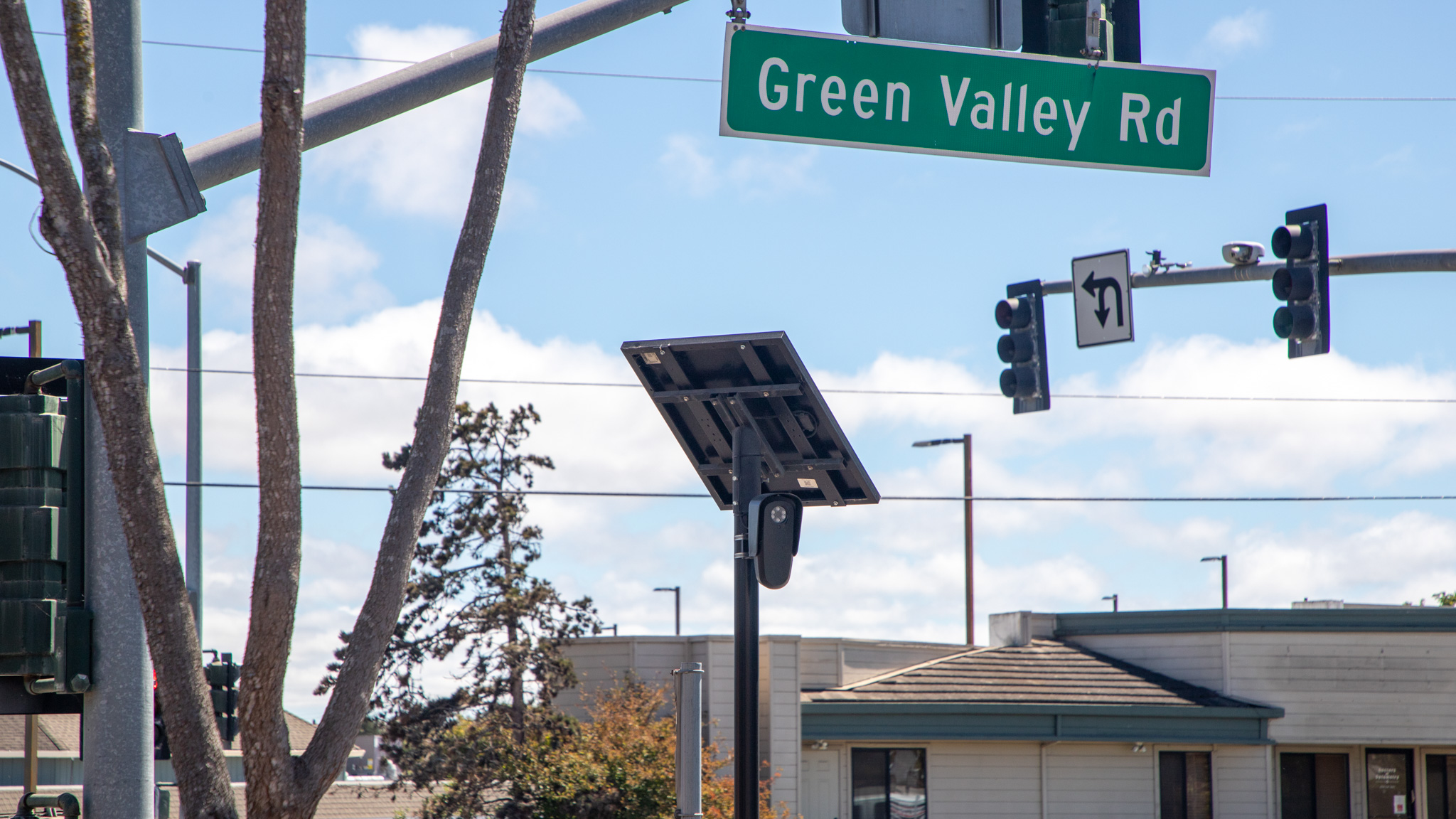
One of 37 Flock cameras in located across the City of Watsonville. (Amaya Edwards —Santa Cruz Local/CatchLight Local file)
Watsonville City Council meeting- 6:30 p.m. Tuesday, Sept. 22.
- Attend at 275 Main St., Top Floor, Watsonville, on Zoom or by phone at 669-254-5252.
- Meeting ID 165 283 0257. The meeting also will be streamed on the city website.
- To comment ahead of the meeting, email citycouncil@watsonville.gov.
- Include “Public Comment” in the subject line.
- In the body of the email, include “12.c Discussion Regarding the Watsonville Police Department’s use of Flock Safety cameras.”
WATSONVILLE >> Amid recent scrutiny of license plate cameras across Santa Cruz County and the nation, the Watsonville City Council on Tuesday is set to discuss the city’s contract with license plate camera company Flock Safety.
Watsonville Police operates 37 Flock cameras, the most in the county, which leaders have credited with locating stolen vehicles, finding suspects of violent crimes and solving hit-and-run investigations.
Advocates with local group Get the Flock Out are pushing the city to end its contract, in part because in 2025 Flock allowed out-of-state law enforcement agencies to access the license plate scans of some California agencies, including Watsonville Police.
In some cases, out-of-state agencies made searches on behalf of federal immigration enforcement. Flock has since removed the ability of California agencies to share data nationwide. The Santa Cruz City Council voted to end the city’s contract with Flock in January.
Questions or comments? Email info@santacruzlocal.org. Santa Cruz Local is supported by members, major donors, sponsors and grants for the general support of our newsroom. Our news judgments are made independently and not on the basis of donor support. Learn more about Santa Cruz Local and how we are funded.
Learn about membership Santa Cruz Local’s news is free. We believe that high-quality local news is crucial to democracy. We depend on locals like you to make a meaningful contribution so everyone can access our news. Learn about membershipThe post Watsonville leaders to discuss Flock contract appeared first on Santa Cruz Local.
The man who built Apple’s stores doesn’t buy Silicon Valley’s bet on AI shopping
California tightens datacenter rules on water and power
Mamdani plays Trump like a fiddle—again
After a meeting with New York City Mayor Zohran Mamdani Monday, President Donald Trump couldn’t help but gush about his ideological nemesis. “I’ve seen it with numerous different mayors, and I said some great ones and some not-so-great ones, so hopefully you’re going to be a great one,” Trump said during the press conference. “I’ll be able to say you’re going to be a great one, and you’re off…